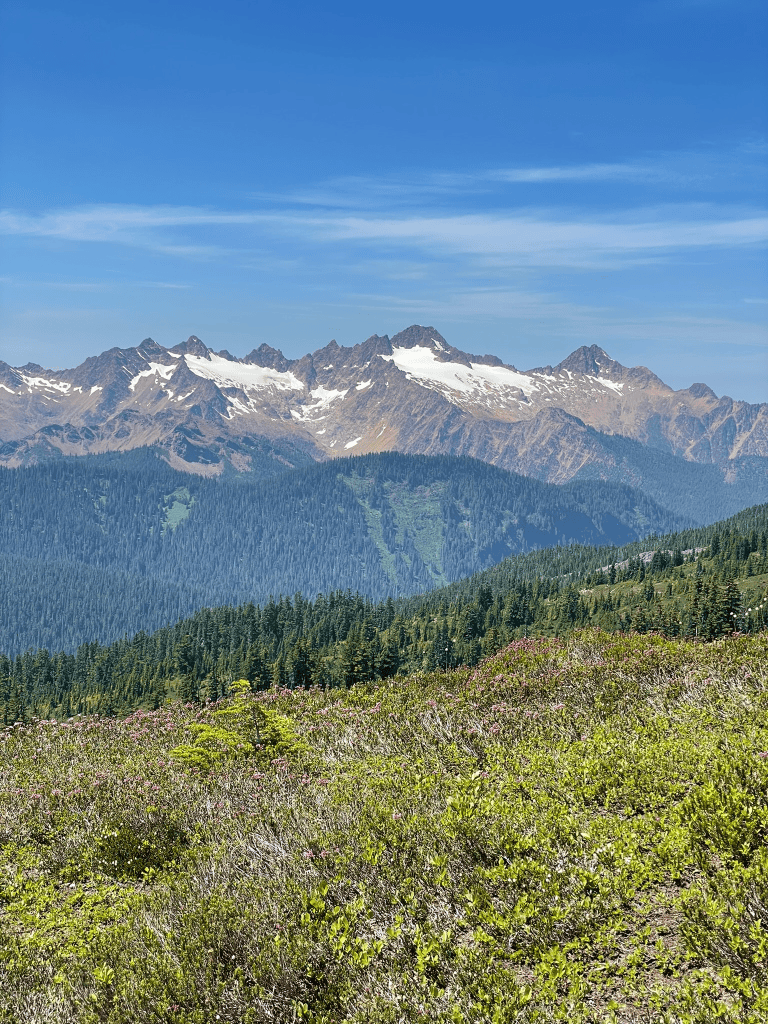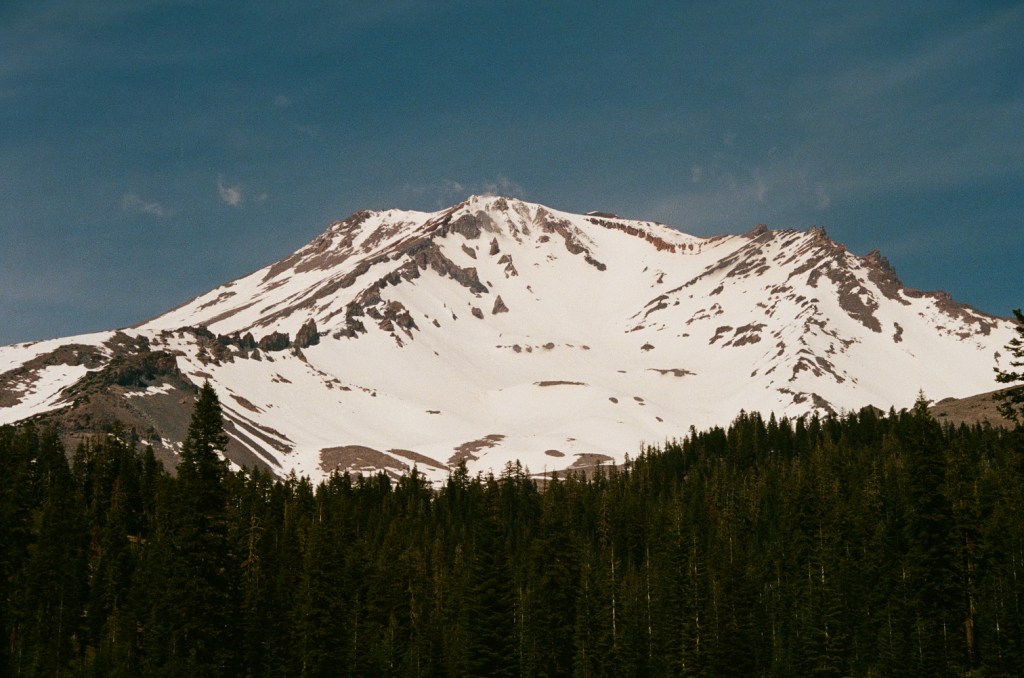
There is something quite awesome about the end to each ski season on the West coast. Despite the bittersweet feeling of loosing the snowpack and feeling the incoming heat of summer, late spring has one last outpost of great skiing. Of course this is the great stretch of Cascade volcanos that stand incredibly prominent from Washington to Northern California. Once the roads open to each respective trailhead, access is granted to giant snowfields that remain somewhat skiable through mid summer each year. Days are incredibly long and the snowpack is generally very stable, making for excellent conditions to make big climbs and big ski descents. This year was no exception and I had my heart set on finally skiing one of the classics of California skiing as a whole: Mt. Shasta. This is the second largest volcano in the continuous United States and stands nearly 10,000 ft above the valley floor below. Its an incredible landmark and one of the most breathtaking views along highway 5 when driving north in the state. My old coworker Kyle and I had been meaning to ski together for a while and I immediately accepted when he asked if I was free to join his trip to Shasta in the Spring of 2026.
Earlier in the year, a good friend of mine attempted Shasta on a weekend with a moderate wind storm. Given the mountain has such great prominence and is so close to the coast, it is known for some crazy strong wind and independent weather systems from the surrounding area. I backed away that weekend due to the weather and later heard he was struck by rockfall. Luckily he was wearing a helmet and had a great partner who successfully contacted a rescue team for a relatively quick exit. Regardless I was feeling incredibly cautious about our subsequent attempt and biased a conservative approach to conditions. Kyle and I agreed to attempt our summit on a Tuesday morning. There was a storm hitting the mountain over the weekend and ending Monday morning, so it was likely that the incoming high pressure would serve us well. Even then we also decided to get an incredibly early start to lower the likelihood of rockfall induced by the warming sunrise. So soon enough I found myself driving to Shasta with my new truck with an expected rise of 1 am the next morning.
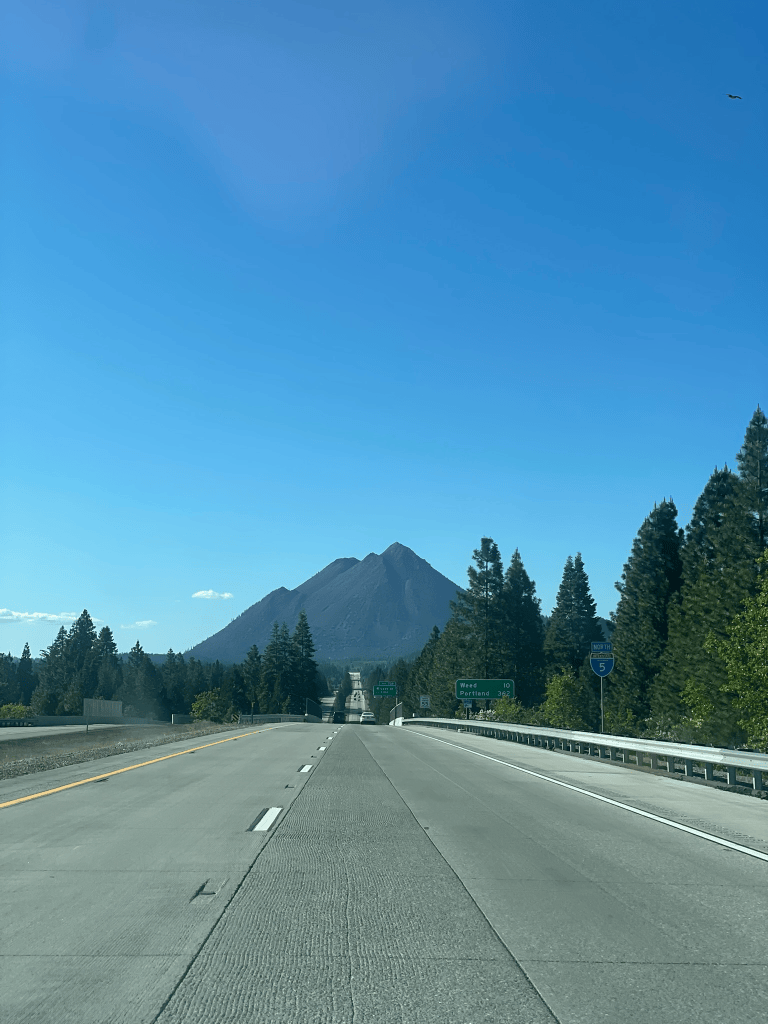
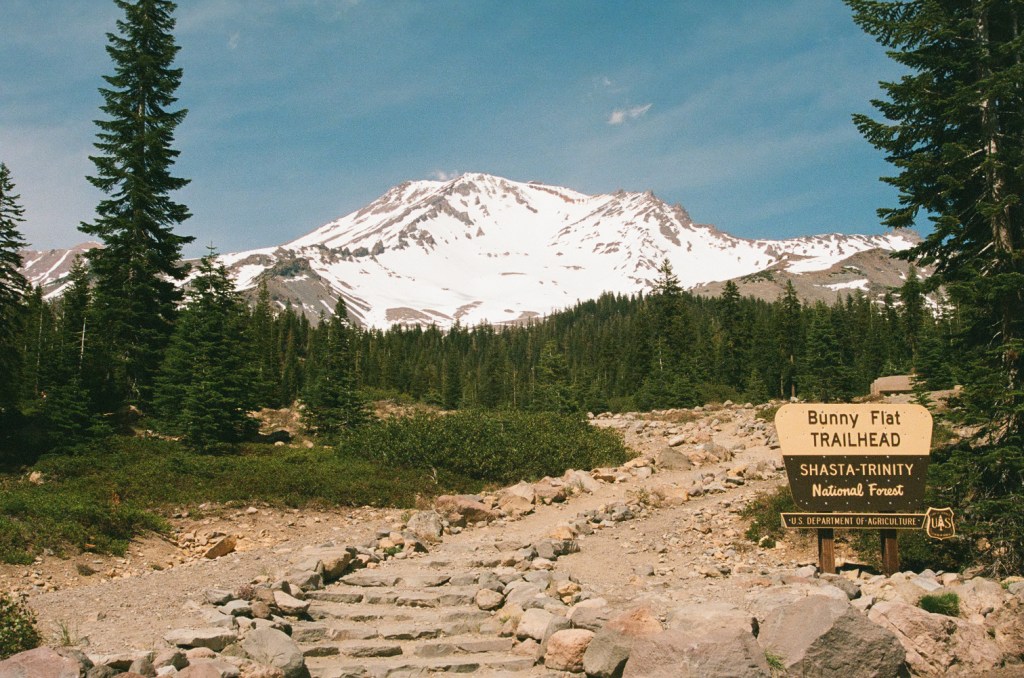
Waking up is always painful for days like this. I had some breakfast and caffeine prepared but this did not mask the feeling of grogginess and pain that alpine starts bring. Still I felt incredibly excited for the day and it wasn’t long until I started the watch and began and hike up on foot. Our plan was to ascend the avalanche gulch up the south side of the mountain starting from Bunny Flats trailhead. Normally in May the snow line would start almost directly from the parking lot, but this time we had to hike in about a mile and a half to horse camp before reaching continuous snow. In the dark it felt pretty quick and I was putting on my skins less than an hour into our journey. Once we began our ascent above the treeline I began to see the sky in its full glory. There was no visible pre-dawn light, but the mountain was still lit from the stars above. We were blessed with a crystal clear sky and the milky way presented itself directly above the peak in the distance. Skinning up the mountain felt like I was standing in a giant planetarium with panoramic views of the night sky. Capturing this with a phone camera is futile and I knew I just needed to appreciate the moment.
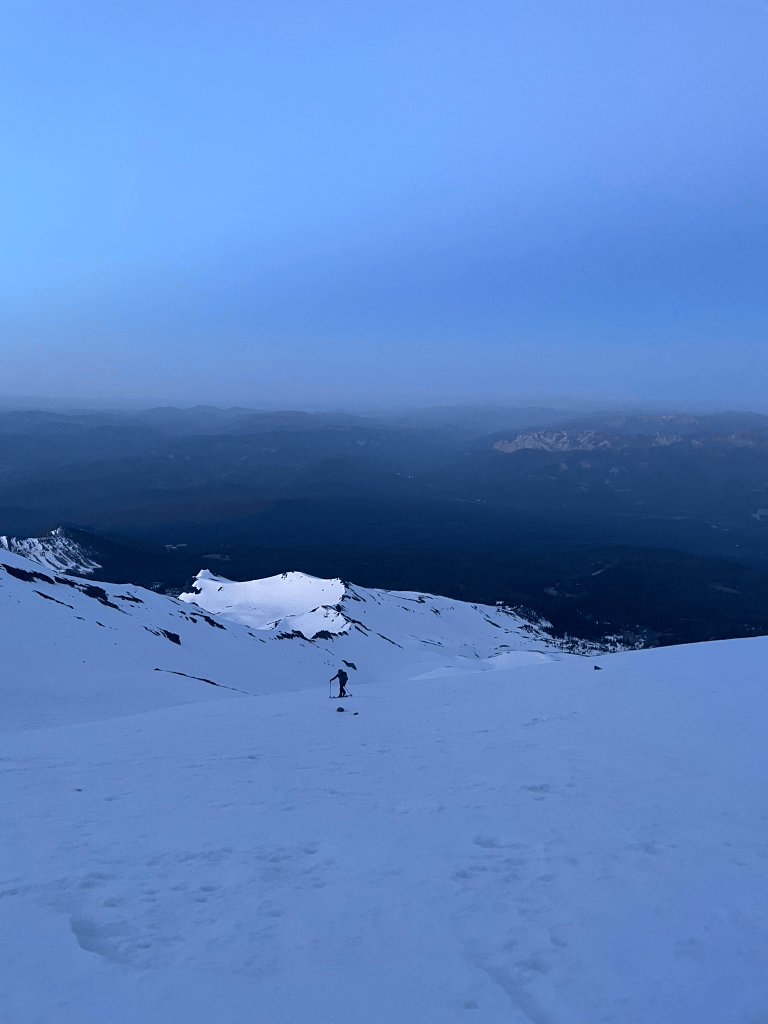
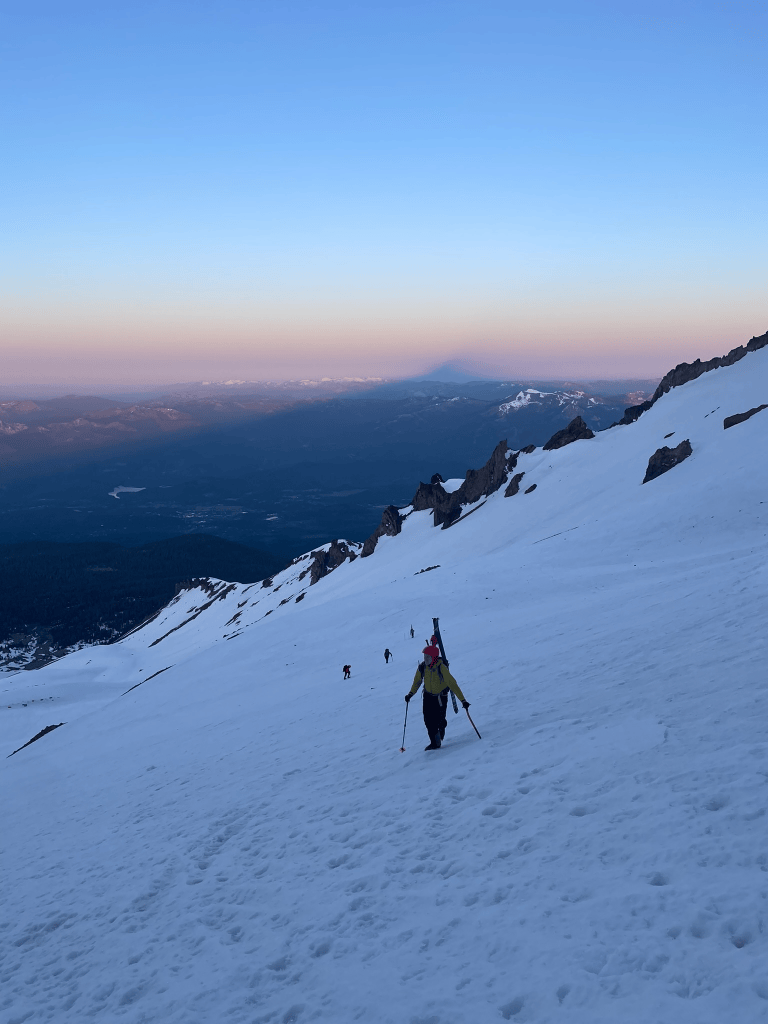
While Kyle and I basked in the stars, we were also making incredibly quick progress. Before I knew it the sun began to rise and lite up the valley below us. We were about 3 hours into the climb and nearing Helen Lake, the approximate halfway point in terms of vertical feet. The mountain created a crazy triangle shadow that seemed to tower and stretch far into the surrounding area. The light allowed us to really appreciate how far we were into the huge mountain bowl and we saw huge ridges on either flank shoot dramatically into the distance. Avalanche Gulch could be a ski resort of its own and I was feeling stoked to descend later in the day. Ahead of us was the real climb of the day. It wasn’t very technical, but would still be the crux in terms of sustained steep climbing and objective hazard. We were well prepared for this and quickly transitioned to our boot packing setup with crampons and ice axes. Our pace barely faltered and it wasn’t long until we approached the red banks rock band near the crest of the large south facing bowl. At this point I was starting to feel the altitude. We were at about 12,500 ft and we were both effectively coming from sea level the day before. I was in great shape, but my footsteps felt harder and my spirits faded just a little bit.
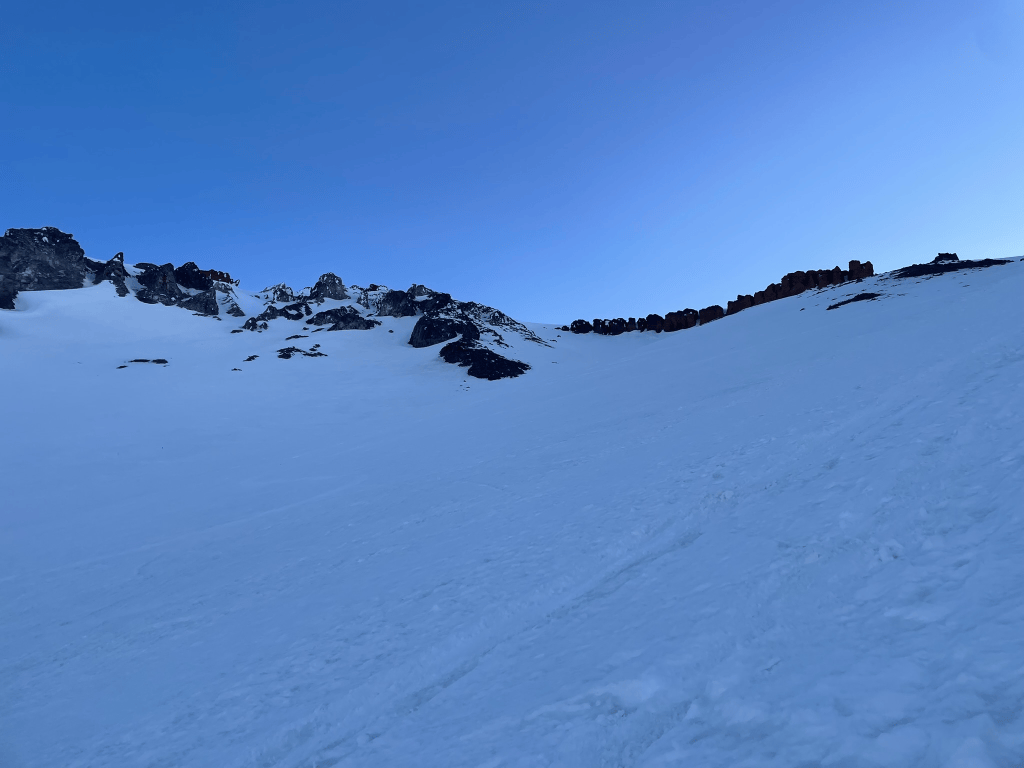
There were only about 1,500 ft to go, but it wouldn’t be as easy as before. First we ascended heartbreak hill, a ~1000 ft subpeak that would bring us to the summit plateau of Shasta. It was only partially filled in with snow, so we trudged up it awkwardly with crampons still attached to my boots. By the time I made it up, I reluctantly agreed with the hill’s name and took a short break before the last summit push. Kyle and I agreed to ditch the skis right before the last little summit climb as the skiing looked obviously futile up top. We took a somewhat direct line up a chossy third class gully and then stood upon the summit boulder patch about seven hours after our early start. The views were incredible and made up for my altitude induced bad spirits. Kyle brought a nice photo of his late friends who had passed skiing another peak in the cascades. It reminded me of my friend who had also faced a tragic accident on the mountain. Its hard not to accept Shasta’s great spiritual influence on the surrounding people and land. I had a moment of reflection and was grateful that our experience so far that day had gone exceptionally well.
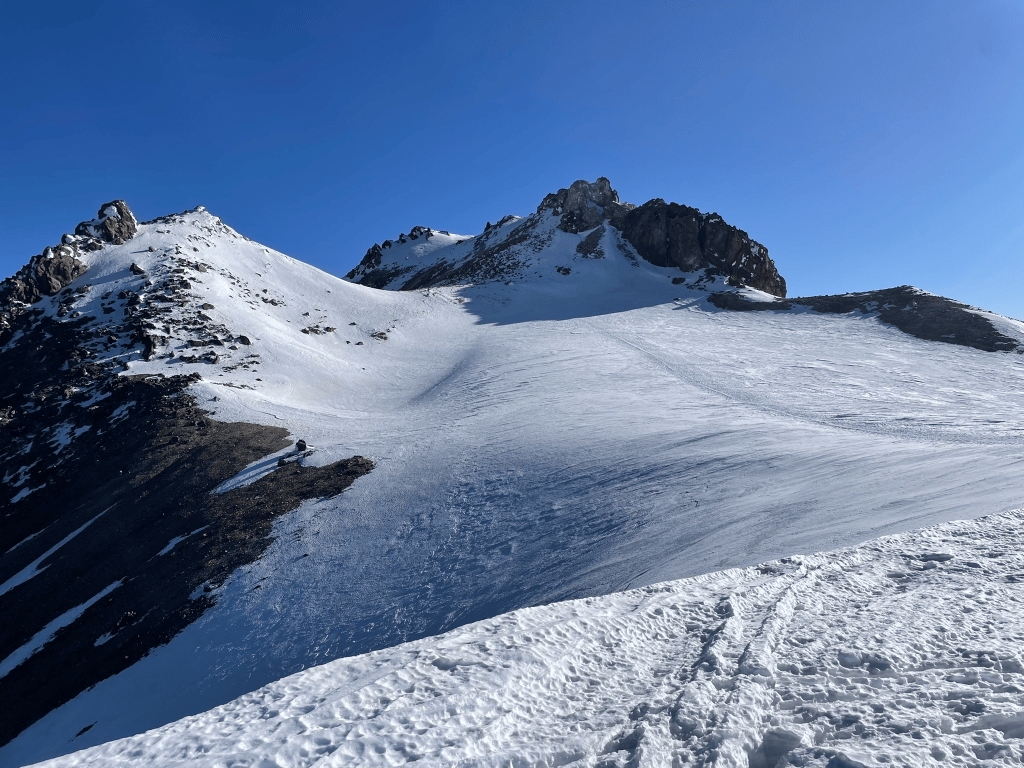
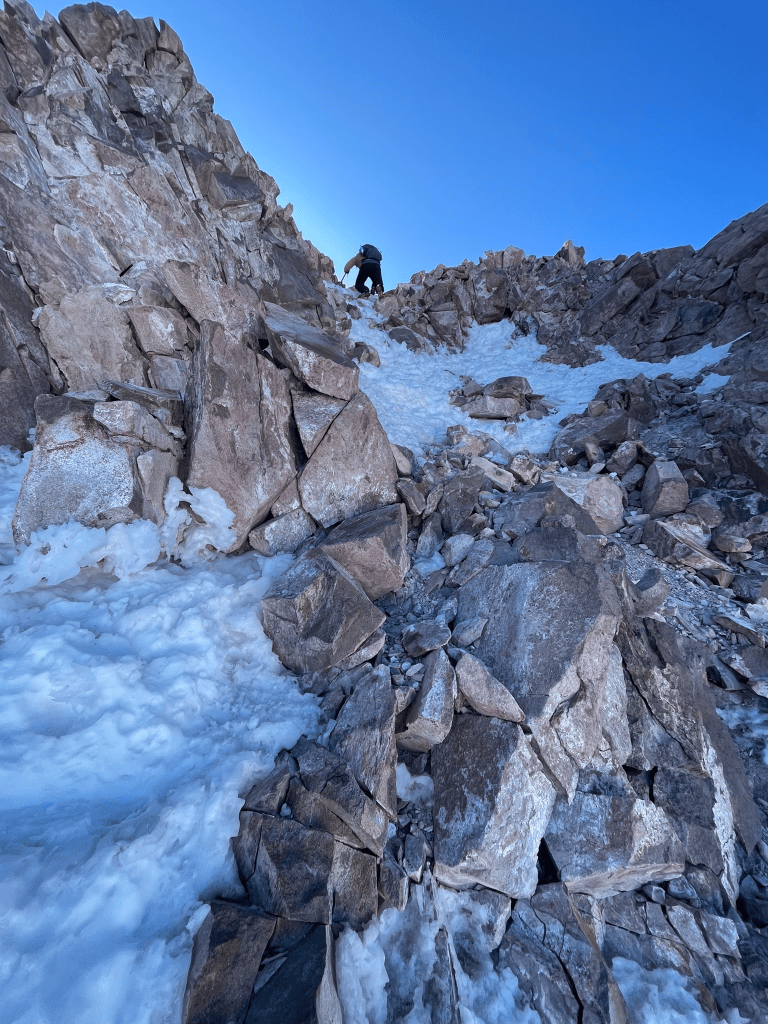
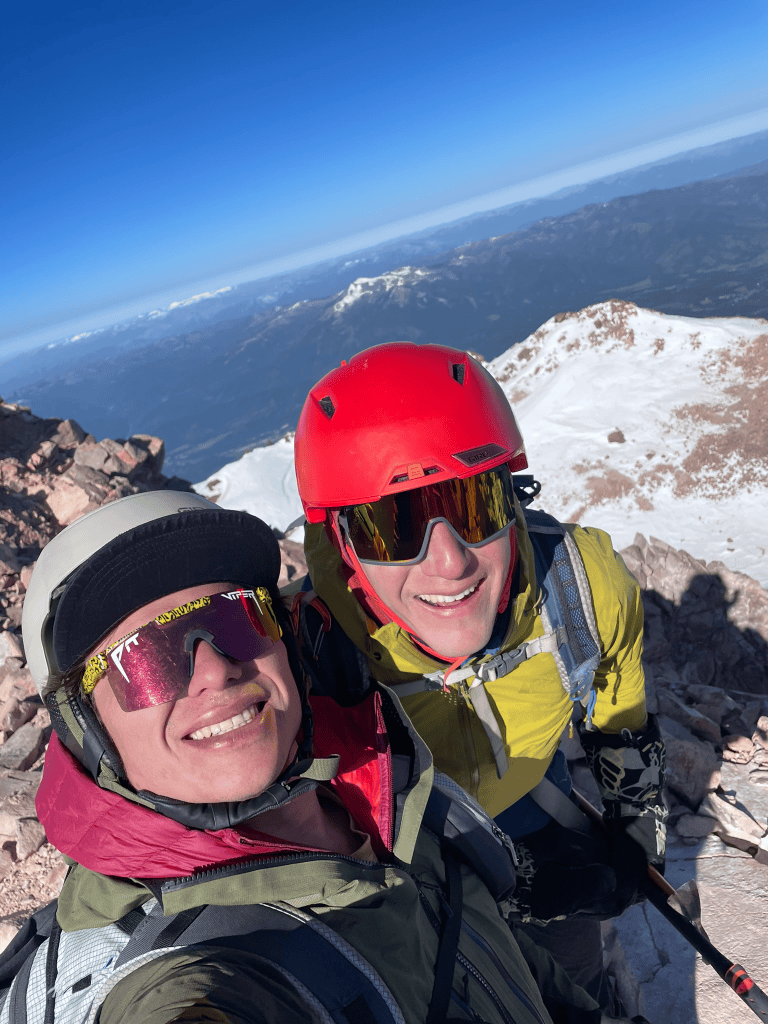
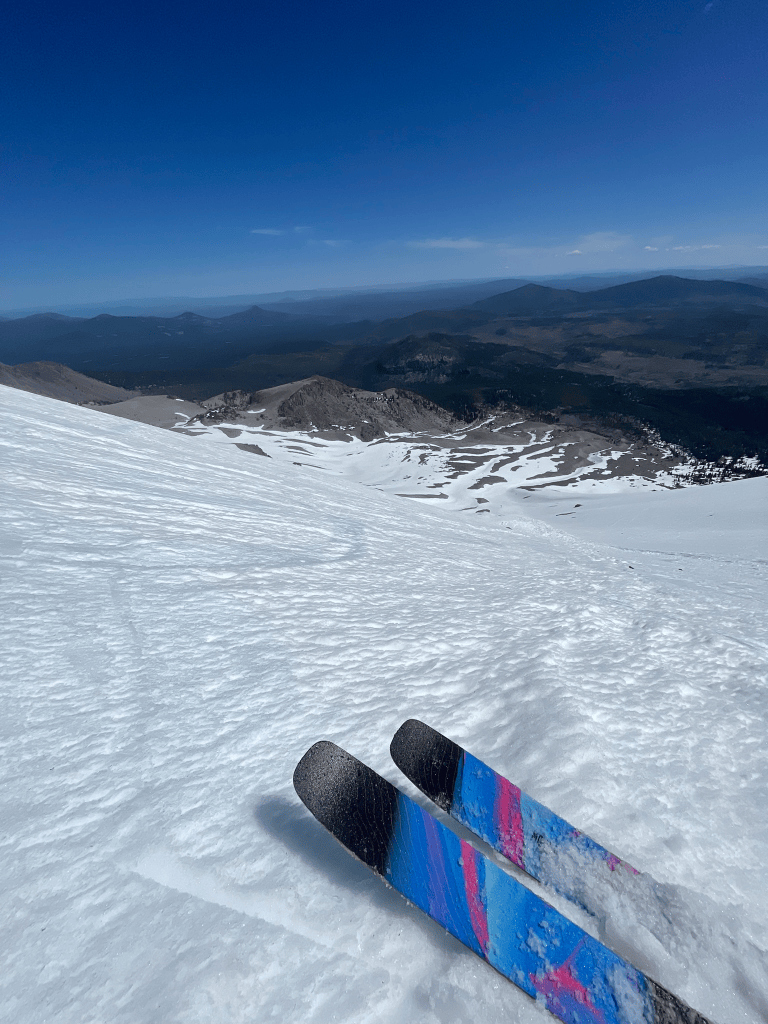
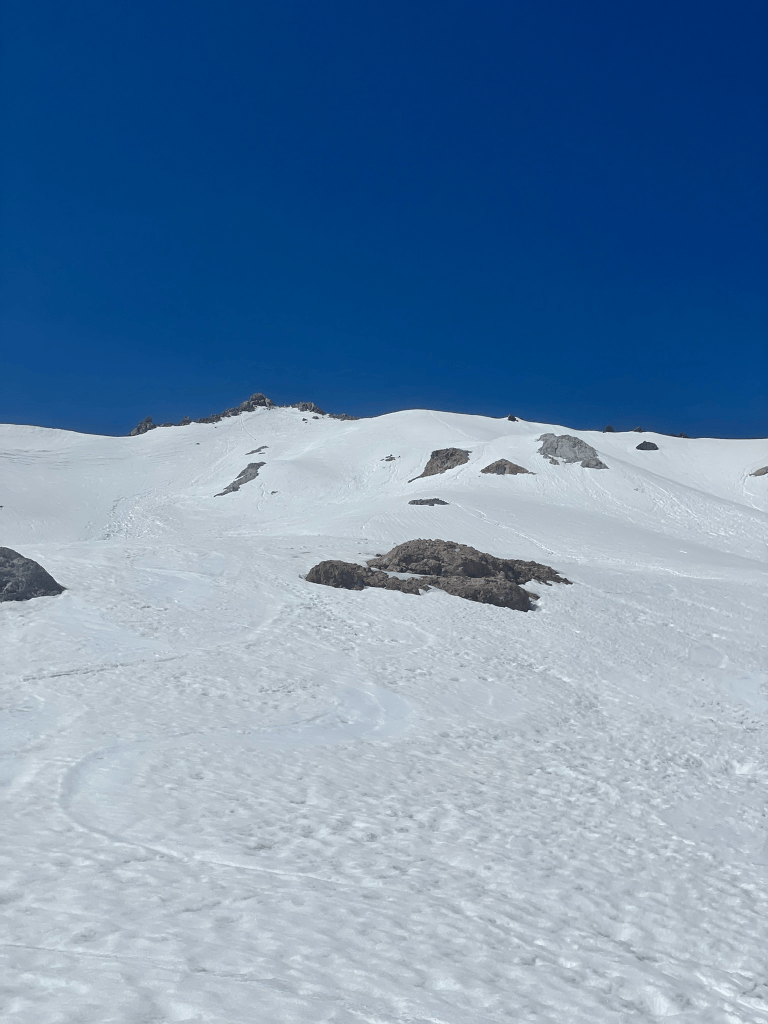
After some mandatory summit photos and a brief snack break, we started making our way back down the mountain. We had summited quite a bit earlier than expected so we discussed waiting for a bit above the gulch to see if the snow would warm up at all before skiing down. Descending heartbreak hill still seemed like a slog and I was happy to sit down for a bit while we accessed conditions. I layed down in what I hoped would be a protected pocket of rocks above the gulch headwall but the wind didn’t really allow me to stay comfortable. Kyle took a little walk to see if there were any better spots and didn’t have much luck. After a measly 30 minutes or so we decided it would be best if we just started our way down and avoided any risk of clouds coming in to obstruct our view. Sadly this meant the headwall conditions were pretty horrendous. The slope was probably no more than 35 degrees, but a fall might be unarrestable in these conditions and would result in a very long slide down the mountain. This meant I was pretty puckered and made my first few turns very cautiously. Soon after we began we were also joined by a single skier who seemed to be more confident in his turns. Unsurprisingly this was not the right idea and one of his skis ejected after a bad turn. It just barely arrested itself as I caught up to it and he manage to get his skis on okay for the rest of the descent. As we continued down with him he explained that he was carrying a second set of skis on his back. Apparently these were left on the mountain from the storm over the weekend where another lone skier had left them in fear of being blow away from the high winds. I was lucky I was skiing with Kyle that weekend because of the countless reminders that many others on the mountain were not nearly as prepared.
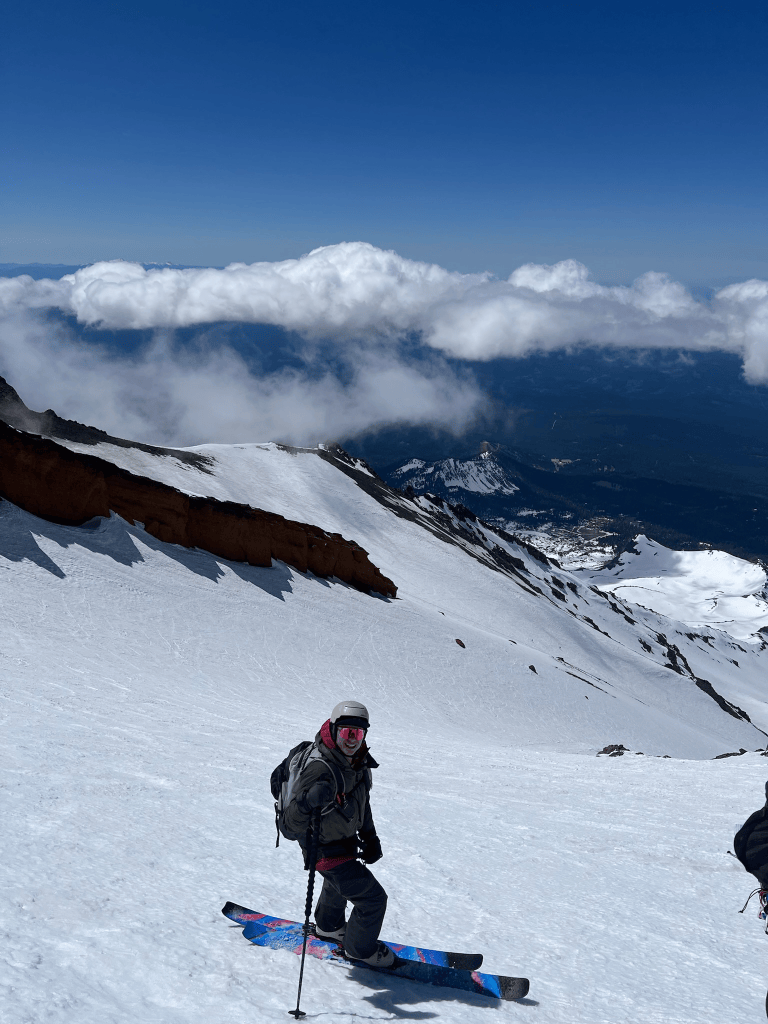
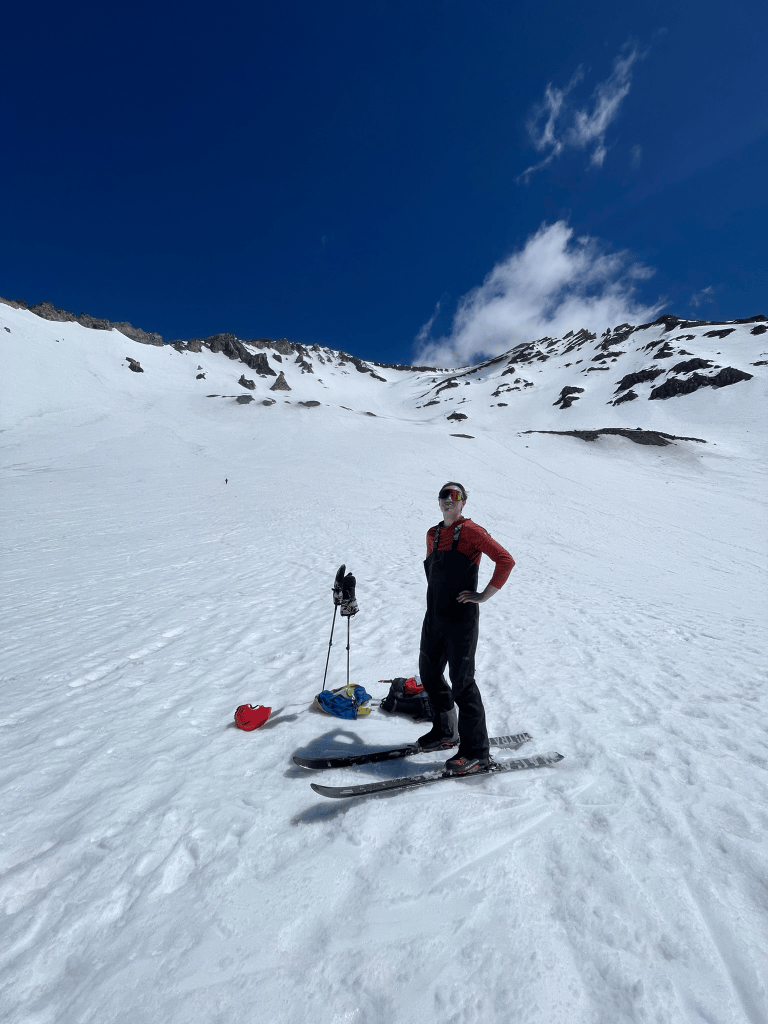
Despite this rough start to the descent, the snow slowly started to soften up as we made our way down the headwall. After about halfway down I could finally gain some better confidence in my edges and began to open up my turns. Then I returned to that oh so familiar feeling of confident skiing. We still had about 4 or 5 thousand feet of descent and at the same time the altitude sickness began to fade. Soon I was hooting and hollering while making the big arching turns that I was hoping for upon our descent. Quickly we made it back to Helen Lake and took a quick pause to eat and chat about what was next. It was still pretty early in the day and the sudden access to oxygen made me feel awesome again. I was pretty stoked to continue skiing but Kyle and our new friend were less enthusiastic. Ultimately we agreed to ski down a little further and then consider making a second lap. The way down was fantastic and we were greeted with more soft corn snow for a couple thousand feet. We stopped just below 9,000 ft and then Kyle was convinced to join me on the climb back to Helen Lake. I had my heart set on making it to 10,000 ft of climbing for the day. This meant about another 2500 ft of skiing and I was feeling great in the beginning. My biggest hurdle at this point was fuel. Even though I stole a few snacks from Kyle and the solo skier, I was completely out of my own food. So for the first 1,500 ft or so I blazed up the mountain before slowly loosing some speed for the final push. Kyle slowed down and planned to stop at Helen Lake. I didn’t want to keep him waiting so I kept pace as much as possible and finally hit 10,000 ft at the start of the bootpack up the headwall.
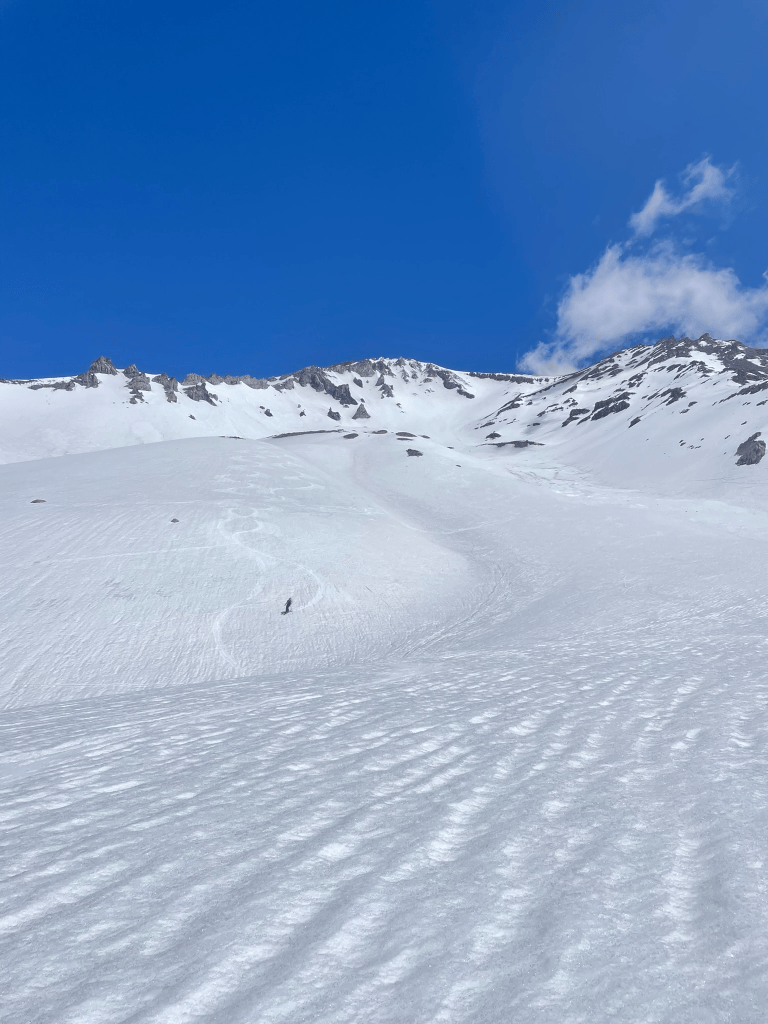
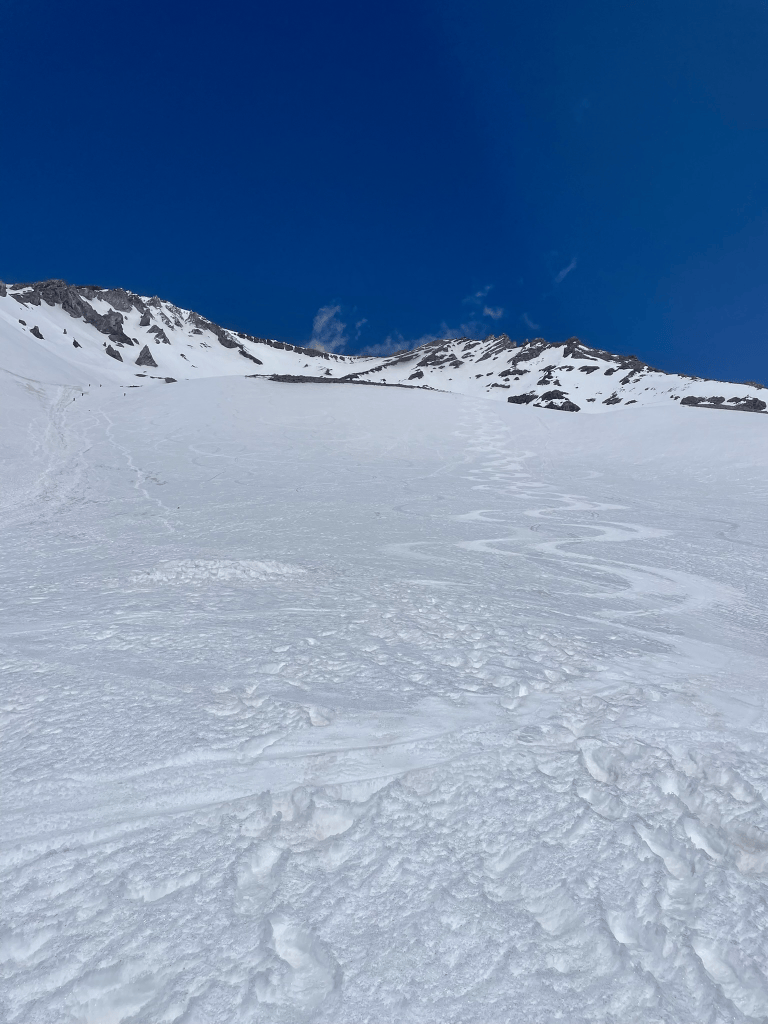
I was now pretty tired and ready for the real descent back to the trailhead. While we made more fun and big arching turns down we passed countless hikers making their way up on foot. For all those moments I was increasingly glad that we were capable of making the journey on skis were the descent was vastly faster and easier. In fact we found ourselves back to Horse camp were we stashed our trail shoes within 10 mins or so of our Helen Lake departure. The day was absolutely fantastic and all we had left was a mile or two on foot with skis on our backs. One day I would have to come back to really ski the full 7,000 ft of descent from car to car. For now we trudged back to our cars still feeling incredibly stoked from the day’s success. From our cars we’d make it into town for some burgers and beers as expected. Kyle would have to continue his journey north towards Seattle. He would be meeting more friends to complete their annual ‘sea-to-summit’ adventures near Mt. Baker. For myself, I had debated making one last stop on the way back for the following day. The year before I had skied Lassen with another friend of mine and knew it would be in prime condition to ski.
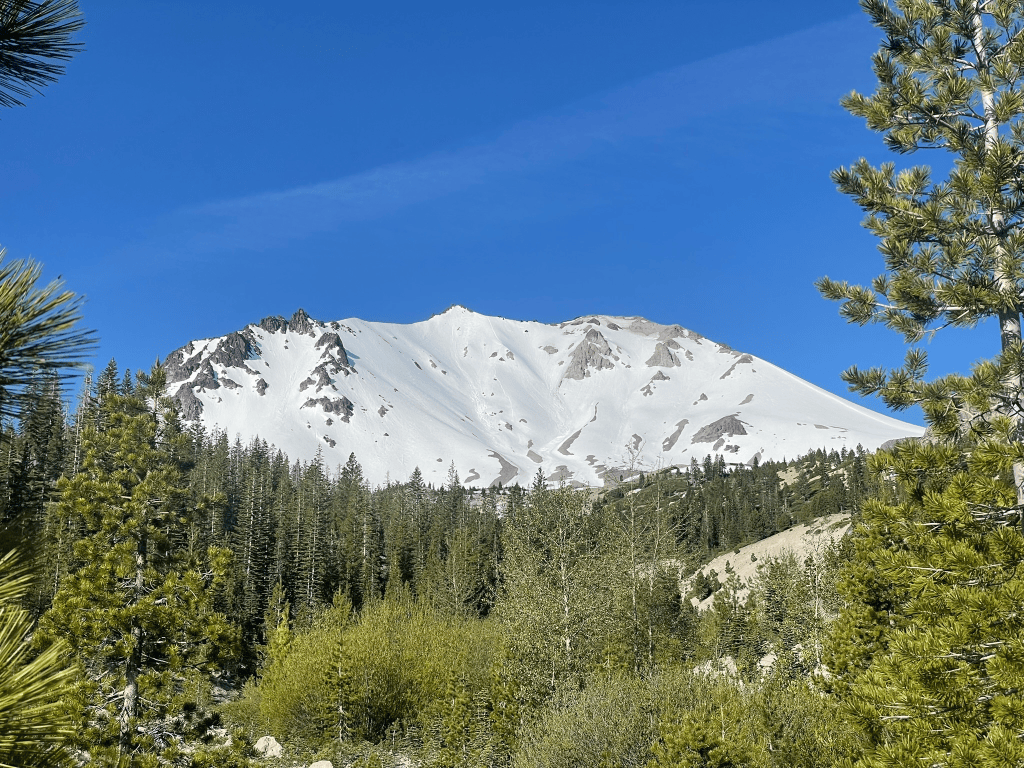
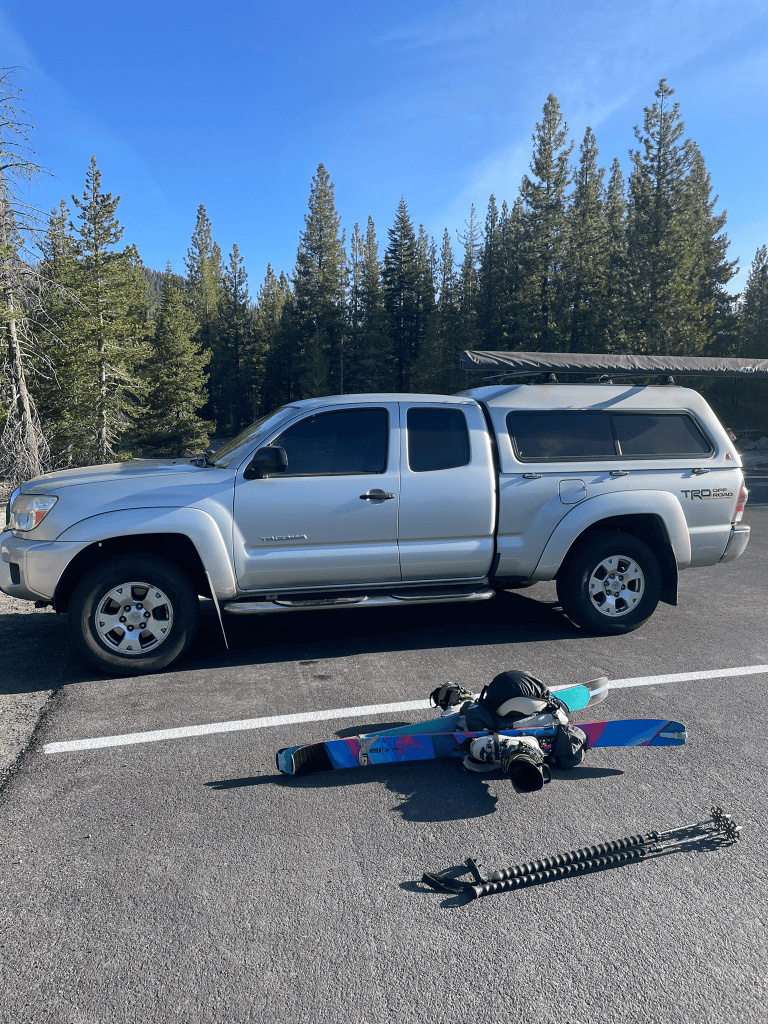
That night I decided I just had to make the side quest out to Lassen and found myself at the trailhead just before sunset. I was alone and knew I didn’t want to make a huge day out of it given the Shasta mission the day prior. Still I had a great night of rest and woke up around sunrise the next morning. Thankfully I saw another group of skiers arrive, which made me feel better about my trek deep into the area. I would be leaving from the Devastated Area trailhead on the North side of the mountain. It was a significantly better ski than the south side (which was also not open for cars yet) but required a longer approach and vertical. Sadly the snowpack was also horrible for the season and the trail in was incredibly dry. The year prior I had gone in the first week of June and only had about a half mile of dirt before putting on skins. This time around it was mid May and the hike in on dirt was about three times as long.
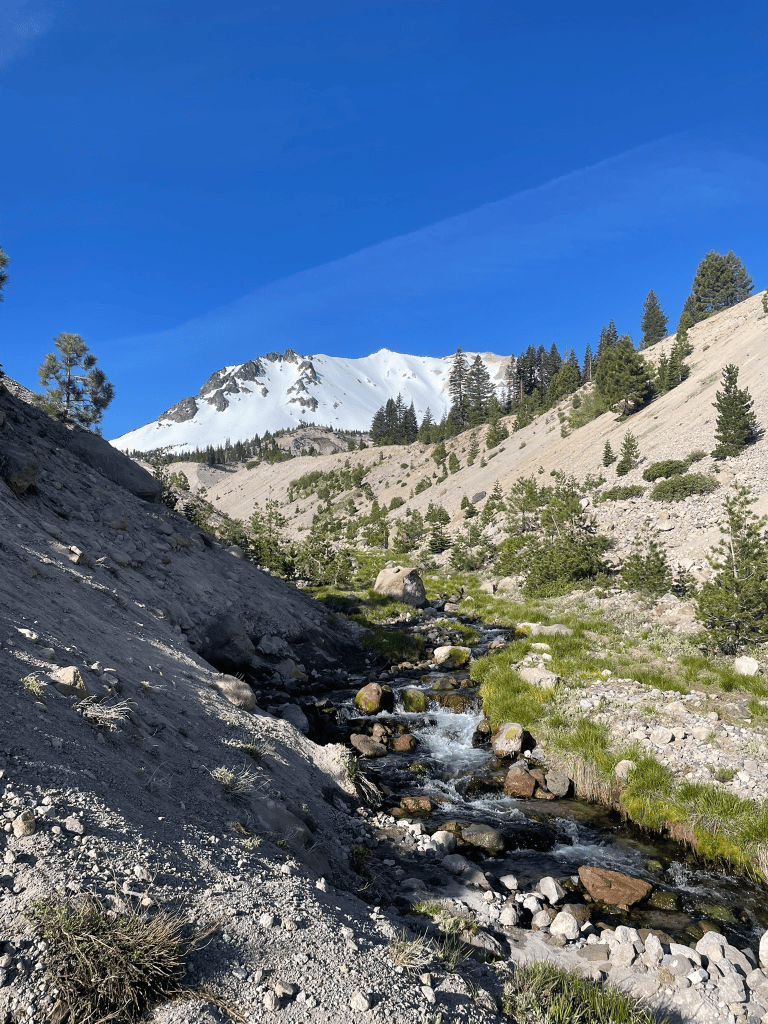
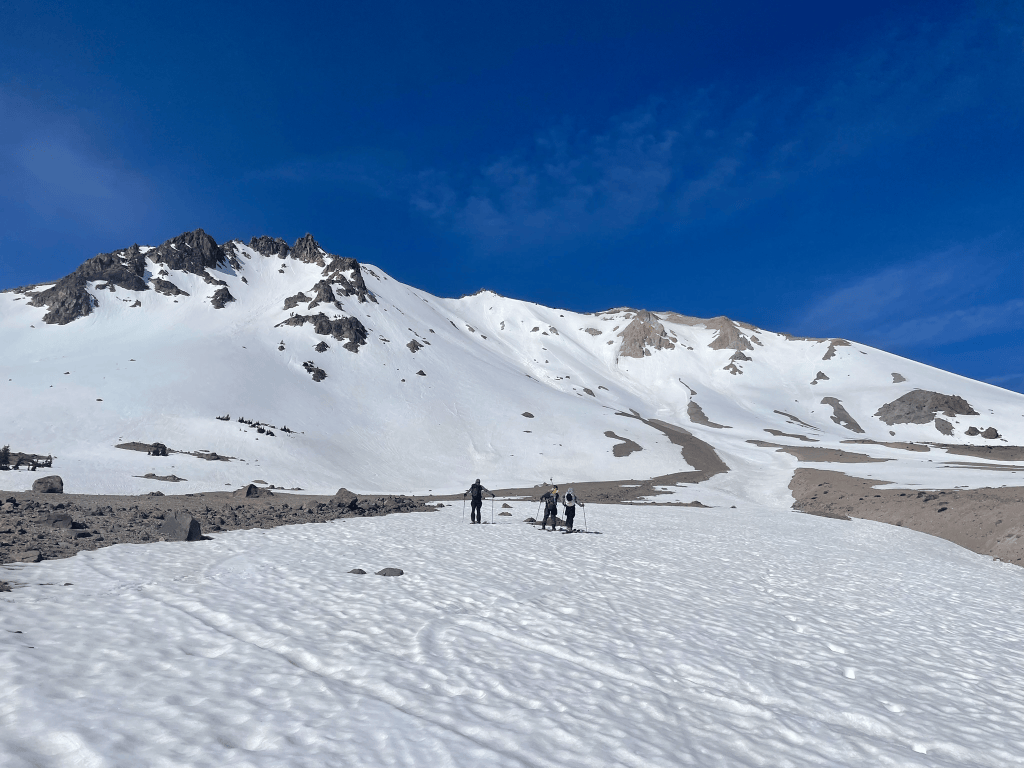
I took my time getting ready and let the other group of three skiers get a 30 min or so headstart. I was in the mood to make this a quick mission and once I started off the trailhead I made quick pace. Unlike the year prior I almost immediately had to navigate a stream uncovered by the low snowpack. I was in trail runners and constantly had to cross either side of the water as I made my straight line towards the volcano’s north face. After about a mile and a half I stashed my shoes and skinned up the awkwardly off camber slope adjacent to the stream. Once I made it up to the end of the steam I saw the other group at about the same distance in as myself. I couldn’t help but feel a little competitive and motored up the skin track and towards the headwall. As I reached the start of the bootpack, the others joined and seemed to be having a great time. I took a bit longer than them as I strapped on a pair of crampons. Really this just made me faster and I sprinted up the slope to catch them. I had more than enough fuel in the form of nerd gummy clusters and didn’t let off the gas as I stamped my way up the headwall. Within an hour I had made it to the summit and widened the gap to my new friends. I don’t mean to be overly competitive normally but for being alone it made my ascent way more fun. After a few moments enjoying the summit I quickly skied down and said my goodbyes to the other group. I made it down to the transition spot within two pitches and no more than 5 mins.
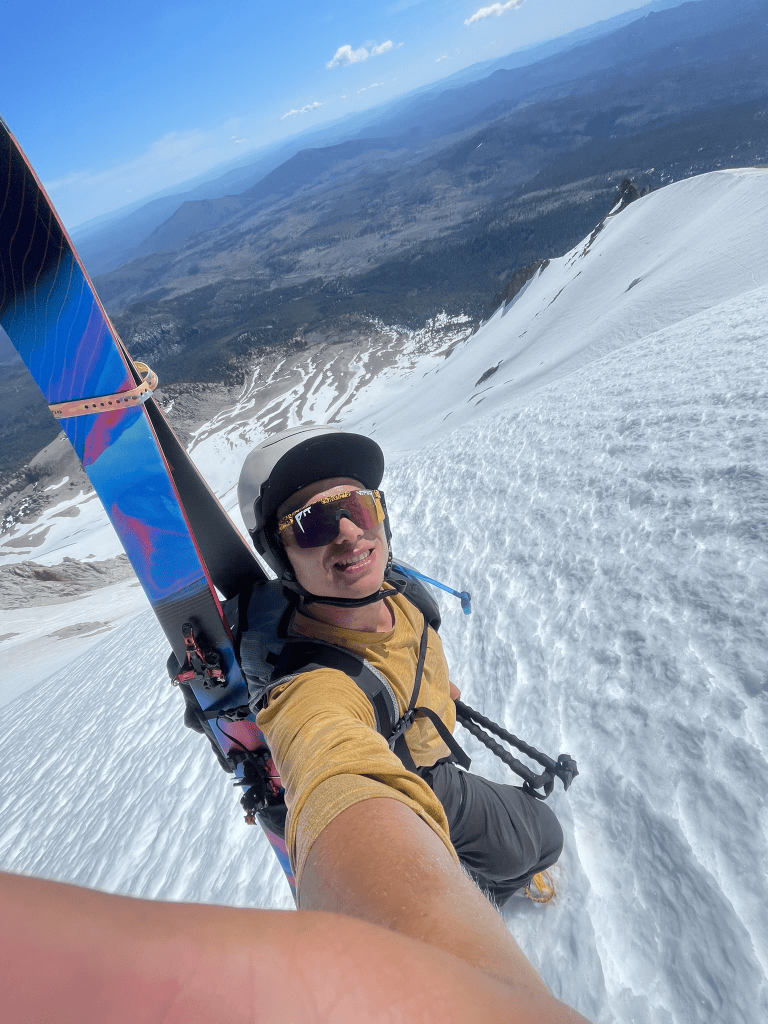
On the way out I was feeling stoked and was almost running with my skis and pack bouncing aggressively on my shoulders. My goal was to make it back in three and a half hours total. I had some idea of distances to the trailhead from my watch but nothing exact. So instead I just went as quickly as I could, hoping over the stream many many times. By the time I finally saw the road I was in full jog mode and just barely made my time with a couple minutes to spare. The whole trip was probably equivalent to Mt. Tallac and I was super stoked with the pace and the great descent. There is something awesome about being able to move around the mountains incredibly quickly that makes the experience feel particularly rewarding. I’d have to come back in the future to repeat this effort and either loose some time or make more laps. For now I headed back to the bay feeling proud of the effort in the last couple days.
Fast forward to nearly two months later and I found myself ready for one last hurrah of the volcano season. I was a little sad that I was not able to join another group of friends on their trip to Mt. Baker and Shuksan in June, so I did not hesitate at the opportunity for another cascade trip in July. My frequent climbing partner Joe organized a trip to Washington for several weeks and we put a group together to test our skills on Mt. Baker. Ultimately the group was thinking about a Rainier attempt and we all agreed that Baker was a great warmup. Unfortunately this group was not really experienced on skis, which meant I would find myself walking back down the long slope like the hikers I saw on Shasta. It would still be an epic adventure in the mountains, but even now I know I will need to go back to ski this volcano in the future. The season prior I also tried to summit and ski Mt. Baker from the Coleman glacier. I organized a group of friends to take a glaciated ski mountaineering course and we got some great skiing in despite the lack of a summit. This go around the road into the Heliotrope trailhead was washed out (seems like this will almost always be the case nowadays), which meant we’d have a better time ascending a different glacier and aspect.
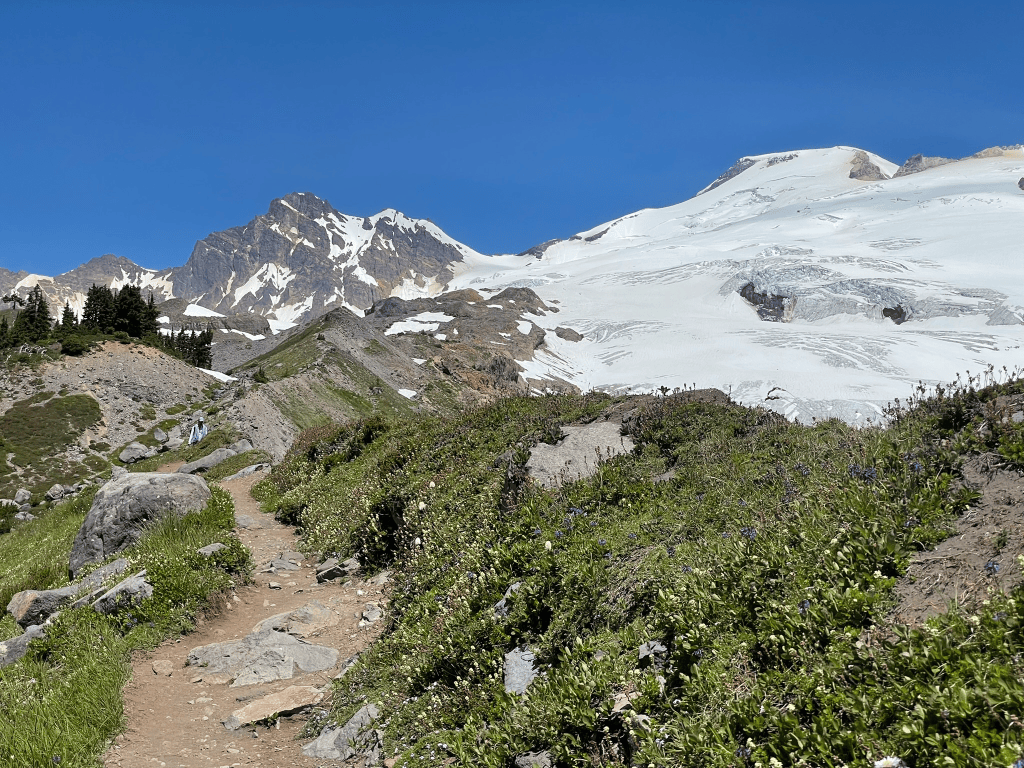
I met my friends this time around at the base of the Easton Glacier. The trail was well established and we were one of many groups that day ascending the mountain. We all had different experience levels and mainly wanted to test our glacier travel and rope skills. Two members of the group, Pranad and Kalari, both came in by plane and were newer to the sport. We had climbed the crystal range traverse as a group a few weeks prior so we all knew the dynamic before getting started. Baker from this aspect would be a really big day, slightly larger than Shasta. This meant that our wakeup time was a horrifying 11:45 pm. I got there early and managed to get nearly a full night of sleep. The others did not really sleep at all. Remarkably we all were awake at the right mark and the stoke of the group made up for the brutal alarm. The first stretch of the trail was relatively quick and uneventful. Usually its always pretty easy to strike off the first few hours of an adventure like this as fatigue doesn’t set in and excitement is high. Unfortunately Kalari was not feeling as good by the time we made it to the start of the snowfields. This was the last established camp and marked approximately a third of the way to the summit. We were making great time but there really was a ton of terrain left to go.
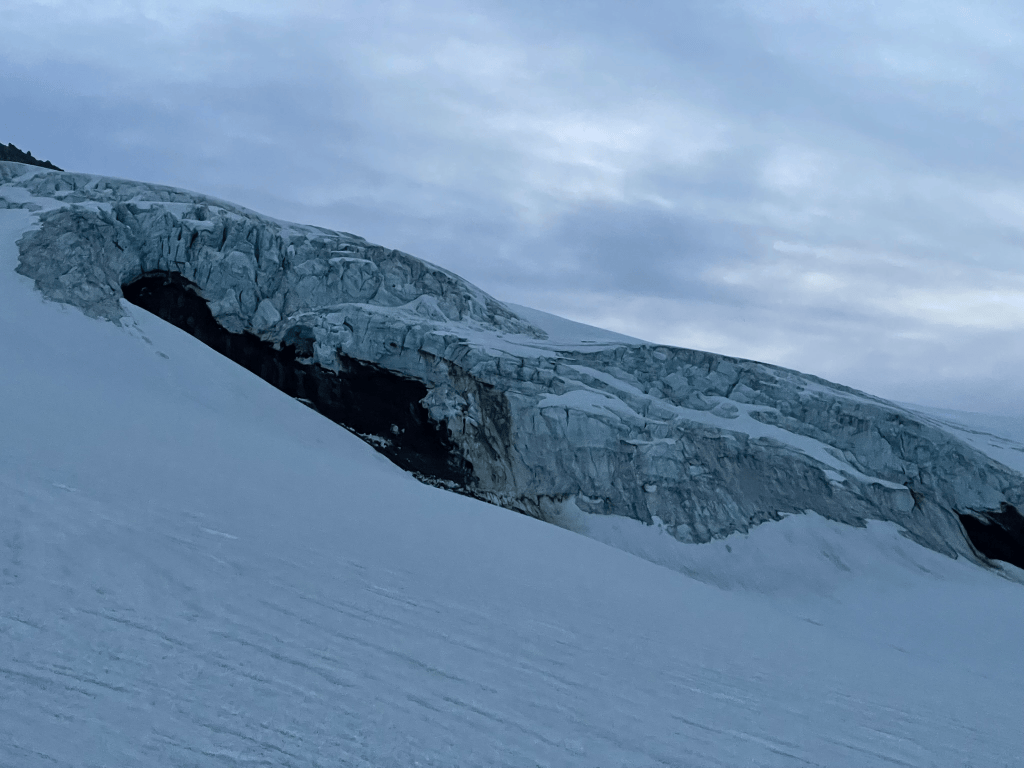
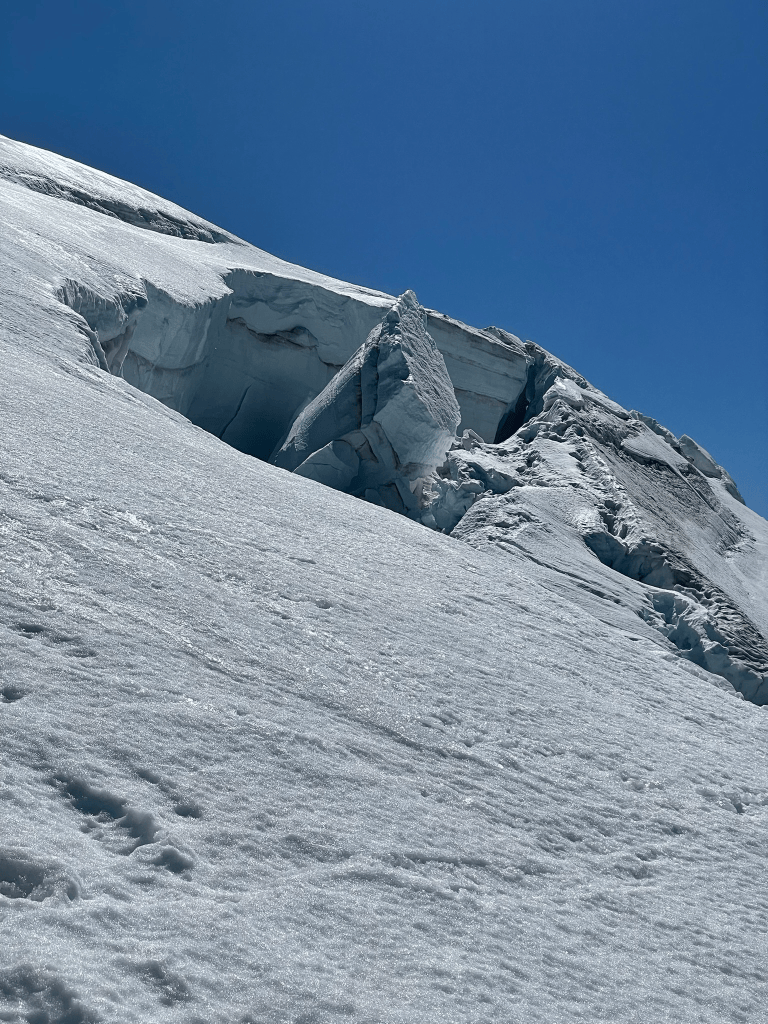
Soon we were back on the ascent and began up the snowfield. There was about a thousand feet or so of some mixed snow and ridgeline before we met the glacier proper. By this time the light began to shine and we found a good spot to transition to our roped travel. In front of us was a massive icefall marking the toe of the Easton glacier. From the Instagram page of the Mt. Baker rangers I learned that the icefall had recently exposed bedrock. It was likely this bedrock had not seen the light of day for many thousands of years prior and it was quite sad to the the drainage below devoid of any ice. Seeing the massive cleaver of ice also reminded me of the severity of glacier travel. Once we stepped onto this ice there was real potential of us falling into a crevasse and needed to quickly jump into rescue mode. I had brought up route finding as one of my biggest worries for the trip and initially was nervous for our ascent past this point. However, as we started up it was pretty clear that this trail was well established. What I thought would be a field of cracks and snow bridges was more like any other trail we had seen that day. The majority of hikers attempting to summit this day were camping from the night before and were ahead of us on the trail. We simply needed to follow their old footprints and occasionally cross some well supported ice bridges over the glacier’s crevasses. While it was not necessarily the route finding crux I was expecting, I was somewhat relieved we would not have to face any real danger that day.
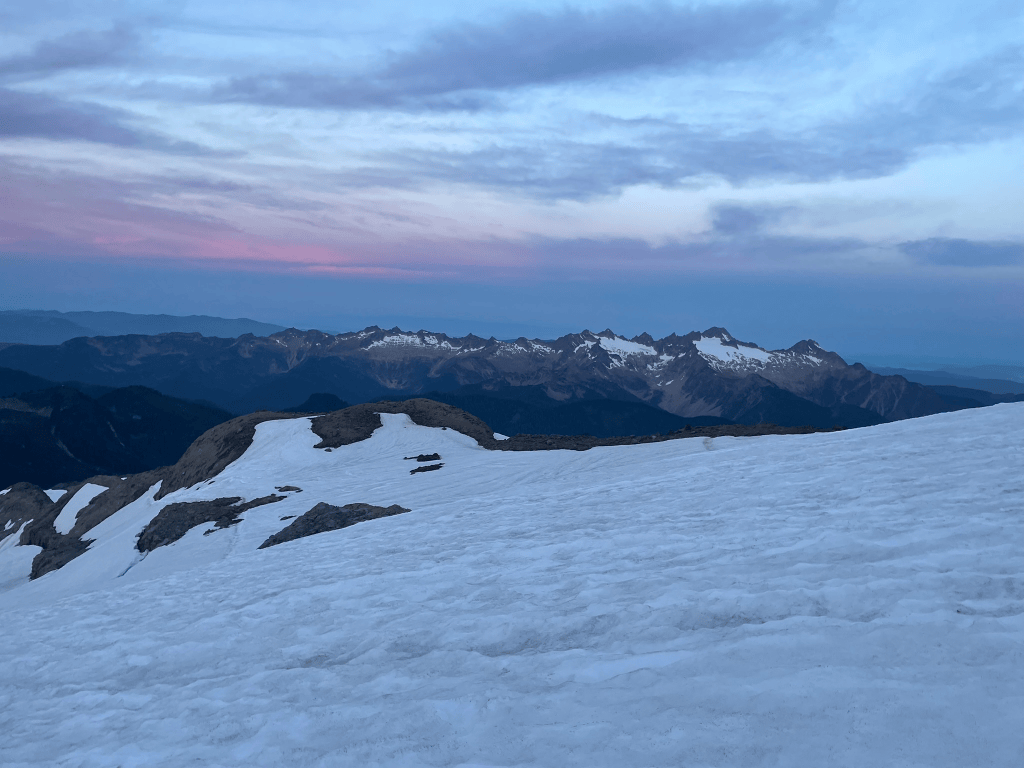
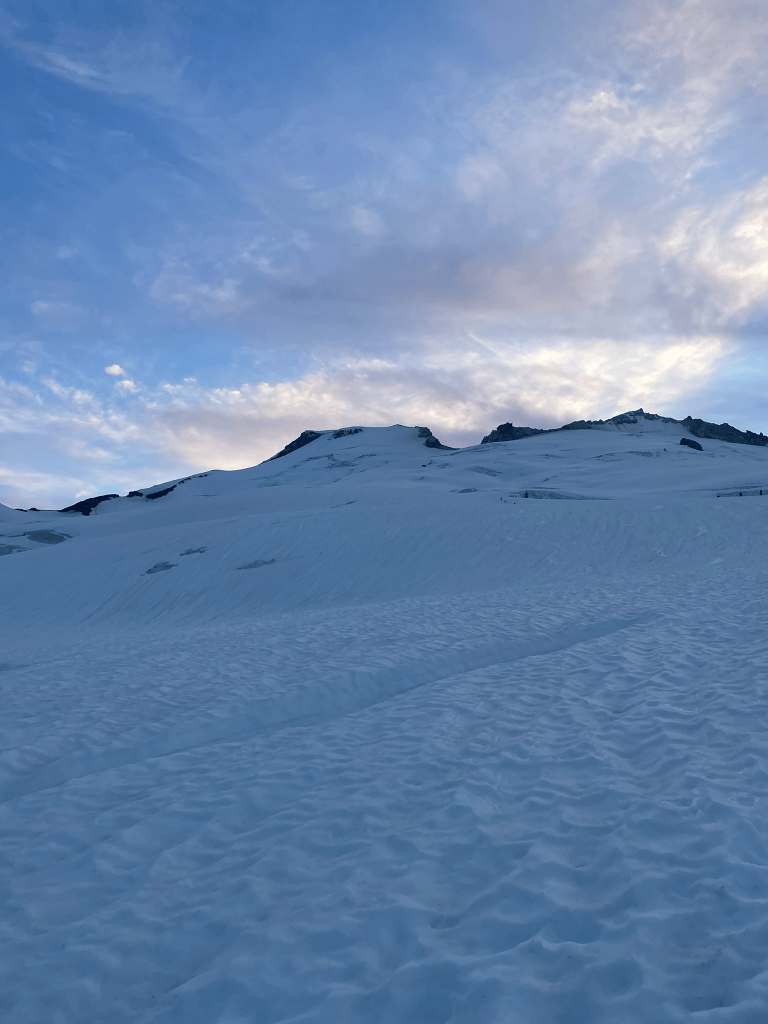
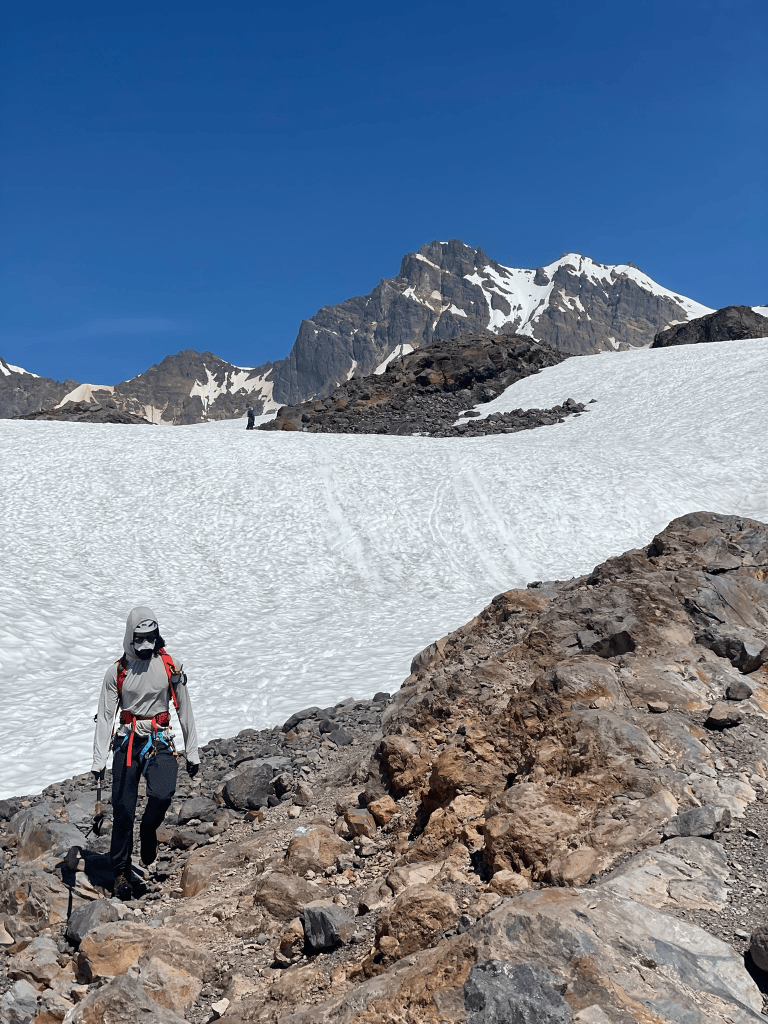
As the sun rose that day, we fell into quite a good rhythm. The weather was great, the route was easy walking, and we did not have much issue dealing with the ropes between us. Soon enough we made it to the base of the headwall and took a break to look into the massive caldera on the south side of the summit. Sometimes its easy to forget we are really on a volcano and times like this feel quite awesome. Clouds of sulfery gas bellow out of large fumaroles and jagged rock outcroppings line the rim of the volcanos crater. Pranad brought a film camera and captured some incredible shots of us while we caught our breathes for the last summit push. At this point there was only one or two groups ahead of us. The path was incredibly mellow and I definitely could picture myself skiing down the headwall in the future. Not long after we crossed the long summit plateau and basked in the glory of the true summit. The views were incredible as always and we all felt pretty good for the amount of terrain that we just crossed. To humble us for the day we also saw a trail runner casually tagging the summit in what he described as a routine 3-4 hour push. Then it was time for the slog of a descent back to the trailhead.
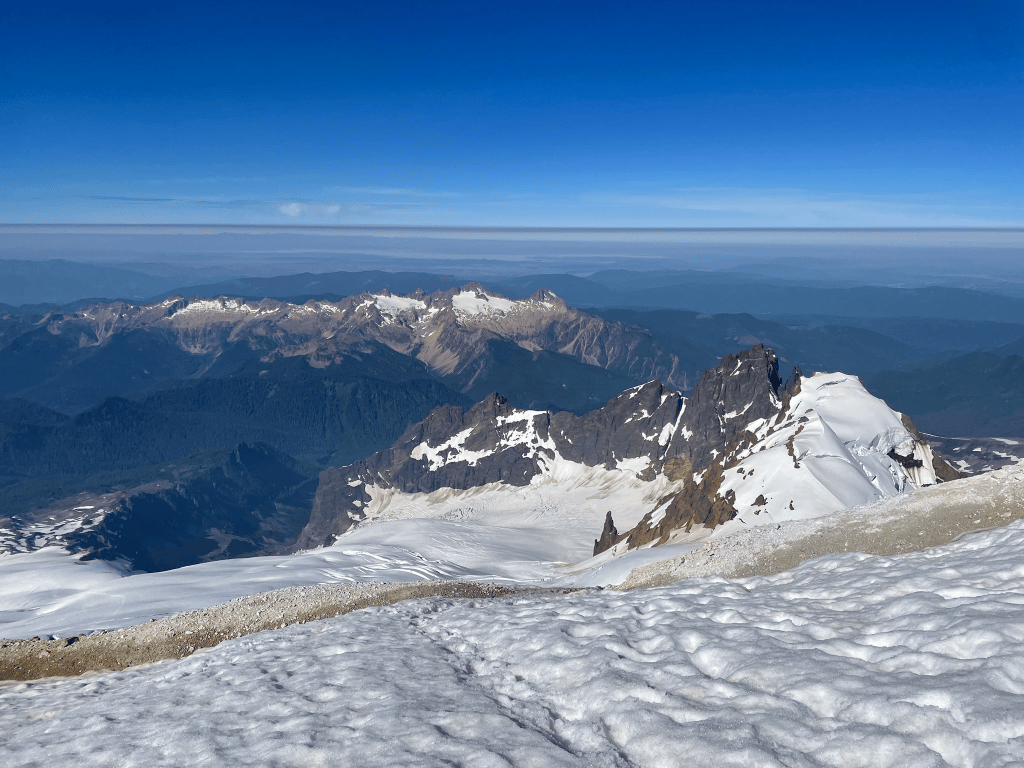
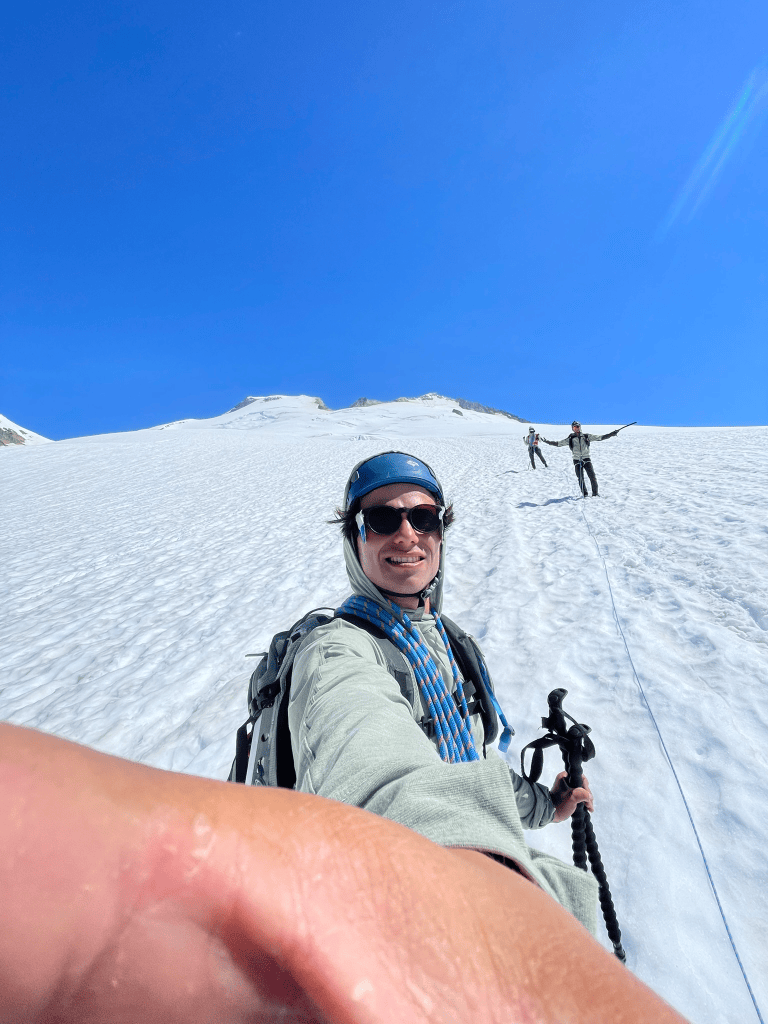
Our way down was relatively straightforward and we made quick progress of the snowfields. Passing other groups on the headwall was probably the most annoying part but we were not really in a rush. Eventually we were able to take off the crampons and half glissade half jog down the slope. We were still roped up but probably could have been fine without it. When we finally made it back to our camp I was feeling the fatigue start to set in. I was uncomfortable but at least could take in the spectacular views of the surrounding valley that eluded us in the dark on the way in. I knew that the trail ended on a prominent ridgeline but didn’t really understand how exposed it was until our descent. Green grass, wildflowers, and steep rocky walls lined the ridge on both flanks. A huge rounded valley stood as a monument to the glaciers former glory. Now there was a relatively small but rapidly flowing river sitting at the center of the cavernous and rocky drainage. As we descended we took in the views and trudged back down the trail. I felt pretty fatigued and knew that Joe & Pranad were feeling the same. It was just over thirteen hours by the time we finally arrived back at the trailhead. We covered many miles and nearly 8,000 ft of elevation gain for the day. I felt bittersweet on the summit knowing that I would like to come back and ski the mountain in better style for the future. Either way it was an epic day and a great end to the volcano season this year. I’ll be ready to come back year after year to continue skiing these mountains. Baker especially has much more to offer and I feel incredibly grateful to be able to share these experiences in the Cascades with a great group of friends.