Author: max

  • Learning to Ridge Climb

    Learning to Ridge Climb

    Alpine climbing is an inherently polarizing experience. My friends and I’s last trip to the HighSierra (link here) was just as incredible as it was exhausting. Alongside climbing in a truly unreal setting, we achieved our longstanding goal of climbing Whitney in good style. It also was one of the most sustained and difficult physical experiences in my lifetime. We overcame challenges at pretty much every turn and I spent nearly every waking hour either driving or climbing for 2-1/2 days. Coming back from a trip like that convinced me to take an extended break from big backcountry trips. I knew that I’d earn a new inspiration for climbing if I was patient and gave myself time to decompress after such a harrowing adventure. So for a month or two this summer I spent time in the bay area enjoying biking, camping, and running in and around the city. But as Fall came an opportunity arose that reignited my energy for big and challenging objectives. This time it was a route that Trevor and I had been eyeing up ever since our trip to the Grand Teton and one that we’ve failed to commit to several times. Bear Creek Spire is a nearly 14k ft peak between Mammoth Lakes and Bishop County and is home to three classic alpine climbs (as listed in the book “Sierra Classics: 100 Best Climbs in the High Sierra”). We were interest in the easiest of the three located on the NE ridge. It was rated between hard 4th class & ~5.5 climbing when sticking to the true ridgeline, but was substantially longer of a route than we had climbed before. It rose ~1500 ft above Peppermint Pass and about half of this was steeper than 3rd class terrain. It would require us to move much quicker than we had in the past and climb without necessarily using a belay for all pitches. Given we’ve never simul-climbed before, Trevor and I knew we’d have to give ourselves time and strike with a good weather window. So midweek on an early September day, I messaged Trevor and committed to driving out that coming Saturday.
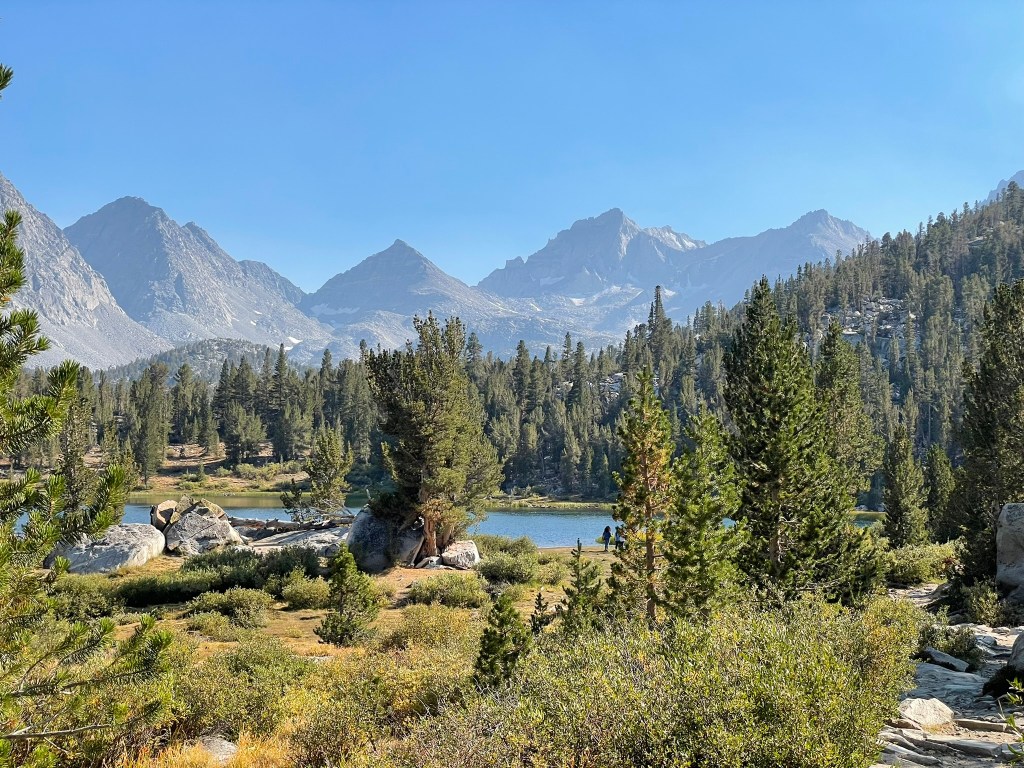
    The incredible Little Lakes Valley with Bear Creek Spire most prominent

    The plan was to arrive at Mosquito Flats trailhead by around 3pm that day. We’d hike in a few miles and camp right below the talus fields encircling Bear Creek Spire. This would give us a full day to climb the route, hike back to the trailhead, and drive back home. In classic fashion it would be two days of almost continuous movement. Despite this, driving out felt easier than usual. The whole time I was excited and nervous. I knew I’d have to just stay calm and excited in order to keep the right headspace. Luckily I made it to the trailhead right on time and missed nearly all the traffic on the way. The only hiccup was driving through a ominous trail of smoke clouds engulfing a large portion of the Eastern Sierra on the way down to Rock Creek. Winds were coming from the SE and we were pretty sure we were in the clear. At the trailhead we also realized I had forgotten by Rockie Talkie and headlamp, but keep on regardless to save time. As we hiked in it was easy to forget about these issues, the scenery was incredible and the tail was nearly dead flat. Along the way we continued to pass serene lakes lined with tall wavy grass and accompanied by calm rivers. We passed handful of backpackers and fisherman who all seemed similarly at peace in the valley. Bear Creek Spire was the largest peak visible ahead of us and towered over the valley. The NE ridge was big and it ended in a knife edge ridge which guarded its summit. The ambiance was similar to the Grand Teton in that our entrance was peaceful and juxtaposed by gigantic and imposing rock spires ahead. But in all the hike went quickly and we were able to set up camp in the light with time to spare. Trevor even brought a switch to play Silksong despite us not really playing much at camp. Bed time was just after 9 pm and gave us nearly a full night of sleep ahead of our 4 am alarm.
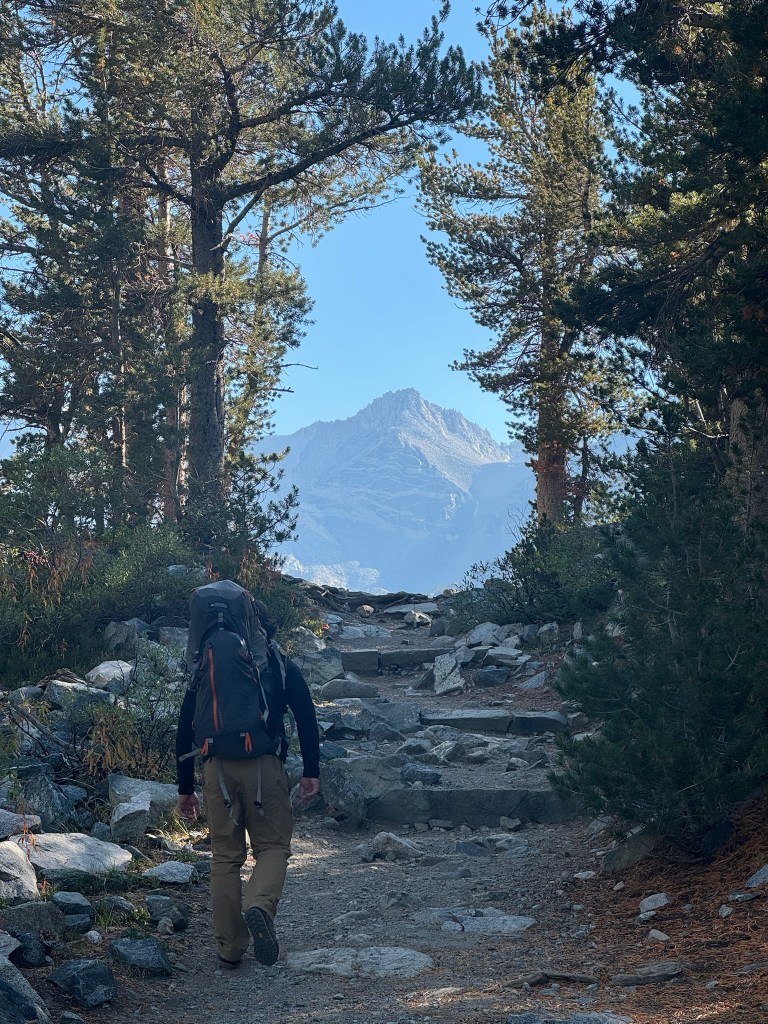
    A portal to the mountains within the valley trail
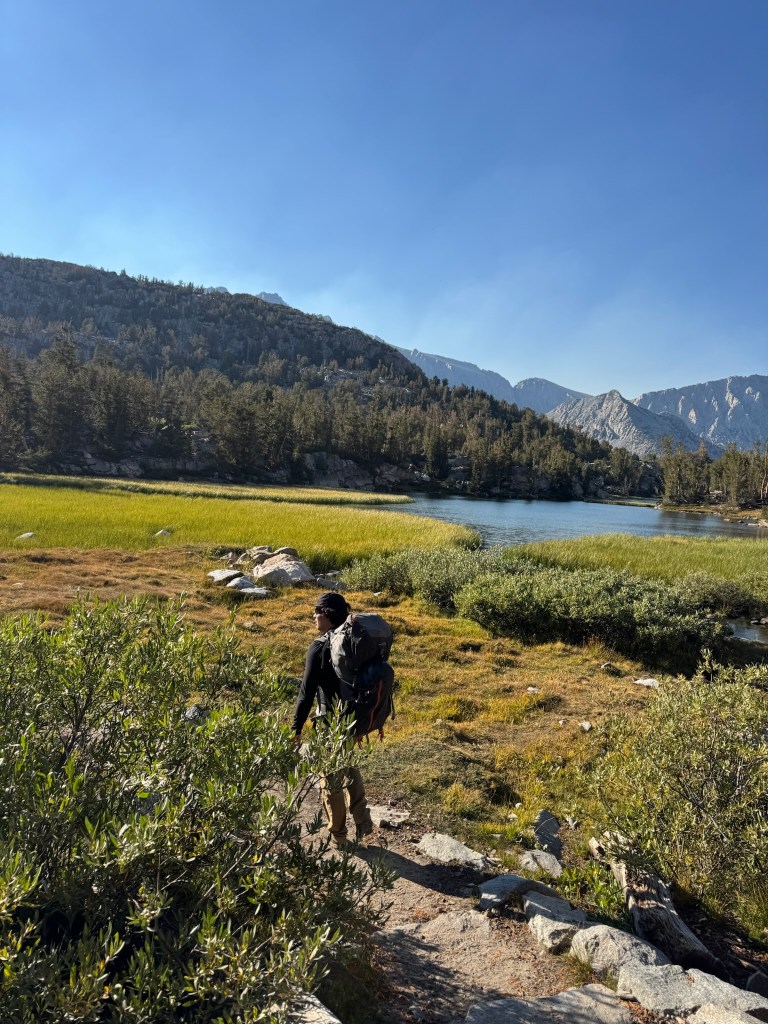
    Incredibly lush grasses and rivers were constant
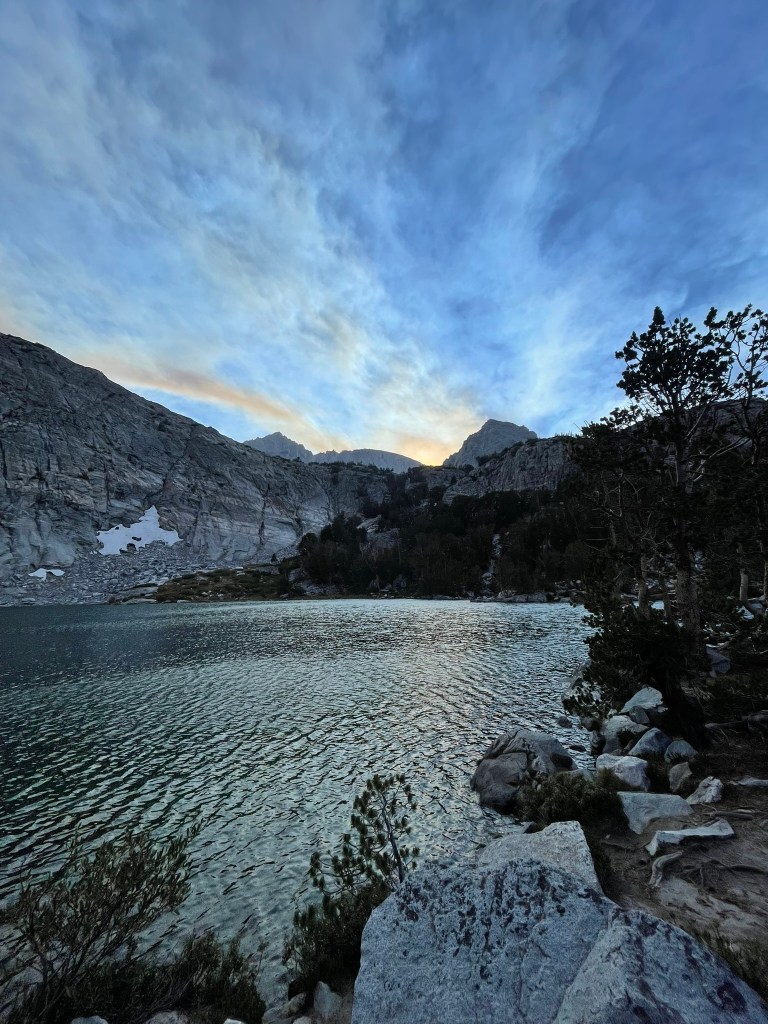
    The view from our campsite with Gem Lake in the foreground and Bear Creek Spire out of view

    Throughout the night, we both were awoken several times by the forecasted wind gusts coming from the Southeast. When the alarm finally came I couldn’t avoid the thought of bailing for the day from the thought of what was ahead. Despite the apprehension, Trevor and I just moved on to packing and eating breakfast. We carried a 60 m rope, a full rack, about 2L of water each, a puffy/windbreaker, and a modest amount of food. Overall we were fairly light for our typical alpine setup and it wasn’t long until we started climbing up the talus fields ahead. For the first hour or two, I had the privilege of climbing in the full moon’s light in leu of my forgotten headlamp. The terrain consisted of shallow angle boulders maybe 2-10 ft in size for several thousand feet. It was much slower than a trail of the same slope and required more care to protect leg or foot injuries. As usual it felt endless, but we were making pretty good progress the whole time. As the sun started to rise, we were nearly Peppermint Pass as intended. The ridge began soon after this point and we decided to take a break for refueling. My stomach wasn’t feeling great and I wound up vomiting almost immediately after an ill chosen protein bar. It was a dumb mistake on my part, but I knew I had to get calories in and was able to hold down the rest of my energy gel carbs. Ahead of us was a few hundred more feet of easy scrambling until we passed a large tower to our ridge and saw the ridge steepen.
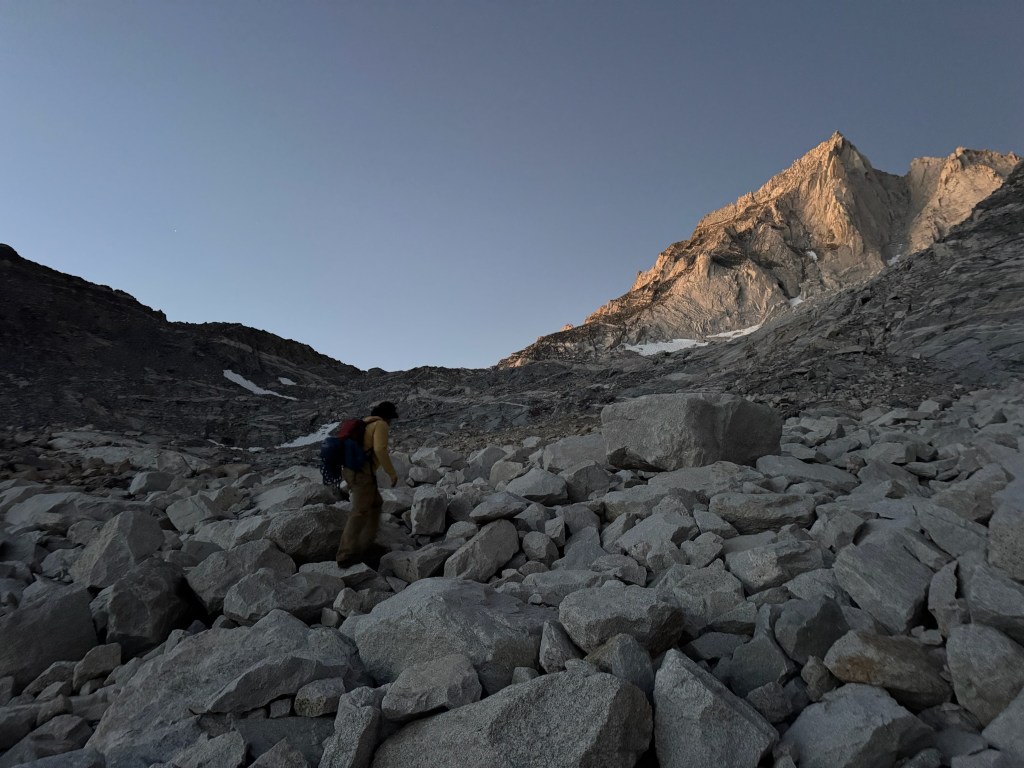
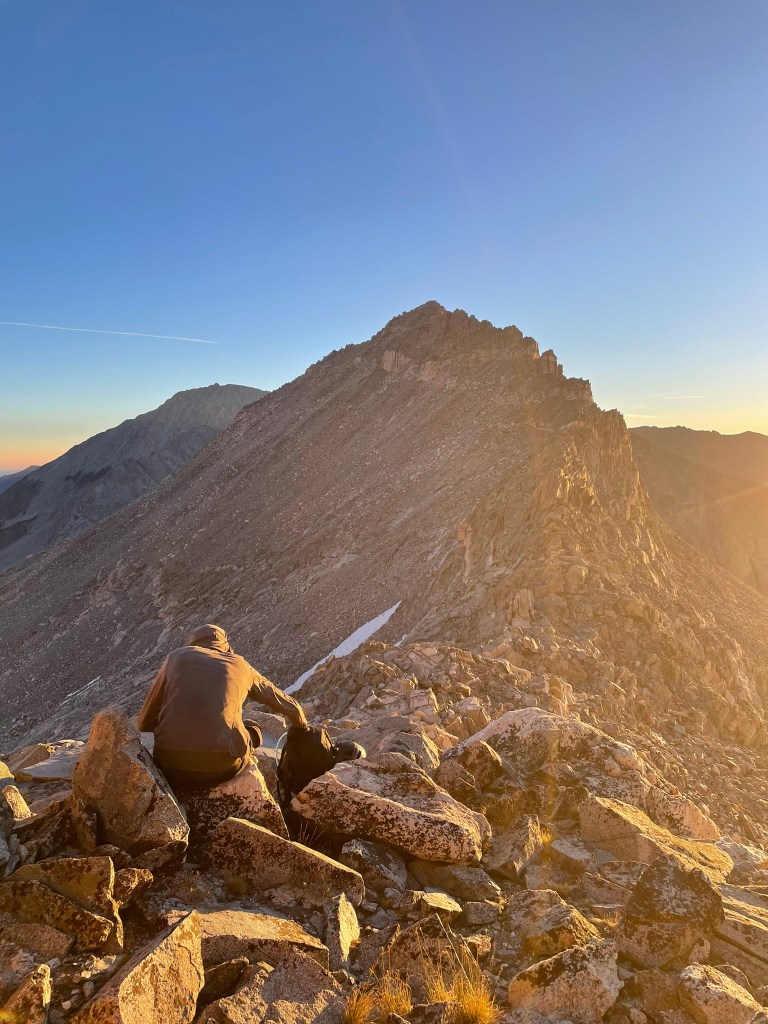
    A little over halfway through the endless boulder field and a view of Bear Creek Spire
    A refueling break as the sun was rising
    A view of our route ahead in the morning’s Alpenglow

    At this point the sun was in full view and I was excited to get started. Trevor got the first lead and was gifted with beautifully layered and fun climbing up flakes that reminded me of Dr. Seuss’ imagination. The ridge was still fairly wide too at this point and I was feeling confident on the terrain so far. Still there was 800 ish feet to go and we both knew we had to move quickly. Next up was my lead and the ridge went back to relatively easy terrain. I placed one cam where there was a briefly exposed move, but otherwise climbed quickly on. At some point I reached the end of the rope and still felt the climbing was solid 3rd class. I yelled back to Trevor and told him to break down the anchor so we could try and simul for a while. Before the trip I was terrified of simul climbing because it wasn’t really good protection. When I saw the terrain in the moment, I better understood its use. We could climb quickly through easy terrain that I was 100% confident in and the rope still made me feel better about our setting high in the ridge. As a result, we blasted through about 400 ft of terrain and returned to a ledge below steeper terrain that was perfect for a belay. Trevor took the lead again and brought us through easy 5th class terrain and onto the true knife edge ridge of the spire. We were still moving pretty quickly at this point and our moods followed suite. Looking behind us Little Lakes Valley came into view and was truly spectacular. It was a green paradise scattered with deep blue lakes and was guarded on all sides by walls of striking granite. To our sides were endless peaks and valleys that all spilled out into the desert in the East. Mt. Tom was the most prominent and stood tall like a fortress as it was separated from its adjacent ridgelines.
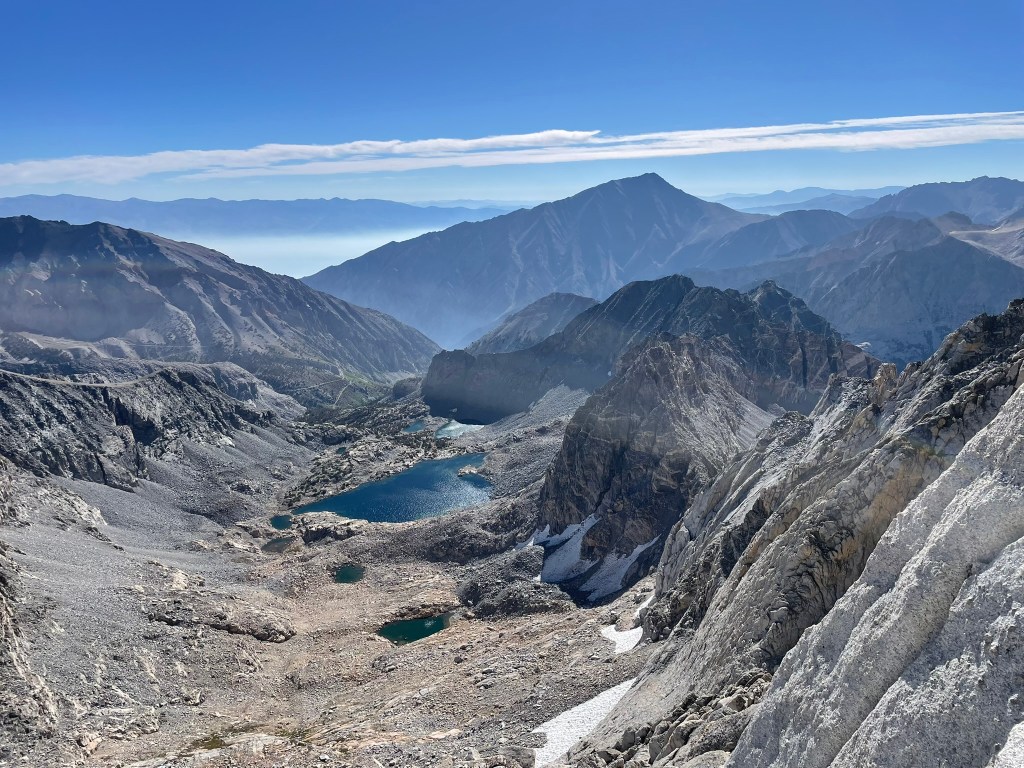
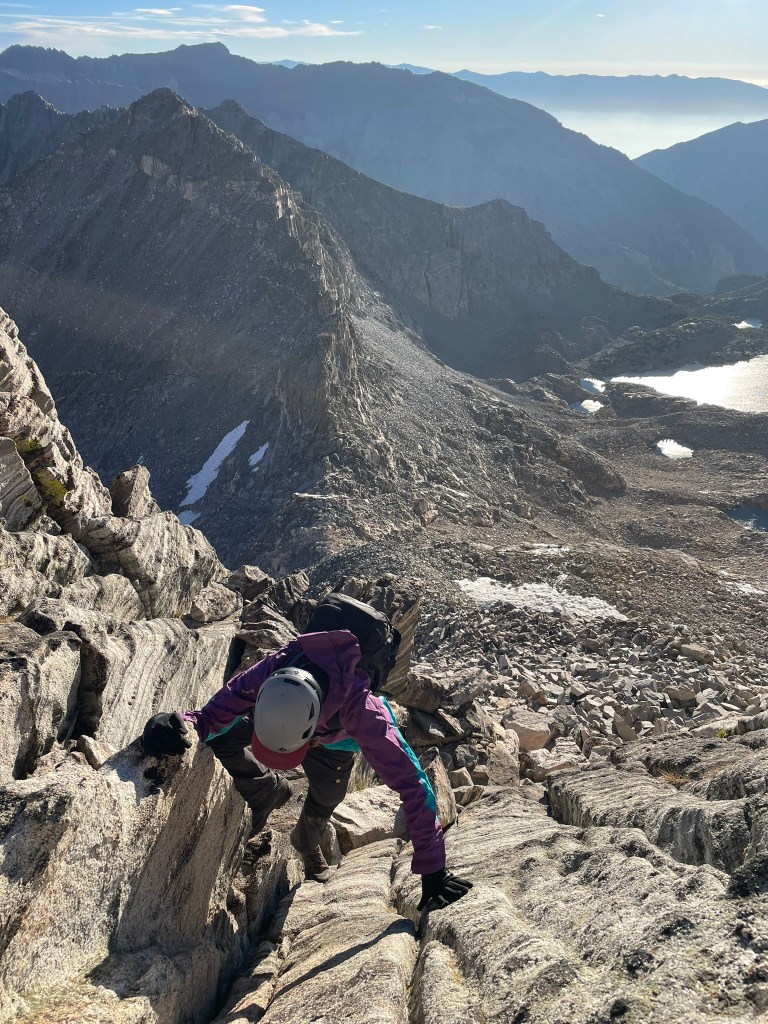
    A view of Mt. Tom in the distance
    Approaching the first tower on 3rd class terrain
    Trevor making his way up our first roped pitch

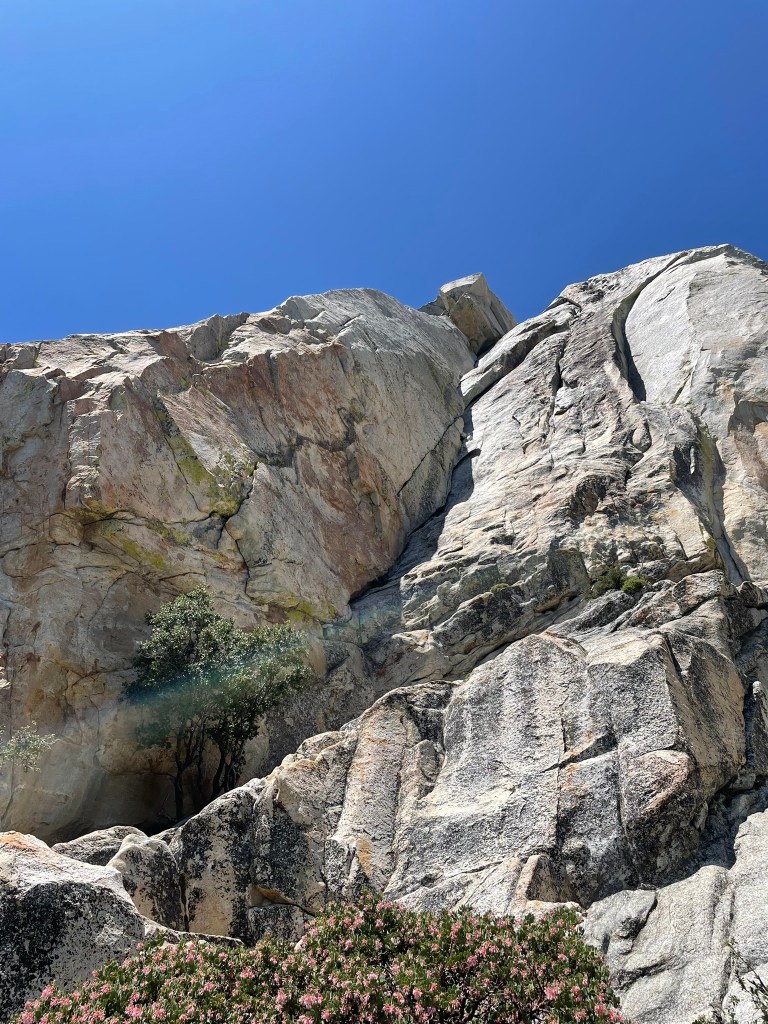
    Looking back at the climb, I saw the sharp end of the rope and harder terrain ahead. This was the moment for me that makes alpine climbing so special. We just put in a tremendous effort to get to this pitch and now it was game time. Right off the belay was a couple of reachy moves to gain the next ledge ahead. There I didn’t see any great options outside of a corner with balancey feet to my left. I put in two pieces of protection and calmly search for good feet placements before committing off the ledge and over exposure. I quickly moved past the corner and onto stepped up to the next rest, which felt like such a great relief. Ahead were still home insecure moves here and there, but this felt like the obvious crux of the ridge so far. This made the climbing super fun and the thousands of feet of exposure on either end felt less intimidating. Before I knew it, I felt the end of the rope and made a quick anchor around one of the numerous horns of the ridge. The summit was pretty close and all that stood in the way was a traverse, short gulley, and maybe 50 ft more ridgeline. Trevor lead this portion and got through some cool moves of his own. But at the same time anchor building was difficult and we lost quite a bit of time through this portion of terrain trying to figure out the best systems for protection. This involved an awkward gear belay and a short section of hard to protect chimney’ing. Regardless once we made it through this section we immediately saw the summit block and knew we were gonna make it out okay. I still roped up for this section and made it to the summit register within 30 ft or so. Technically the real summit still required a boulder problem rated 5.6R. It was exposed to quite a large drop-off and seems like another case delicate footwork with an awkward mantle finish. We both immediately agreed to skip it for the day and instead focused on getting down the mountain. Behind us was another crazy ridgeline view with a Little Lakes valley backdrop I think I’ll always remember vividly.
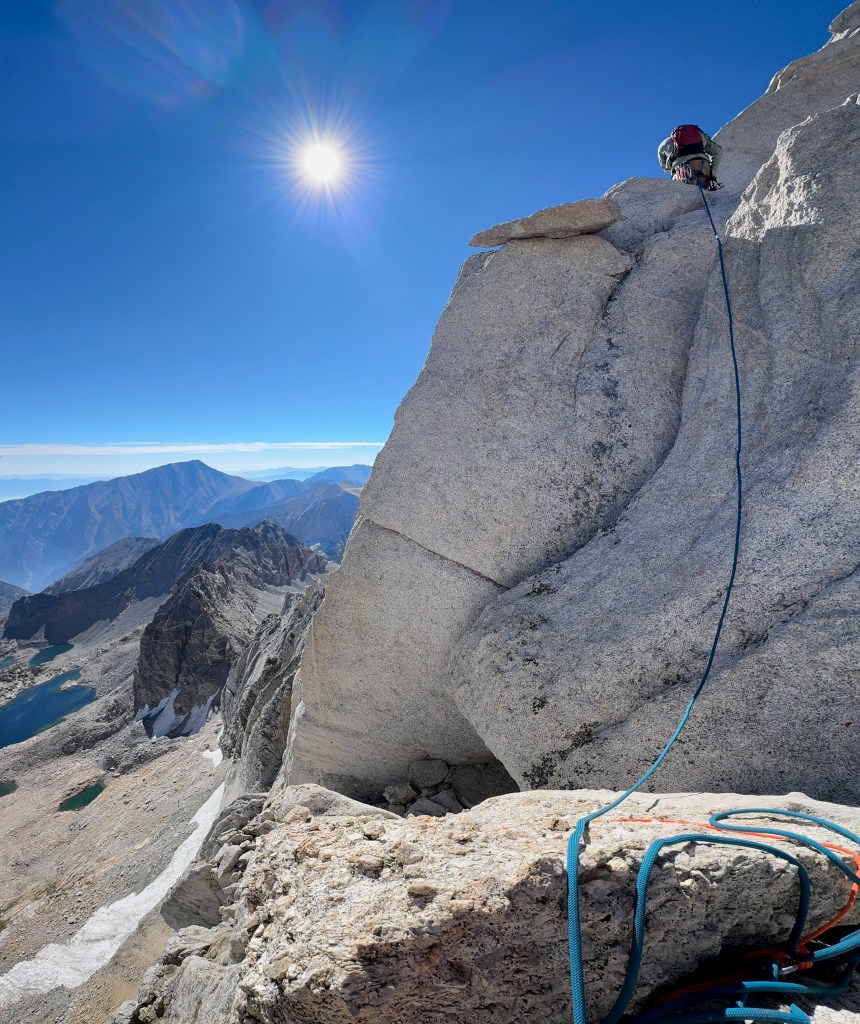
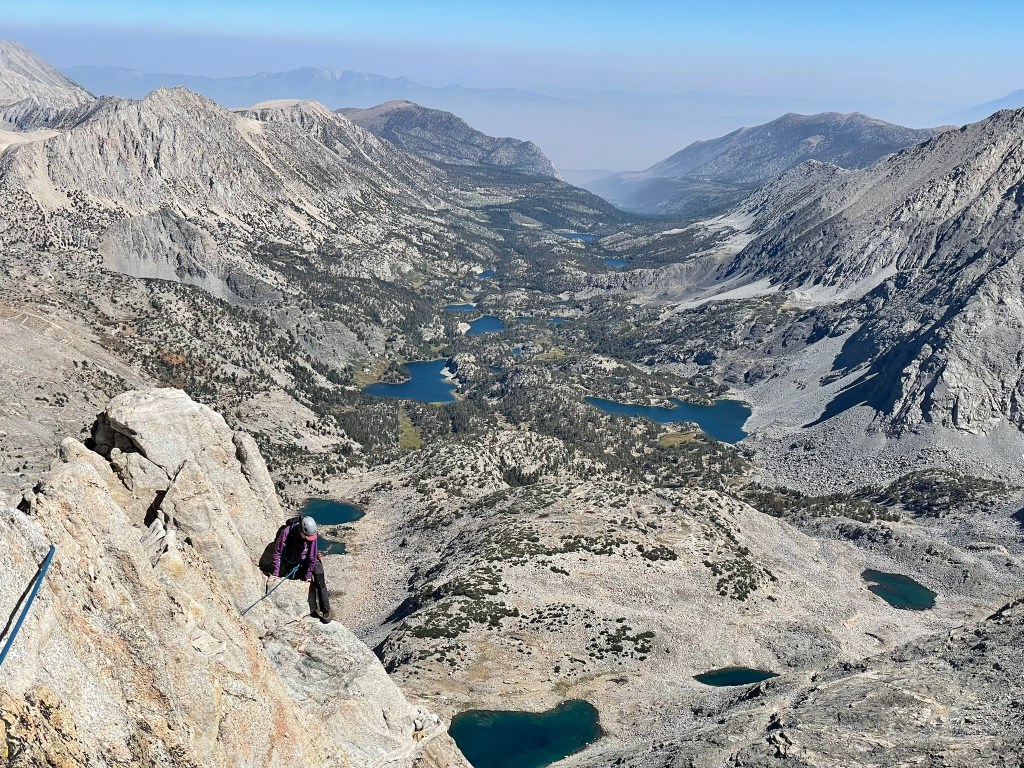
    Myself on the sharp end placing protection ahead of the ridge crux
    Trevor following on the ridgeline proper with a glorious view
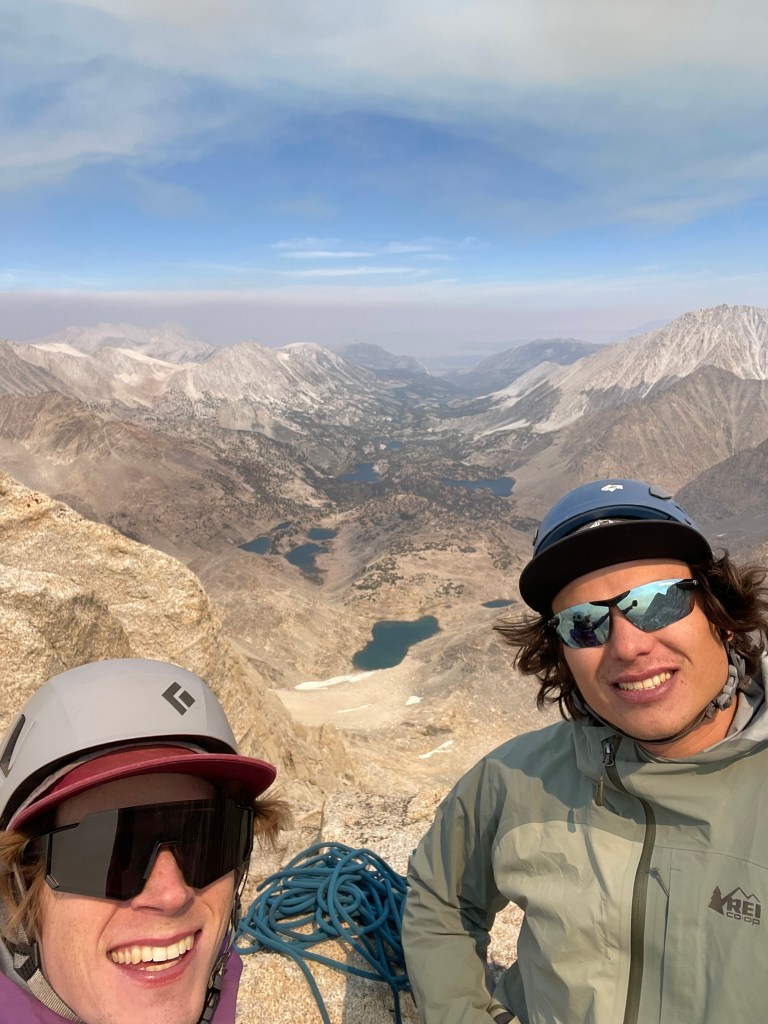
    Trevor and I at the summit

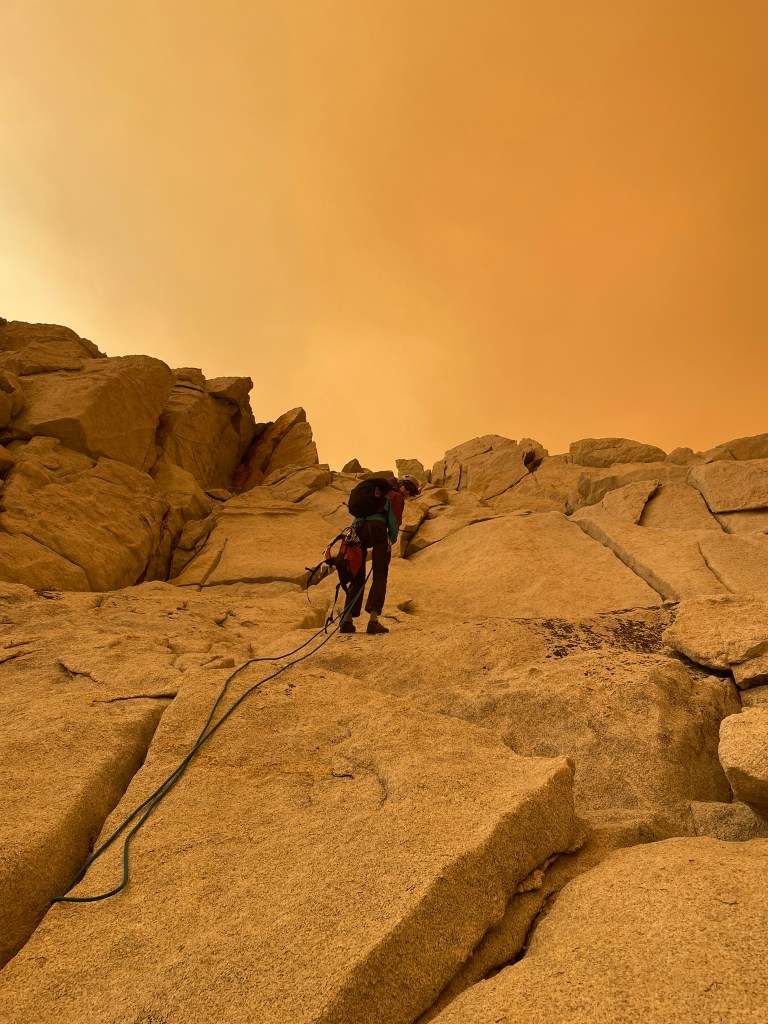
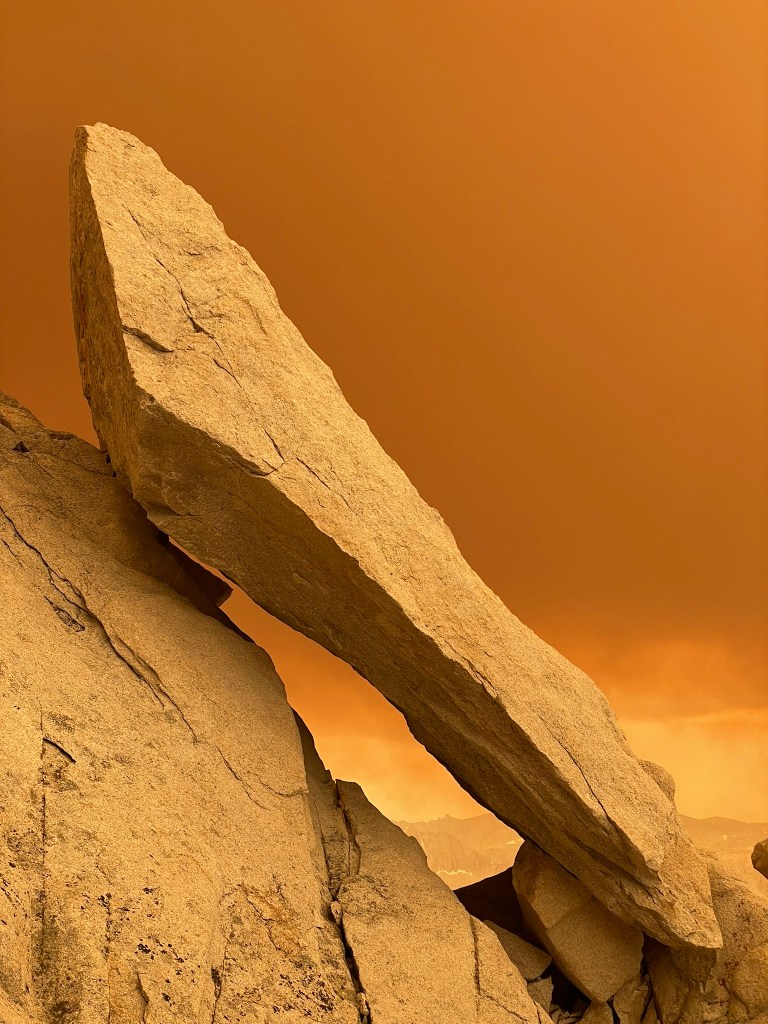
    But the view didn’t last long, as we added some cord to the existing tat-ridden anchor we could see a puffy and out of place cloud in the distance. Before we both made it off repel, the cloud quickly turned into large sweeps of red-orange smoke that would consume the entire area. Blue skies and sprawling landscapes turned into dramatically red tinted backdrops of nearby peaks and a otherwise brown haze. We joked about its resemblance of mars or mordor, but also wanted to get out of there as soon as possible. The smell was clearly of burning wood and exposure to this was certainly doing damage to our respiration. Making it out involved a return to the endless talus fields and so we got a move onto the next col between Bear Creek Spire the next NW peak. As high quality as the rock on the NE ridge was, the terrain following this col was equally poor. We chose to downclimb this section, which was maybe a hundred feet or so of 3rd to 4th class choss. Some of it was sand and some of it was large loose blocks that we’d toss down the mountain at our discretion. It was pretty clear we would make it down, but we remained on edge the whole time and had to be very methodical with our chosen hand or foot holds. At the bottom of this short headwall we returned to the endless talus. We’d take one or two short breaks and otherwise tried to descend as quickly as possible.
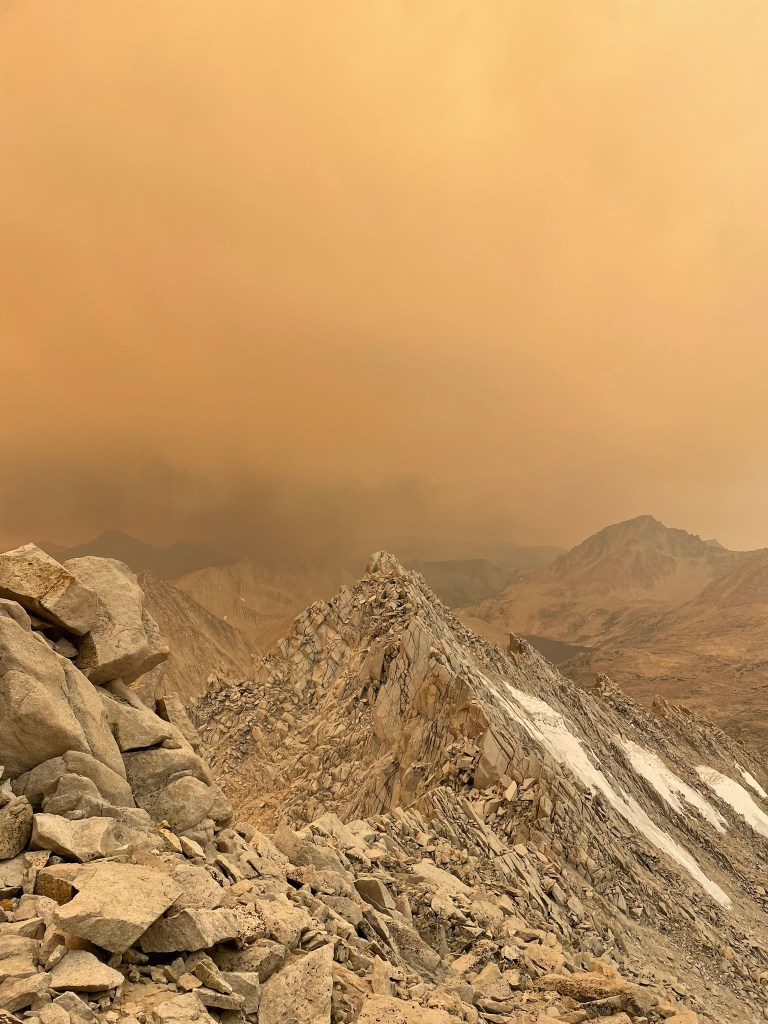
    Incoming smoke clouds
    An otherworldly rock
    Trevor repelling down in the smoke

    Without snow to cover these boulder fields movement is pretty slow compared to a trail no matter what we tried. Going to fast was pretty risky for injury potential so we just maintained as fast a pace as we could and would sometimes swaps leads to boost energy. Eventually we made it down to camp at around 4pm, nearly 12 hours since we had woken up. Once there we took another well earned break and were greeted by some older guys who were stoked that we made it back from the ridge okay. They were clearly nostalgic from their days of climbing and we exchanged some stories back and forth of our climbing experiences. It was a cool moment of celebration and we got to enjoy the fact that we did what we set out to do. As we broke down camp, Trevor even took a plunge in the lake and I took a few minutes to relax. After this was what I thought would be a short hike. As usual it still felt long and strenuous having to carry a big pack and having been moving for so much time. The way back smoke clouds still filled the whole valley and encouraged me to move fast. Some sort sections of uphill scattered about were brutal and I was exhausted again towards the end. We made it to the car just after 6pm and exchanged the last bit of gear between us. Normally I would have loved to celebrate, but instead we both rushed out of the trailhead and on our 6 hour journeys to SF and LA. Smoke lasted for nearly an hour of driving and finally making it back to clear skies was such a relief.
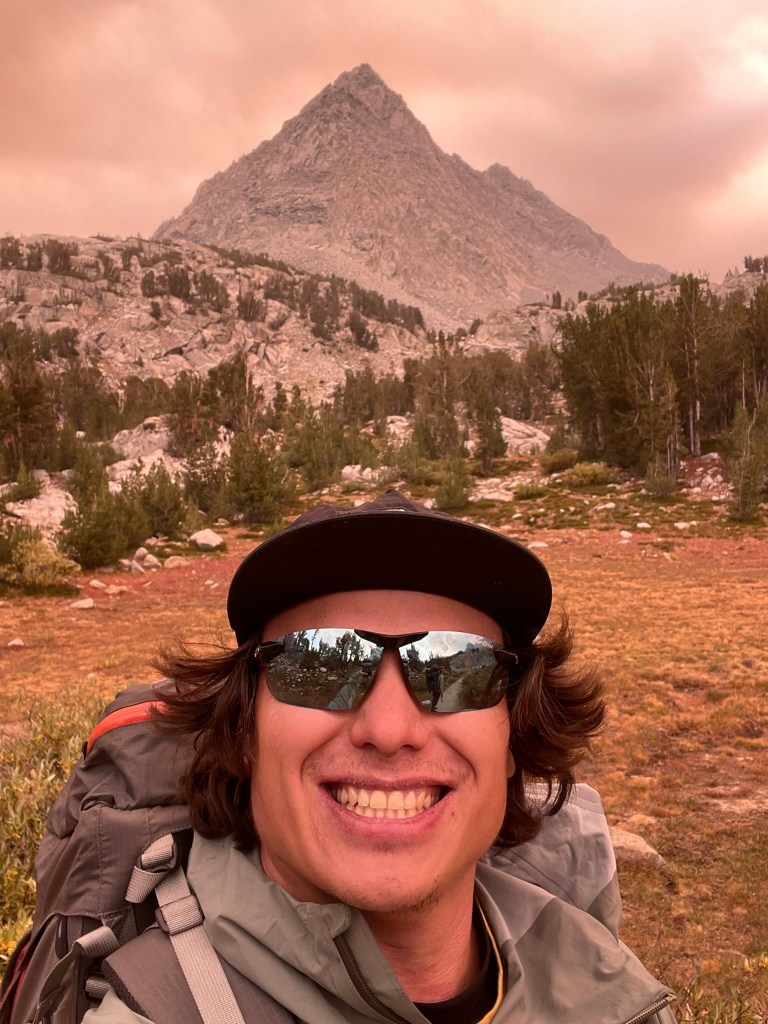
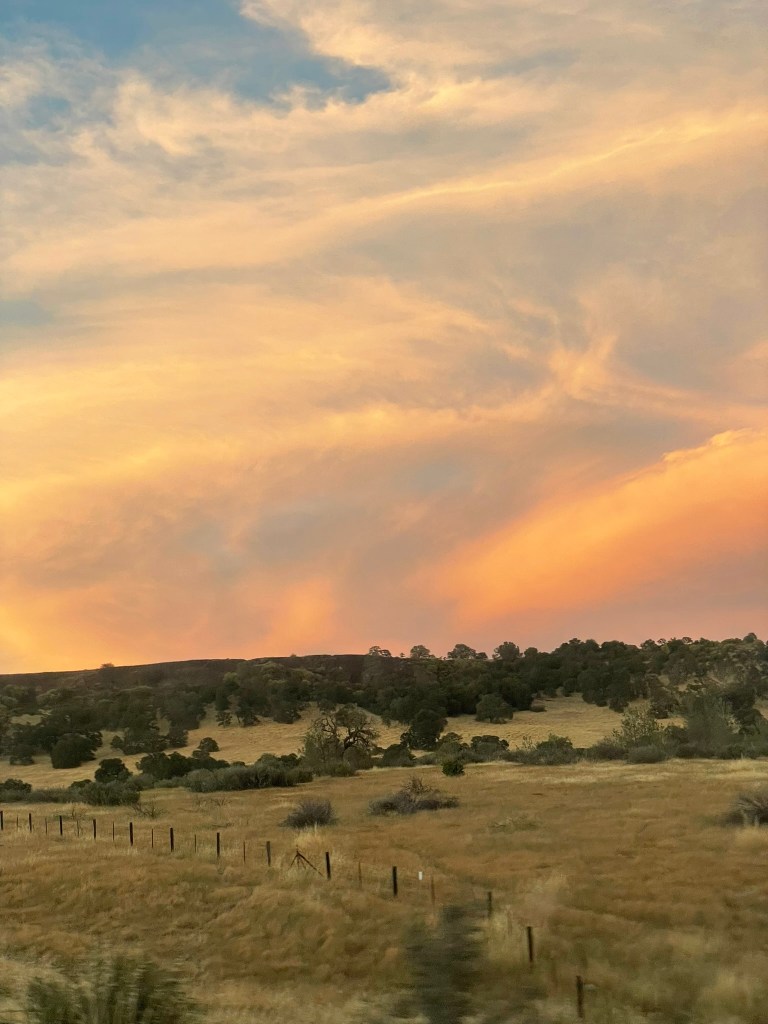
    A red tinted world on the hike out

    For another weekend, Trevor and I had an incredible adventure. I was impressed by the beauty of the valley and as usual was very glad we finally committed to the climb. This trip made for one of our smoothest alpine climbs to date despite many obstacles and unexpected moments along the way. I’m glad I took the time off I did to reflect and earn back the passion for mountains that enables these crazy adventures from time to time. Looking to the future I’m more motivated than ever to continue progressing in endurance, technical skills, and experience required to tackle more routes in the High Sierra. Its such a cool privilege to live nearby such an incredible range. Access will never be easy but it certainly makes these moments more memorable.
  • Summer Alpine Scrambles

    Summer Alpine Scrambles

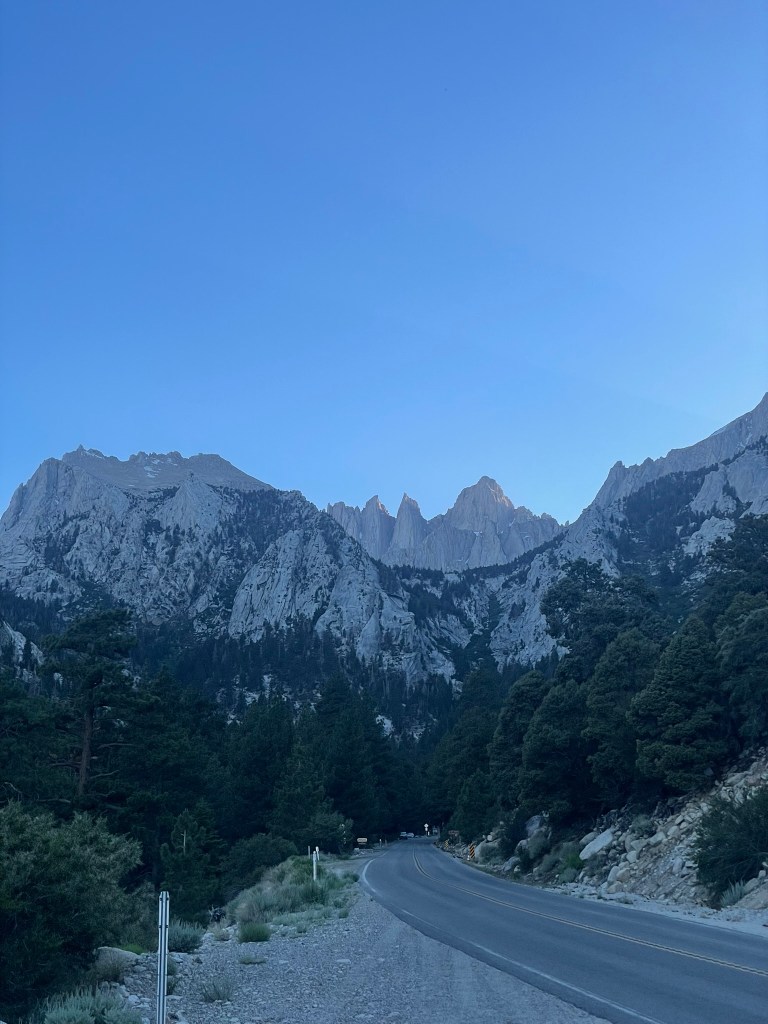
    As June turned to July the existing sierra snowpack dramatically shrank, but I was still as determined as ever to get out into the mountains. I had recently bought SuperTopo’s guidebook on climbing in the High Sierra and quickly became intimidated by the possibilities the range provided. There was endless climbing potential just as there was for skiing and a huge amount of it was easy scrambling to low 5th class terrain. In my typical fashion, my first thought was to start at the beginning and tick off the 3rd and 4th class routes. So I started mapping out some possible routes on OnX backcountry just as I had done for ski touring in the previous months. One common trait was clear from the get-go: the high sierras require big and burly approaches through mixed alpine terrain. If I were to tick off some of these scrambling classics, I’d have to be committed both on a long drive in and a very long day out in the mountains. Once I accepted this fate I got back to researching route beta until I stumped across a way to ease the pain. What if we took advantage of a mega approach by linking more than one route? The sierras are known for massive linkups and traverses, so why don’t we follow suit? So the next day I messaged the usual crew and pitched what I thought was just within our limits of endurance in the mountains: a linkup of Mt. Russell’s East Ridge, Mt. Whitney’s Mountaineering Route, and Mt. Muir’s scramble from the Whitney Crest Trail. I wasn’t sure if this would be possible, but it certainly sparked the inspiration I was looking for and began a ~month long journey of big climbing days in preparation.

    The view of Mt. Whitney driving up to the portal

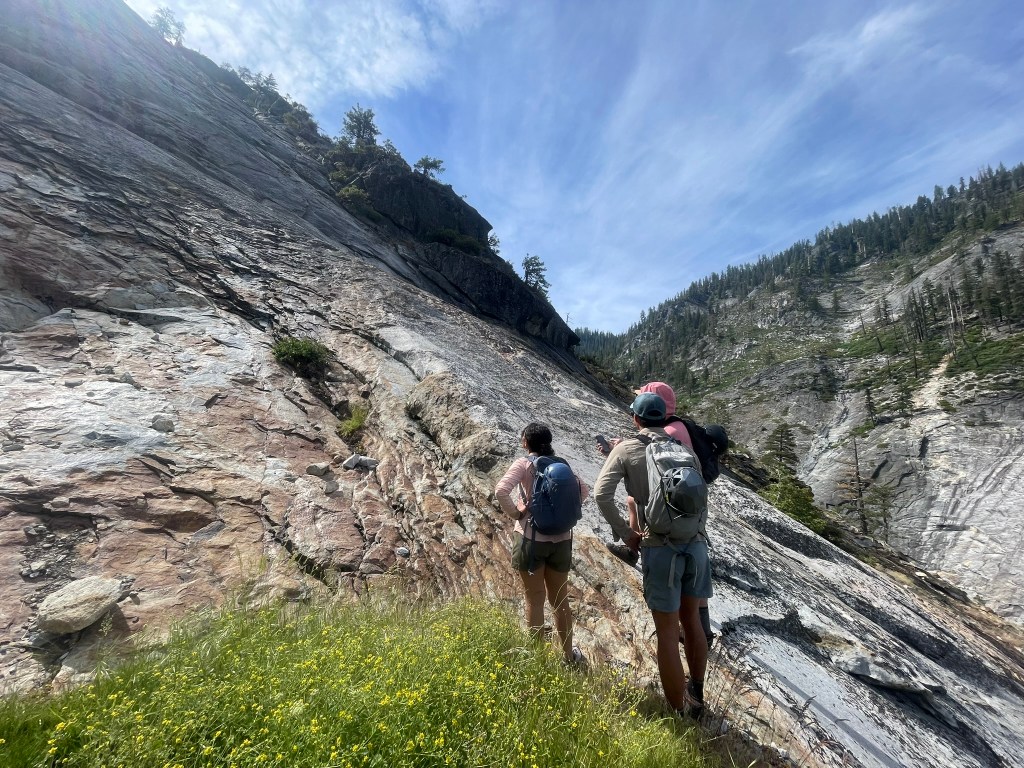
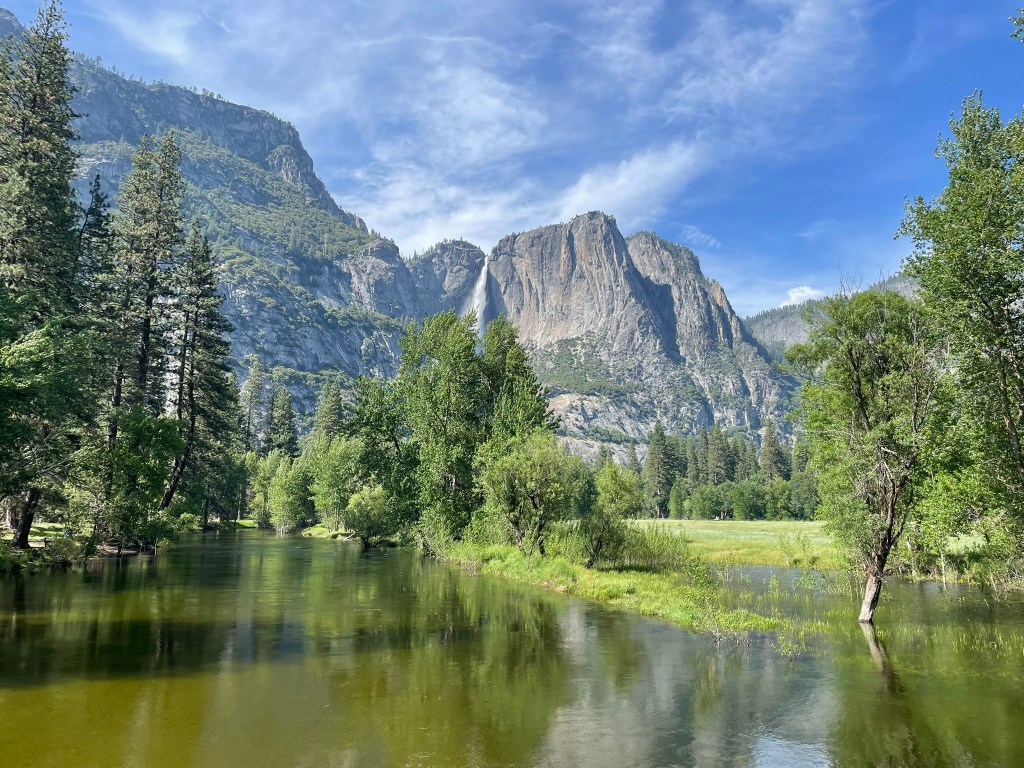
    The first step of my training plan came by surprise. My friend Joe invited me last minute to join two others on a trip out to Yosemite Valley. I hadn’t been since I was a teenager, but felt obligated to take any opportunity to go as a bay area resident. The goal was a big scramble and bushwhack to try and summit the three Cathedral rocks that towered prominently in front of Bridwell Falls. I got a link to a route description that claimed the whole trek was 4th class, but I had a feeling we might find ourselves in pretty sporty terrain. Luckily, two of the guys in our group were strong trad leaders & we carried some rope and rappel gear in case things got hairy. Soon enough, I picked up Joe in the Easy Bay and headed off towards the valley. That night we arrived at a campsite just passed Groveland and found the two others in our group already fast asleep in their tents for the night. It was ~10 pm and the schedule wakeup was regrettably 4:30 AM. This would sort of set the tone for the month, but doesn’t really change the painful wakeup each time. So we setup the tent, tried to get some sleep, and were greeted soon after by our partners in the morning. Good thing we did get up early, because the next morning I foolishly left my phone at the campsite and had to circle back at 5 am to retrieve it before we started off. Regardless, getting to the valley the second time I felt much more awake and took in the gigantic walls of granite that enclosed the valley like skyscrapers would in NYC. Even the three cathedral rocks standing 2000 ft tall in front of the trailhead were dwarfed by their older brother El Capitan dominating the meadow below. Its incredibly inspiring to be in this place with the knowledge of its unique formation and rich climbing history across the last century. I was excited to start that journey for myself in the valley, even if it paled in comparison to what was possible.
    Classic California view on the way to the valley
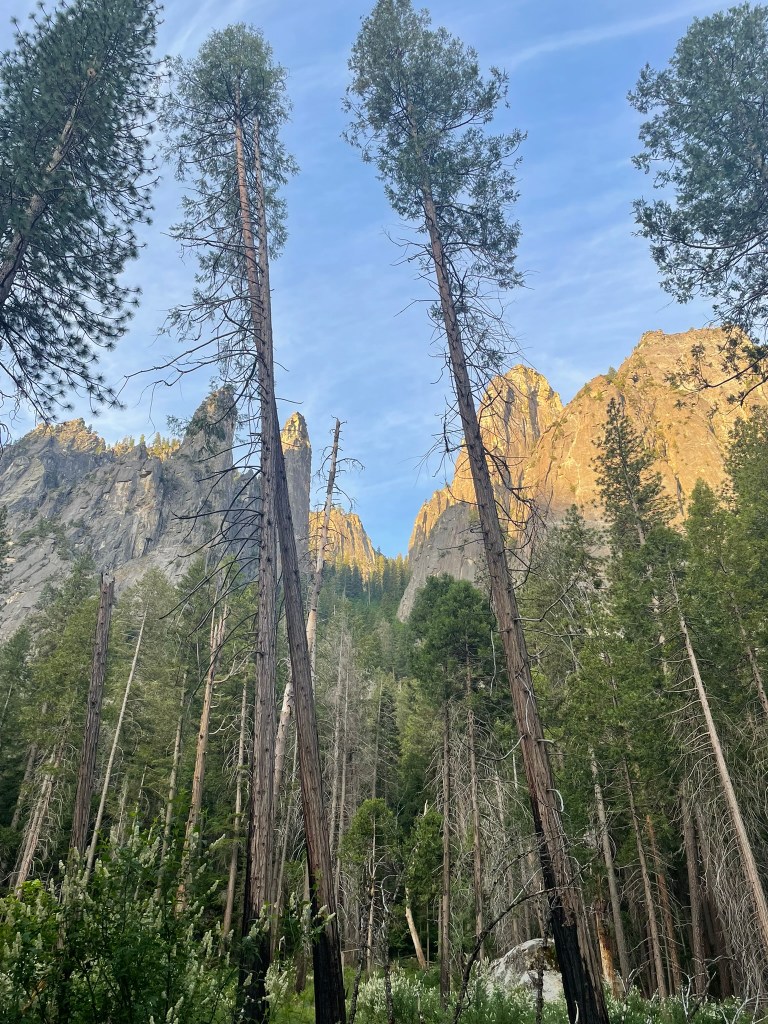
    View of the Cathedral group from the trailhead

    By the time we started again, it was about 6 am and we had a short hike to the start of the gully between middle and lower cathedral rock. We cruised through this section and made it to the base of the route. First up was Gunsight to lower cathedral, which was the normal descent for the adjacent routes and had some fixed lines running through the crux sections. For the majority of this section, I avoided pulling on rope and got through the steeper sections without too much trouble. Behind us loomed El Capitan, framed perfectly by the ‘gunsight’ of the gully. Frequent ledges made resting easy and it wasn’t long until we reached the true crux at the top of the route. My more experienced friends opted to solo the ‘5.4’ ish terrain most directly ahead, but I opted to use fixed ropes on a slabby section to its right. Really this section felt pretty exposed too and I hadn’t used rope hand over hand before in this manner. Regardless I was glad to have the option and met the rest of the group at the top. Getting to the top of lower cathedral was pretty easy from here. We bushwhacked a bit and made our way through easy scrambly terrain until making it to the summit proper. This was the first peak of the day and it presented a spectacular view of El Capitan and the valley ahead. To our right loomed middle cathedral, which was the largest of the cathedral formations and was quite a bit higher than where we were.
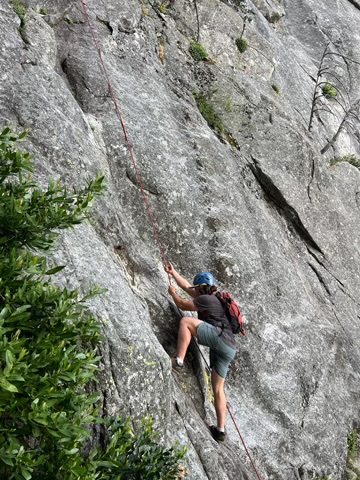
    A zoomed in shot of me climbing up the slabby section with fixed ropes
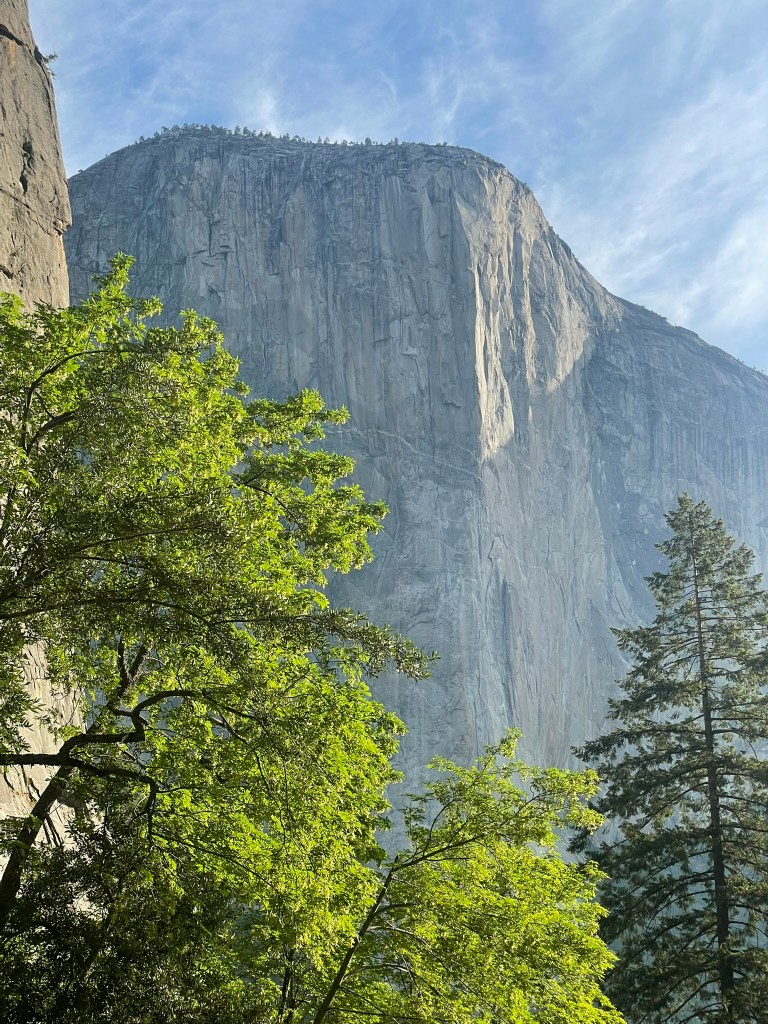
    A spectacular view of El Cap from Gunsight
    Towards the end of the gulley, another fantastic vista

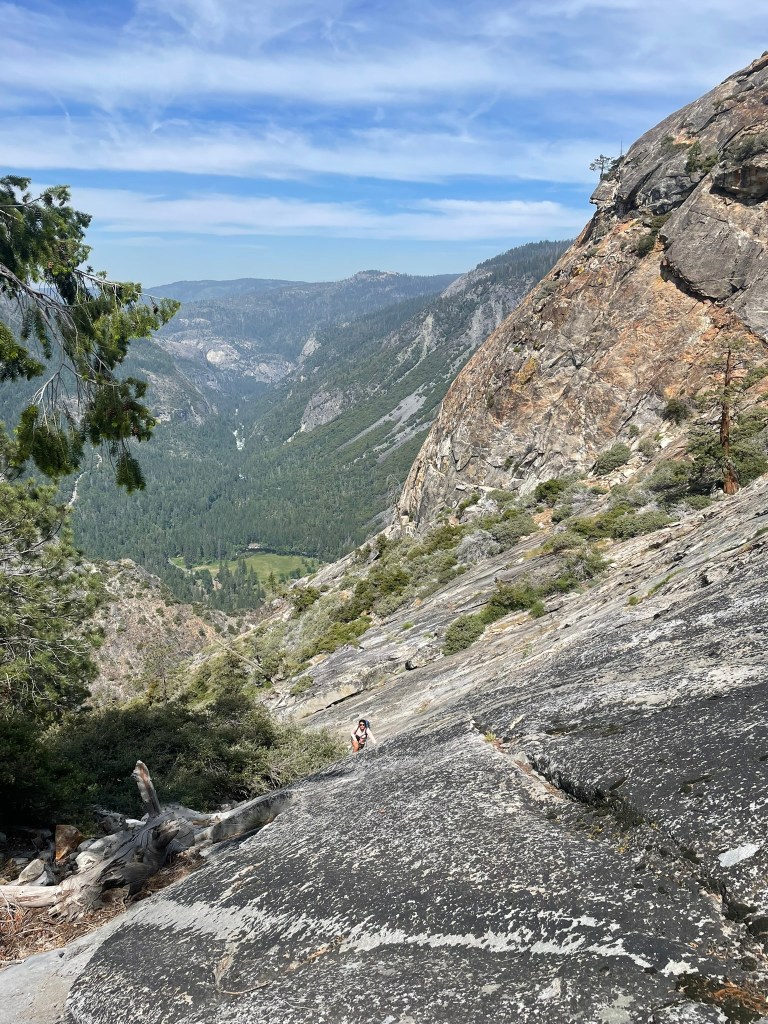
    After a short break we were off again, this time traversing behind the rocks and into the valley upstream of Bridwell Falls. We were lucky to have the whole place to ourselves, which felt pretty unreal for such an iconic destination. However, the path to Middle Cathedral proved to be a mix of heavy bushwhacking and endless slabby scrambling. We all took turns ‘leading’ the way as route-finding was pretty straightforward. I also through of this as great practice for getting comfortable in alpine terrain as I could choose how difficult or exposed the climbing felt. After this initial section came a huge slab that carried us several hundred feat and into the supper section of the rock. Looking behind us were breathtaking views of the valley, which seemed like a tiny hidden corridor compared to the main drainage in front of us. Before we summitted, there was still a good amount of extraneous route finding through manzanitas. When we finally made it through we were back to the incredible view of Yosemite valley and onto our second snack break. Our group was feeling pretty tired at this point, as we climbed most of the elevation for the day and still had one peak to go. One member of the group, Shereen, was debating whether or not to skip the last rock as she had just come off of a huge vacation and was pretty wiped from the trek so far. We looked at Upper Cathedral, which was far closer in comparison than our hike to Middle from Lower and decided to push on.

    Route finding in progress on the way to Middle Cathedral
    A sea of slab on the way to Middle

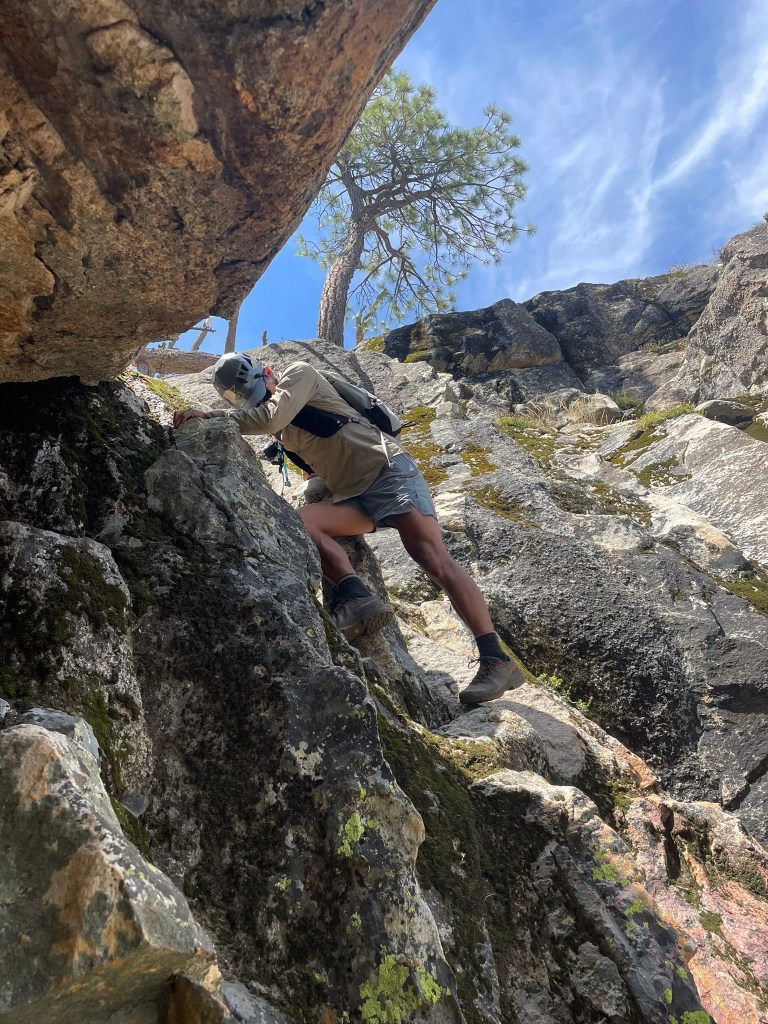
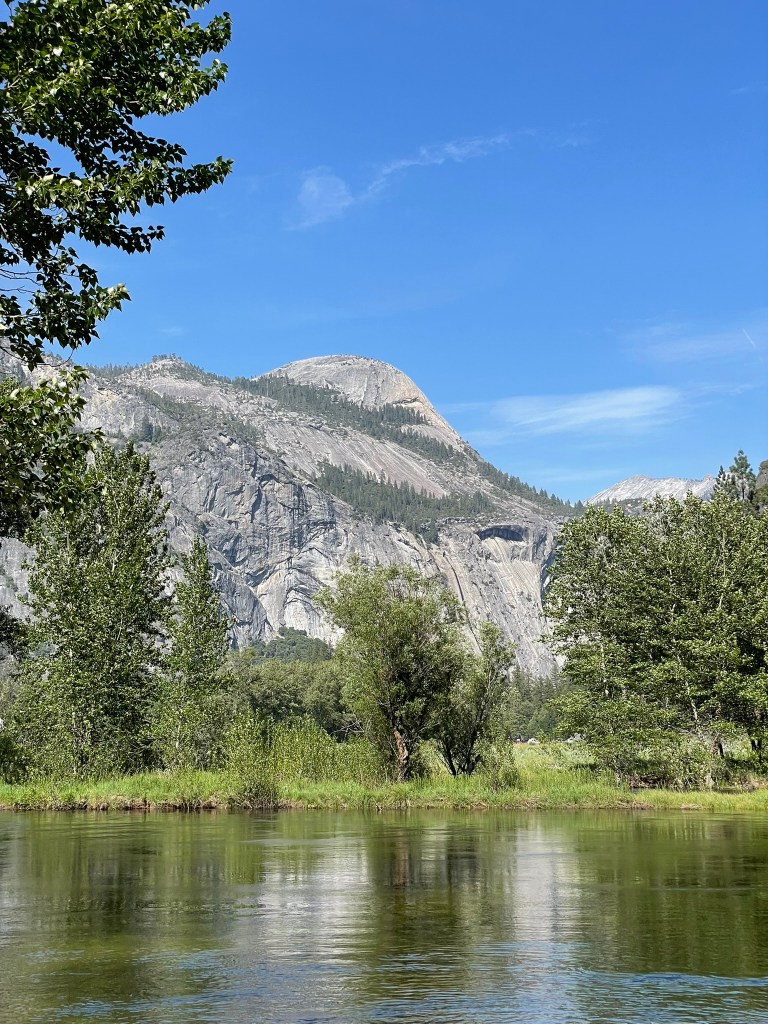
    The last rock did not come easy, we were met with tons of bushwhacking again and a few more steep scrambly sections. The most memorable of these we named ‘bush crux’, which was a short and steep section that both felt insecure and was littered with mazanitas. I followed my fried Tyler up this section and made it through by trying to focus on just the climbing as much as I could. I tried to avoid pulling on branches, but still had to muscle my way through some thick brush before exiting onto the final ramp towards the summit. Shereen had some more difficulty and Tyler was able to step in at the end to offer a helping hand. Finally after this section we were able to cruise up and tag the summit, even through we were pretty wiped it was nice to know the rest would all be downhill. So we quickly fueled back up and made our way down the final gully between Upper Cathedral and the Cathedral spires. The view of these spires was incredible: we could see them towering in front of the valley and even saw a pair of climbers impossibly making their way up its regular route. What was less inspiring was the descent, which required some hairy downclimbing in a large chimney. I was pretty mentally fatigued and got held up in a downclimbing stem move. It took some faith in a juggy but awkward undercling to kick out one foot to the opposite side of the chimney and finish off the crux. I committed to the move, but only after a minute or two of indecisiveness and feeling mentally fatigued from all the exposure of the day. Regardless we all wound up completing this without any major issues and started our was down the gully and back to the trailhead. Even through it was all downhill and was relatively short, there was still about 1600 ft of descent to go and it felt pretty endless. After maybe an hour or so, we finally made it back to the trailhead close to 9 hours after our start. It wasn’t the fastest climb, but given our relative lack of experience and three big summits I felt pretty good about the day. What made it was better was making our way towards the Merced river for some post climb beers and a much needed cool off. This was my favorite part of the day, as we could sit in the river with some drinks at the perfect temperature and look at the giant granite walls which encircled us in all directions. That night I drove back to the Bay Area and got ready for the next weekend of big climbing adventures.

    Nearing the downclimbing crux
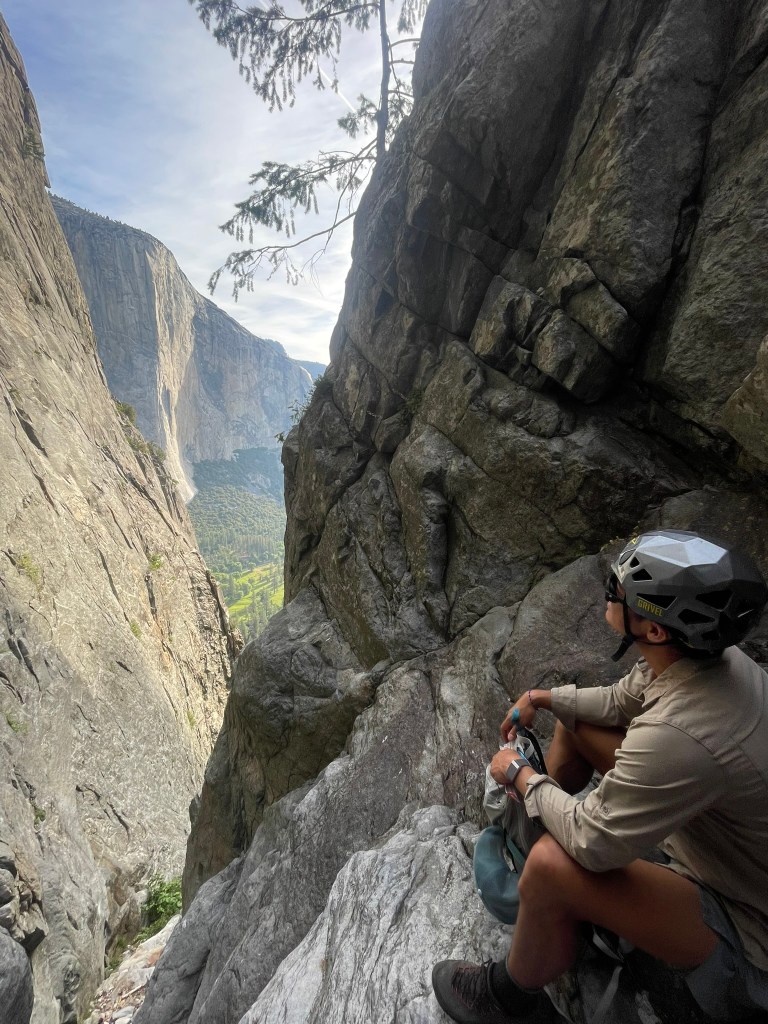
    Joe looking at the valley with Upper Cathedral Spire in the foreground (with a pair of climbers)
    Glorious Merced River basking

    After a week of work I was back off traveling to climb. This time I flew out to LA to visit some friends, discuss objectives, and get some more practice in with our Sierra crew. Our friend Matt had some good experience hiking and moving around the mountain in bigger terrain, but never went climbing in true alpine terrain or with ropes longer than one pitch. So the night before we chatted strategy on our Whitney/Russell/Muir linkup and decided to test out some skills back at Tahquitz for the following day. This wouldn’t be so easy as I had a flight at 7pm that next day and would have to make a quick day of climbing to get there on time. Fittingly I woke up at 4:30 for the 2nd week in a row and joined Trevor and Matt on the ~2 hour drive out to Idyllwild. It was my fifth time getting out there to climb, so we blitzed to the trailhead and made our way on the steep trail without much of a delay. Temps were still relatively cool for the summer so we knew it would be a crowded day. As we made our way to the route, we saw another group just racking up below the ‘Trough’. If we had gotten there 10 mins earlier we would have been the first up for the day, but still figured having other people generally helps to go slow and steady.

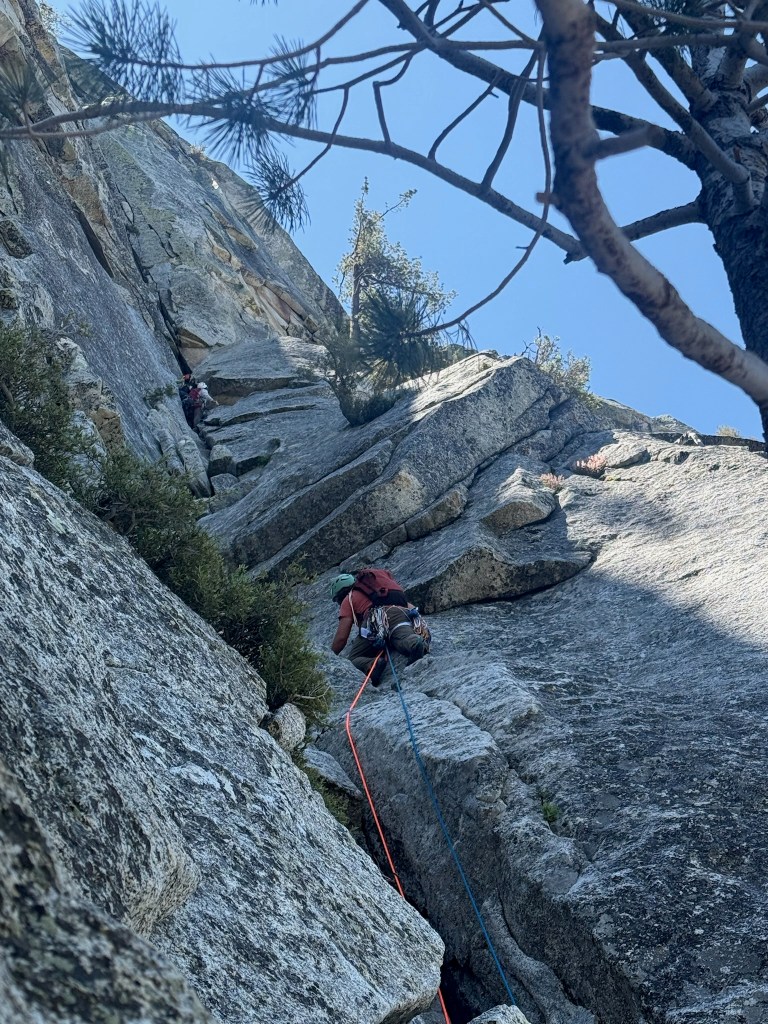
    Myself leading pitch two of the trough, the other group is right in front of us

    Despite the Trough being the easiest route up Tahquitz, it was still the first time for me climbing in a group of three and the first time I would lead pitch 2. Last go around it was only myself and Trevor so we planned to lead the opposite pitches this go around. Fortunately for me, I could rest and take the belay for pitch 1. This pitch was a total cruise, but still took a while due to the traffic ahead. We all made it up relatively easily except for some hiccups making sure I had the right ropes left clipped to protect Matt’s climb behind me towards the end of the pitch. Without these last few pieces of gear, Matt could fall and pendulum over quite a bit as the route traversed over. It was the other group that pointed this out to me and I couldn’t help but feel some extra pressure making sure we knew what we were doing in front of a more experienced group. Trevor who lead the route also had some issues setting up the first anchor and I spent a while adjusting its position while the other group made their way through the next pitch.

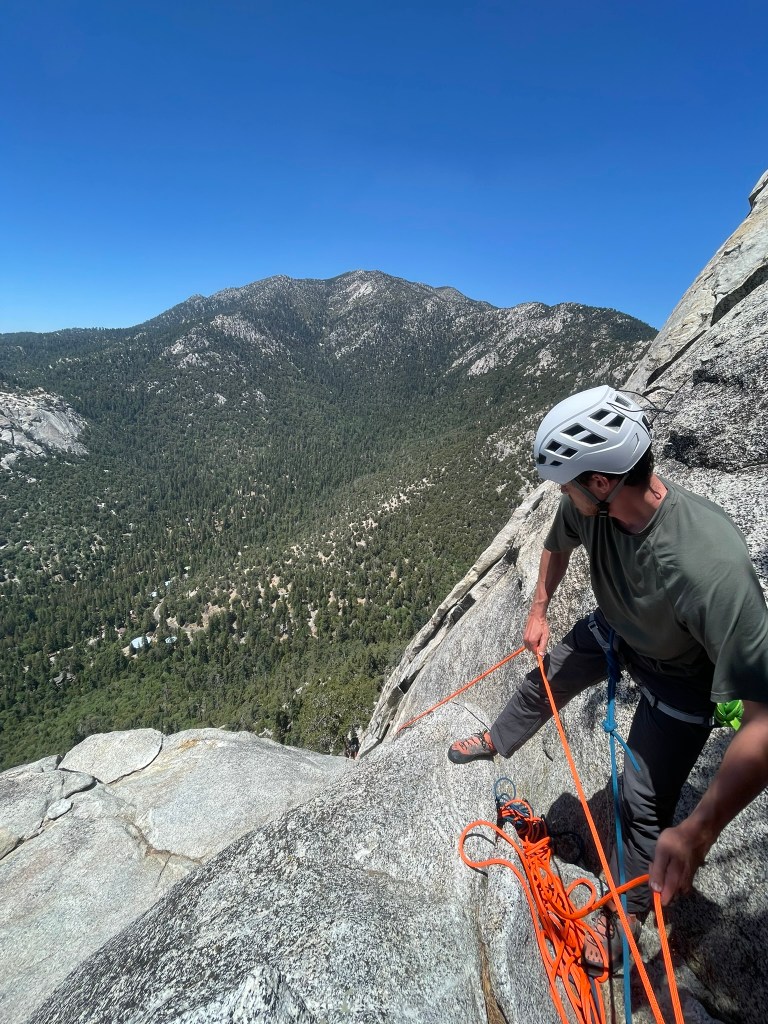
    Matt taking a turn belaying at the top of pitch 3
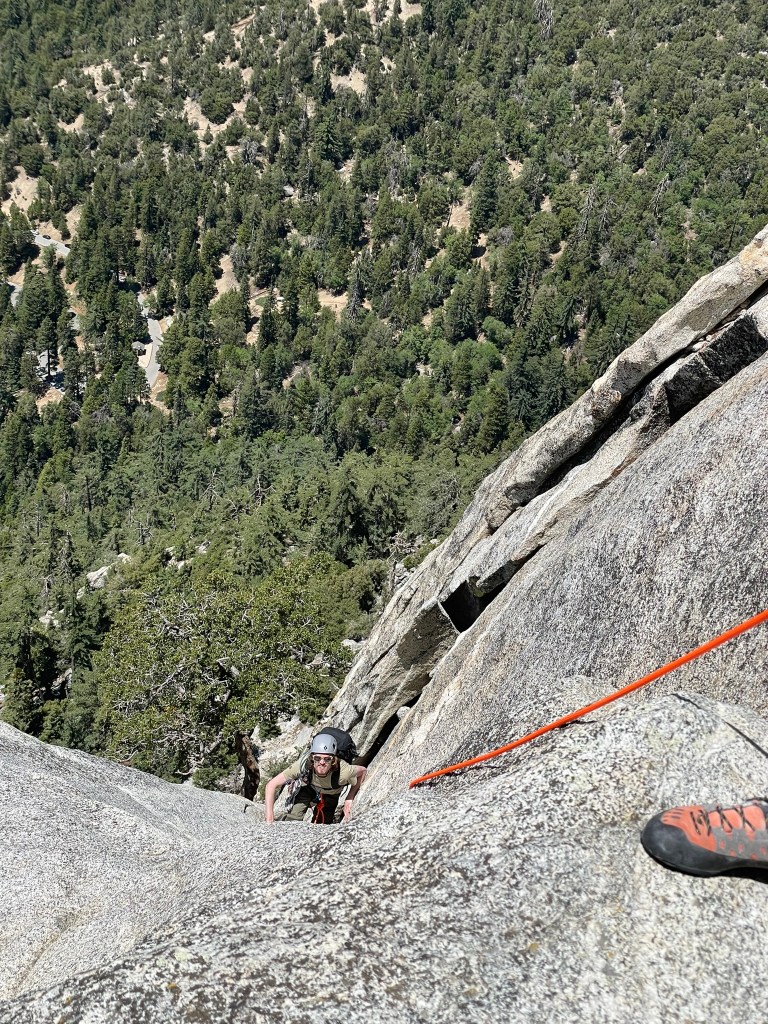
    Trevor making his way up pitch 3

    Soon enough I found myself back on the sharp end of the rope and knew that the delay from the other group was cutting into our time budget for the day. Feeling the pressure, I slowly made my way up the new pitch. The previous time we were here Trevor took quite a while to lead this, but I figured it was all 5.4 and I could cruise past. Turns out it definitely warranted the longer effort. The crux of the route was a bulge with few holds and an insecure mantle. There was a single piton for protection, but it was below the mantle above and I did not want it to trust it for a fall. As I explored options, my legs shook below me and I knew I needed to maintain composure. Matt and Trevor were belaying below and had a good line of sight on me getting through this section. Slowly I pulled out a small cam and placed it above me in a small seam. I considered pulling on it to get through the crux, but instead tried to hover over it as I brought my right foot up high. Carefully I committed to the step and finally got over the mantle. It didn’t feel very clean, but I was glad to have made it through the worst of the lead for the day. I was feeling relieved for the rest of the pitch and got a few more fun moves before the finish. One was a layback on a flake to get past a mini bulge while the other was an easy but exposed roof to finish off the pitch. I shared the belay with the other group, who were considering climbing ‘Piton Pooper’ to the left of us when I found that I had over-cammed and lost a #1 red C4. This was a bit sad, but I shrugged it off and soon after both Matt & Trevor arrived for the final pitch.

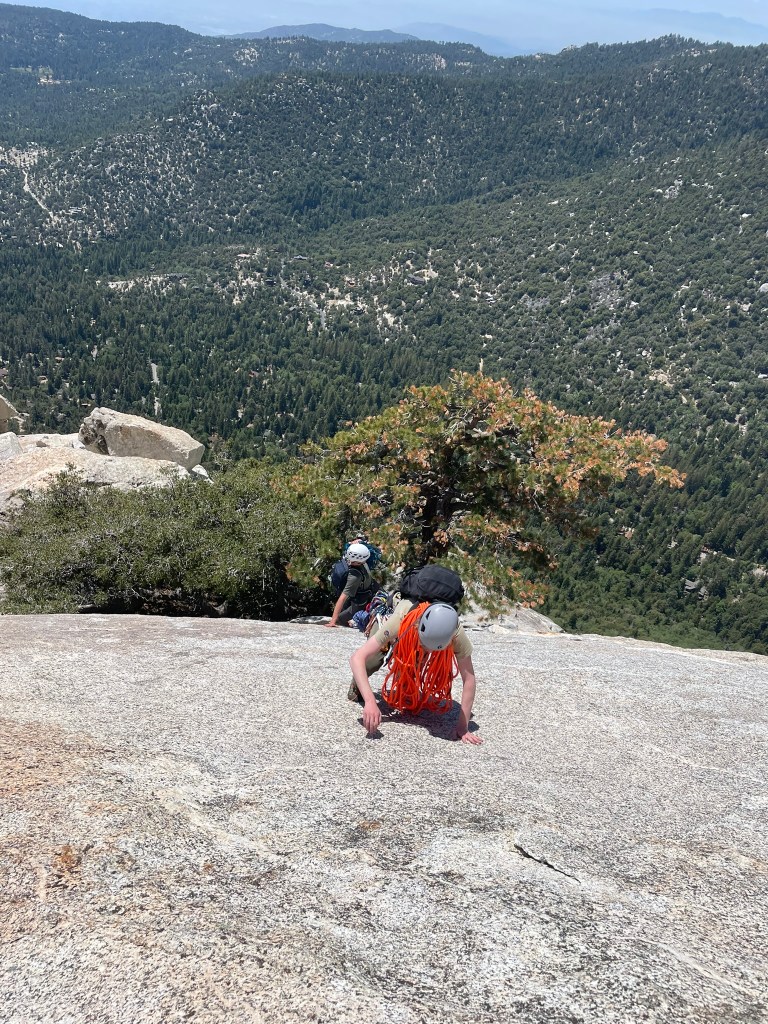
    Smearing up the class 3 slab at the top of the trough

    For timing reasons, I also lead the last pitch up the Trough. This was the easiest of the three but also the longest. I cruised past most of it, being careful to not loose any more gear and to climb a little smoother than before. This part was a great bonus for me and I even linked the last mini pitch to save some extra time. After making an easy anchor on a large tree near the summit, I delegated TR belaying to Matt and took a mini break for myself. We were coming up on our allotted time for the day so I tried to hope for the best and focus on making an efficient exit. Trevor quickly followed and we summitted right after a mini slab finish. At this point we briefly celebrated at the top and finally got to change out of our climbing shoes for the friction descent. This part was pretty straightforward and we blitzed for the exit to Lunch rock and the steep climbing path below. Before I knew it we were back to the car for our most efficient day at Tahquitz yet. Opting to skip any meal on the way, we quickly drove right to LAX in hopes of making my flight. On the way we were feeling great and thinking about the week ahead. Soon we would all be making our way to the Sierra for a true test of our endurance and climbing skillset. Both days out so far combined would not even match the total vertical feet climbed or distance traveled for the planned linkup. I felt ready to take it on, but also had to idea what we were getting ourselves into at the time. For the story of our epic adventure up Mt. Russel’s East Ridge, Mt. Whitney’s Mountaineering Route, and the last summit tag of Mt. Muir, I would recommend reading Trevor’s account: https://tbondi.wordpress.com/2025/06/20/triple-14er-russell-whitney-and-muir-in-a-day/

    The famous ‘Open Book’ route, 5.9, as seen on the descent
  • Volcano Season – Baker & Lassen

    Volcano Season – Baker & Lassen

    As winter turned to spring I had one last big ski trip on my mind. Backcountry skiing takes a lifetime to master and if I ever wanted to venture out of the Sierras and into bigger terrain I’d have to keep on learning each year. For this season, my obsession was with camping and climbing on the glaciers of the Pacific Northwest. Massive piles of snow slowly accumulate on these high latitude peaks and eventually form ice sheets hundreds of feet thick. When combined with a huge prominence above the valley floor, many of the peaks within the Cascade Range form glaciers. And for the average climber they generally require some intermediate snow camp on the way up. Unlocking this skill set opens up a huge amount of terrain all across the world. The Canadian Rockies, European Alps, and the Alaskan ranges are just a few examples of this and all come with their own unique challenge. For this trip I had my eyes on Mt. Baker: a 10,000 ft volcano north of Seattle known for its big glaciers and incredibly good skiing. Luckily enough, two of my good skiing friends Meredith and Ryan were also residents of Bellingham nearby and graciously offered their place as a retreat for the weekend. All that was left was to put together the final crew, find a guide, and prepare for an epic adventure on Mt. Baker.

    The Thunder Glacier resting between Colfax and Thunder peaks

    Turns out this trip would be a big logistical challenge to organize. Glaciated ski mountaineering is a super niche activity. Most of my friends could either handle backcountry skiing or climbing with ropes and natural protection. Meredith and her friend Sof fit the first bill, they were local to the area and great skiers both in and out of bounds. But they were less familiar with building anchors, tying knots, and operating in big alpine terrain. On the other hand my two LA friends both had a good amount of alpine trad experience, but had not been backcountry skiing much at all. So to plan the trip I had to bridge this gap and take on some responsibility that the trip would still go smoothly. First off I wound up hiring a guide. This is something I generally try not to do both for the cost and the adventure of finding my own way. But in this scenario we had a full group willing to split the cost and we’d be getting our money’s worth. With our own guide we could tailor the experience to what we were looking for: maximizing our experience on Mt. Baker, learning how to traverse glaciers, how to preform crevasse rescues, and how to camp in harsh environments on snow. Normally pre-set courses will do this over 3-4 days and cover most of the technical skills in town with accessible snow banks in leu of real crevasses. Instead if we came in prepared, we could skip this intro and try to summit for real while also getting trained on the glacier proper. Eventually we agreed on spending 3 days on the mountain. The first day we’d climb up the North side of the mountain adjacent to the Coleman Glacier to set up camp. Depending on the weather, the next two days would be spent learning crevasse rescues, attempting a summit push, and descending back to the trailhead. All that was left to do was prepare and make sure the whole group was ready to take on a huge amount of learning and climbing in a relatively short amount of time.

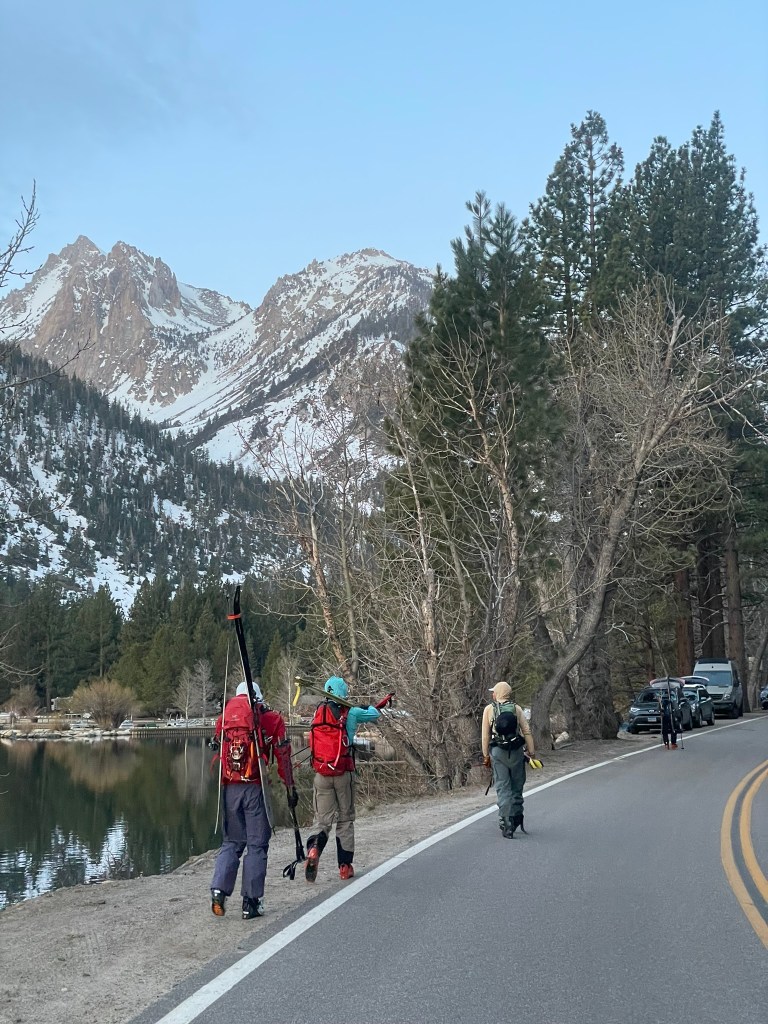
    Tanner, myself, and Trevor on our practice touring mission to June Lake

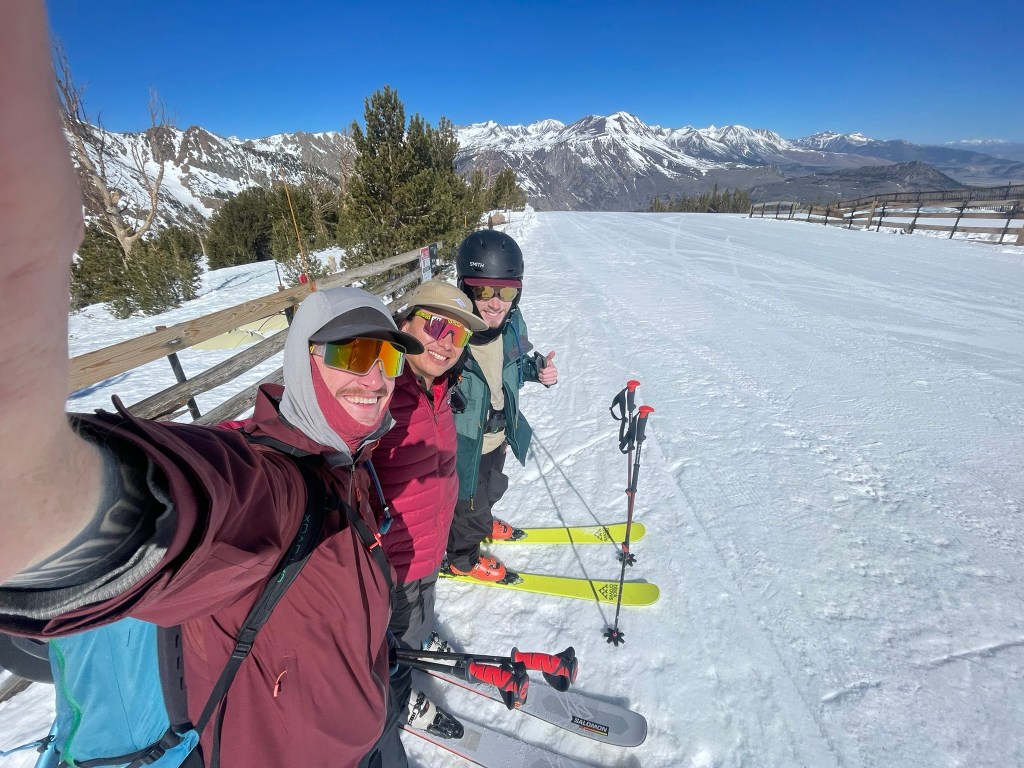
    In the months prior, I worked on getting both groups ready for the challenge. Trevor and Tanner were my LA friends with less experience ski touring, and I promised them at least one tour together to flush out their legs. In April we pulled the trigger and drove out to Mammoth Lakes for a weekend of skiing. We wound up spending that Saturday touring in the June Lake side country, one of the more scenic areas of the Eastern Sierra (See https://maxhalk.com/2025/04/26/25-spring-touring/ for more). Although we had some challenges on the way up and down, we all felt pretty good about the trip and agreed we were ready for the real thing. Meredith and Sof had the opposite problem and we made up for their lack of experience in rope skills with some good old fashion zoom calls. We had a list of pre-requisite knots and I bribed the whole group to learn them with confidence with the promise of some candy bars I’d haul up to the summit. Before I knew it, April turned to May and we were only a few days out from the trip. At this point I had put in way more work planning than I had expected, but knew it’d pay off with a hopefully smooth travel up the glacier.

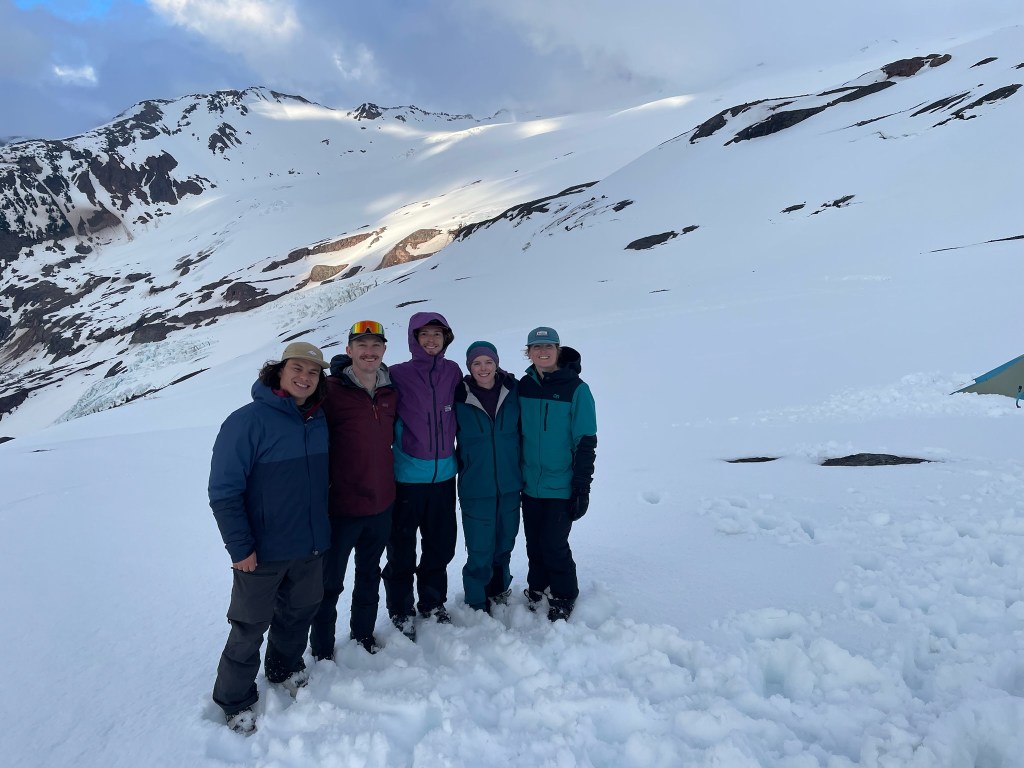
    From left to right: myself, Tanner, Trevor, Meredith, and Sof having made it to camp

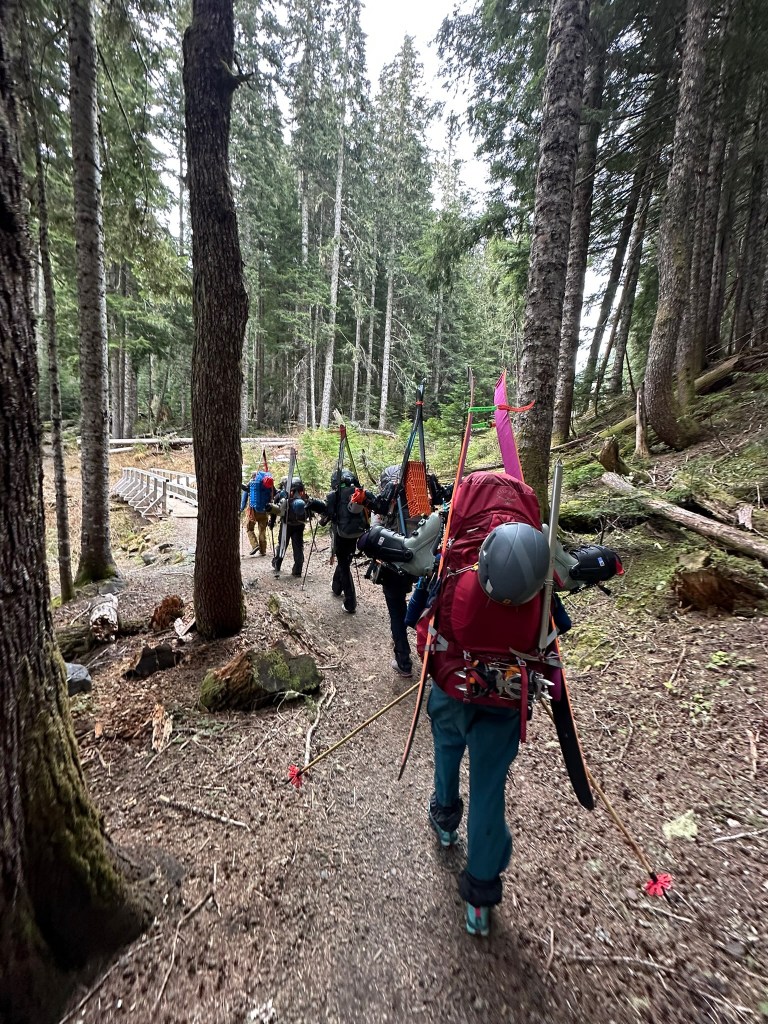
    Trevor, Tanner, and I flew out to Seattle on the next Friday afternoon and made the two hour drive to Bellingham to meet Meredith and Sof. There we had a great dinner thanks to Ryan and threw our gear into a big pile in their downstairs basement. Packing took forever and we made a stop in typical fashion to the nearest mountaineering store for good measure. The next morning we’d wake up early again to meet our guide John at the local climbing shop. Thankfully we had time to pull out all of our gear and repack, which helped me feel better about remembering all of our gear and that I had the lightest pack possible. With overnight gear, ropes, and skis we would all be carrying around 60 pounds to and from camp on the glacier. Putting the whole bag together looked a big ridiculous and putting it on back was taxing and bad for my balance. But this was not surprising for our objective and we hastily left for the trailhead. That day the weather was quite gloomy, the valley was clear but the alpine terrain was masked in a thick shield of clouds. This is typical for the area, which is a sort of temperate rainforest in the tree line and below. We knew that climbing towards the tree line would most likely bring rain and snow.

    Setting off for the Heliotrope trailhead

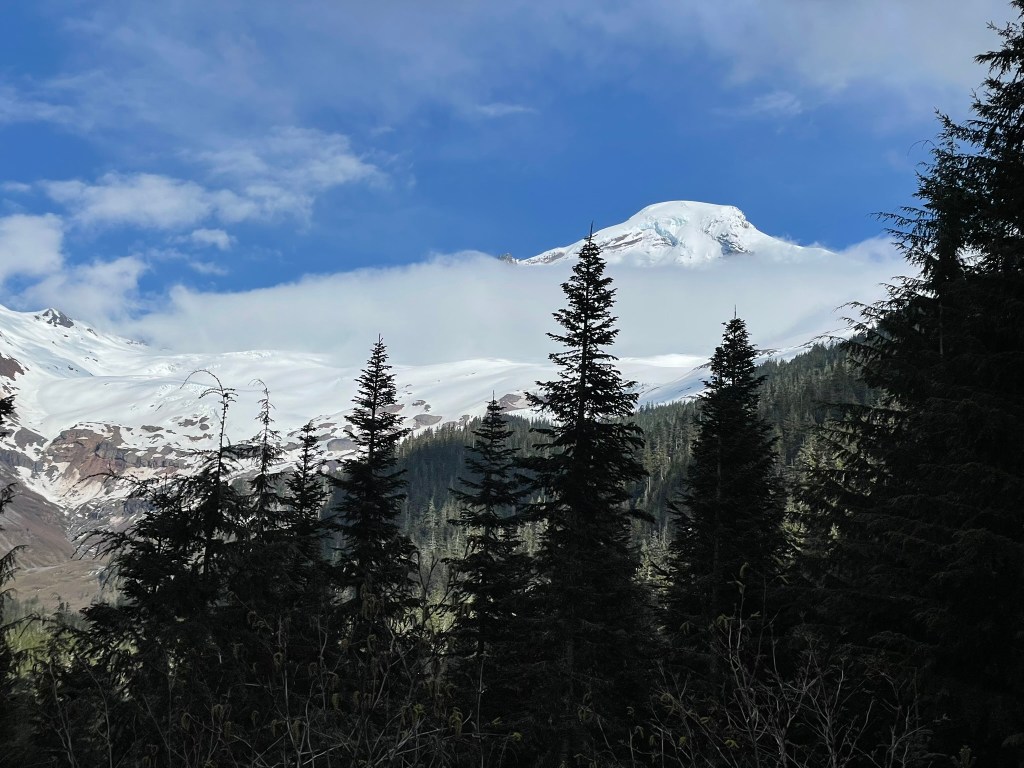
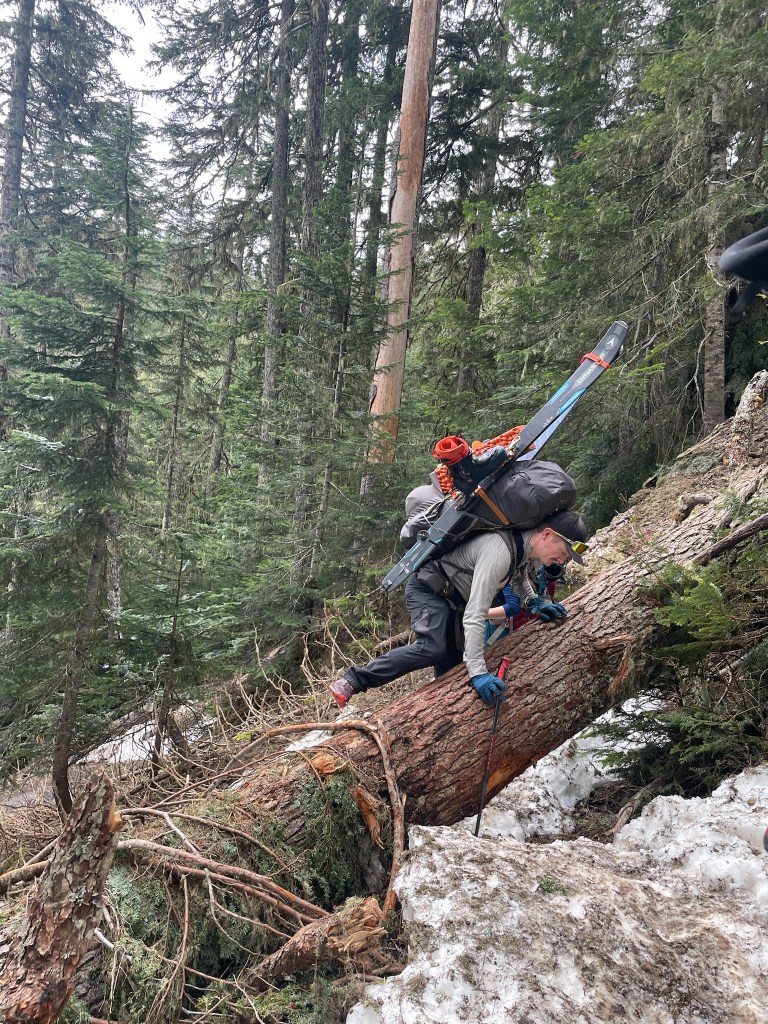
    It wasn’t long after we arrived that we set off for the Heliotrope trailhead, which would deliver us into the alpine. The trail itself was well maintained and beautiful. The trees were covered with thick and vibrant green moss while the rivers rushed with peak snow melt. After a few miles we saw the first bits of snow, which looked like mini glaciers of their own tucked into the bottom of gullies and riverbeds. We cross some of these rivers and snow patches still in our hiking boots before eventually making it to the first region of continuous snow. It was also raining at this point and I could feel my shoes and outer layers progressively getting soaked in. In total we were only climbing maybe 2500 ft that day and the majority of this was not on skis. Finally transitioning to skinning and taking them off our backs was a big relief. My pack was still heavy, but zig-zagging up the next gully on skis felt way more efficient and got me excited for what was ahead. A few more kick turns up the gully later and we could see some other climbers making their descent down the ridge above. Once we got there ourselves the whole environment dramatically changed. What was a sheltered and snowy forest was now an immense and rugged alpine environment. To our left was the Coleman Glacier, which was littered with crevasses and ended in an imposing icefall that shattered into the drainage below. Above us was the summit of Mt. Baker, shrouded in a thick set of clouds that rained and snowed down on us still. Every once in a while we’d get a new portal through the clouds and see some other vast expanse of rock and ice. Before I knew it were had gained the ridge and were ready to set up our camp for the weekend.

    A river crossing on the trail
    Practicing some awkward and exposed climbing

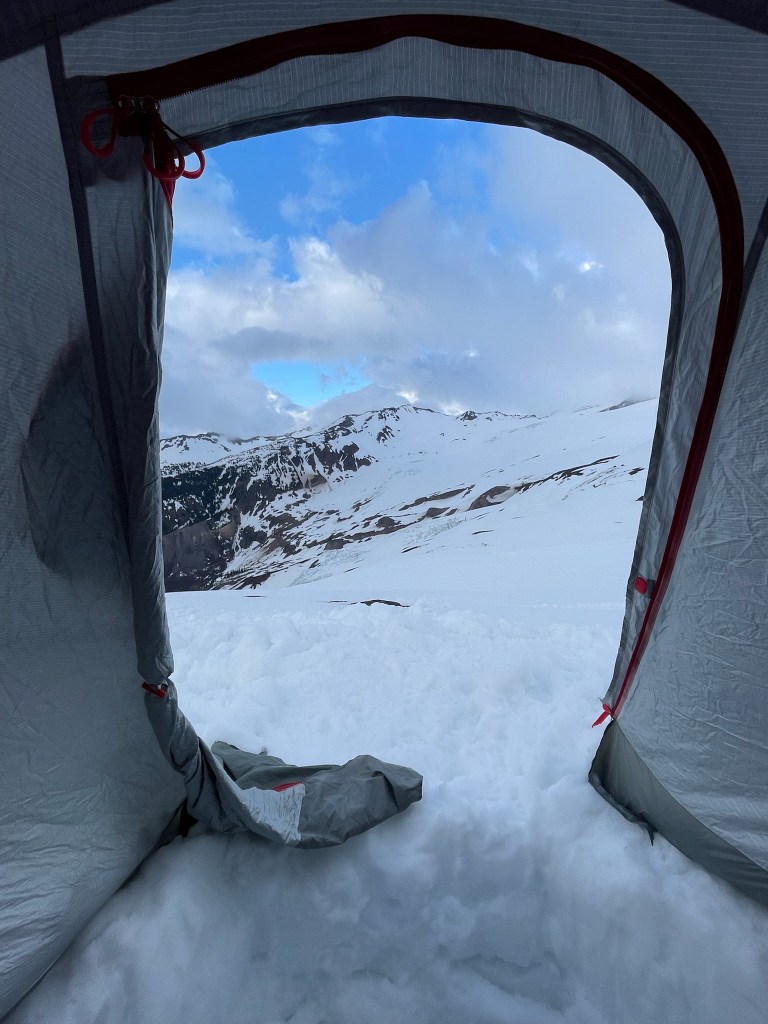
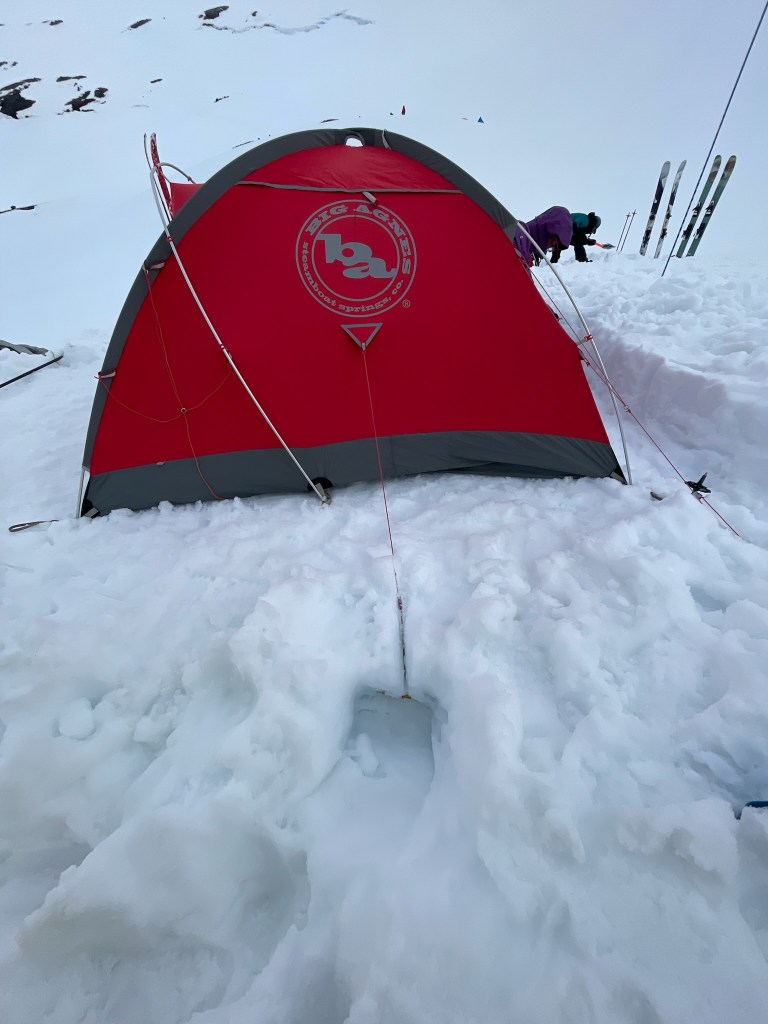
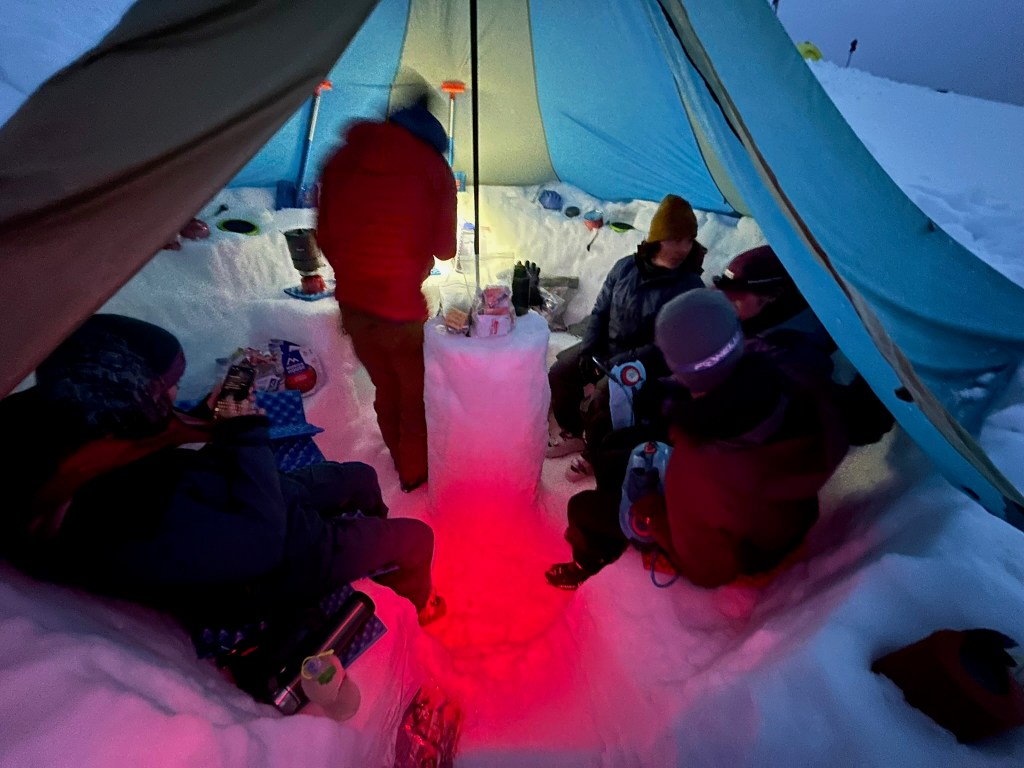
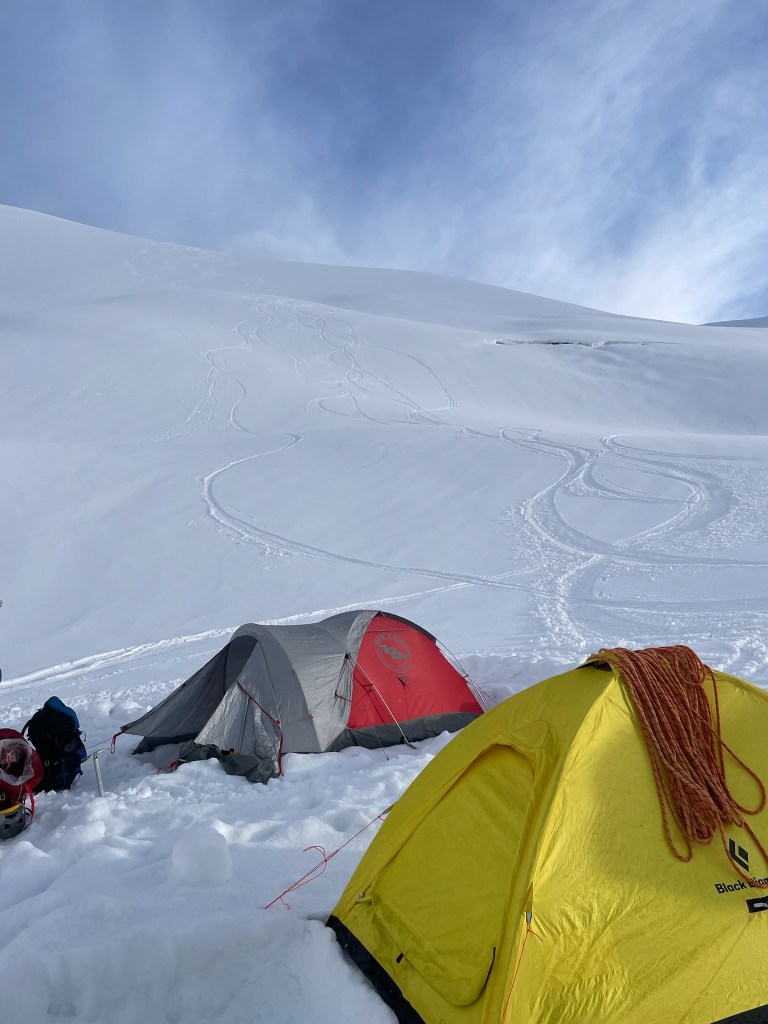
    Snow camping is difficult. It requires setting up a space that you can comfortably eat and sleep regardless of the surrounding conditions. It was also collectively our first time taking this on. Our guide John quickly put us to work digging out some flat platforms for our tents to start. We carefully mapped out an area a little bigger than our tent, dug snow out from one higher end, and plopped it onto the adjacent lower end for proper flattening Next we pulled out the tents and carefully staked in 10 guidewires by digging some deadman anchors (basically a trench for the stakes that was then filled in with snow to prevent them from moving. The rainfly for the tent also extended a few feet from its entrance, so for extra comfort we also dug that section out as a ‘garage’ perfect for booting up in the morning. These were all great skills to learn, but took forever to get right and felt like endless digging in the snow. The last thing on the list for that evening was to set up the kitchen for the weekend. This was a separate communal space meant to shelter the six of us in one location, cook meals, and eat in comfort. John pulled out the ‘mid’ for this, which was a pyramid shaped tent with one central pole to keep the thing up. This was the most fun part of camp building, as we constructed an elaborate kitchen consisting of an entrance staircase, a circular bench for seating, a countertop for cooking, and a central pillar for the sole tent pole. It took another hour or two to construct, but when we were finished we could relax and cook dinner in luxury. Evening had come at this point and we were all famished from the long hike up and crazy amount of digging for camp. But our reward was awesome: dinner with friends and a view of the ridge circling the Coleman Glacier. It was a pretty surreal camping site and probably my favorite to date. That night we chatted about what might happen the following day. The original plan was to spend it learning the ropes and jumping in crevasses, but the weather was not exactly cooperating. It is inherently difficult to judge what would come, but Meredith could check every once in a while on her Garmin inReach and saw we might have our best chance for a summit push the next morning. I was pretty excited at that point and made my way to bed for an early rise.

    A pretty sweet view from camp, featuring the ‘garage’ pit below
    Tent stake deadman anchor pre-burial
    Cozied up in the kitchen while John operates the stoves

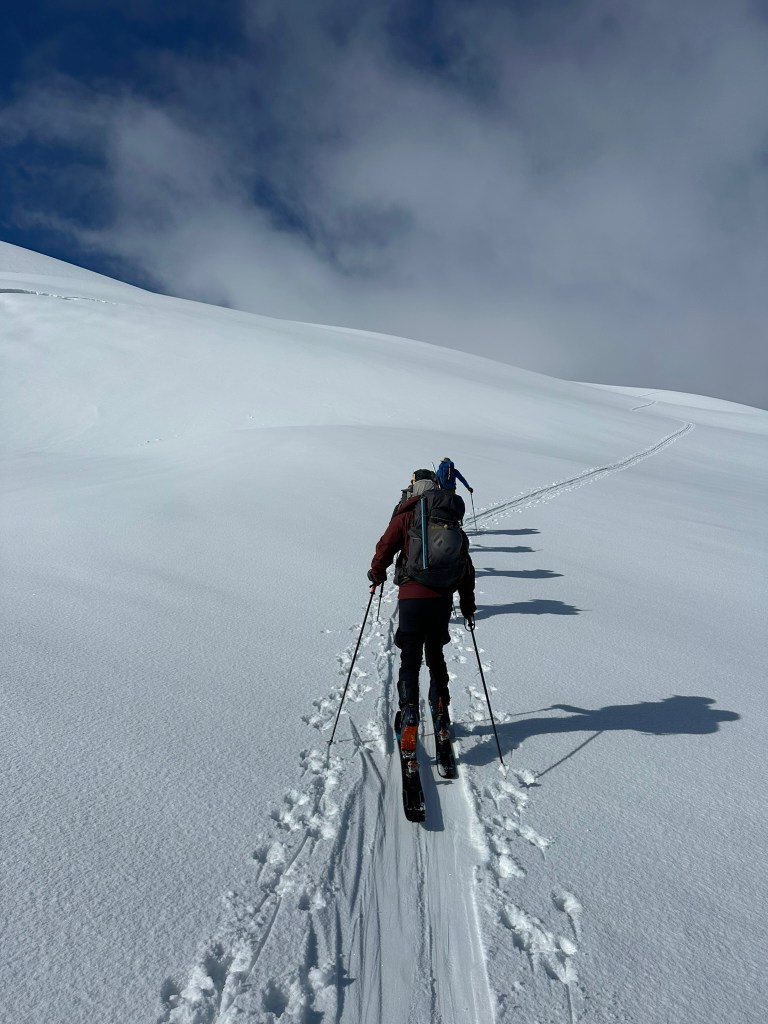
    Soon enough I was up in the morning and begrudgingly put on some mildly wet ski boots. Luckily we had hot drinks and breakfast ready in the kitchen, which served as our mission planning headquarters for the day. We knew the weather and summit headwall conditions were both mixed, but figured it was still worth a shot. Getting to the summit would be about 5000 ft of gain, but thankfully with lighter packs. First we slowly made our way back to the ridge and set foot on the Coleman Glacier for real at its crest. On the way we learned how to identify convex and concave regions of terrain that either pose more or less risk for crevasses to form, respectively. Crevasses could be covered completely with snow and be seemingly impossible to spot. Luckily our route was mostly clear of these hidden hazards, but the risk meant potentially falling many feet into the abyss. This was part of the reason we hired a guide who knew the route well. We avoided terrain to our left, which had massive cleavers of ice that rose and sunk dramatically at the surface of the glacier. At this point we also put our harnesses on and could see the next obvious milestone: the saddle between Mt. Baker’s summit and the adjacent Colfax Peak. Looming above was the Colfax icefall, which was a Serac hundreds of feet thick that hung a thousand feet above us. We traversed quickly through this section as seracs periodically and randomly can cleave off into a massive icefall event. Luckily these are super rare, but still posed an ominous threat as we passed underneath.

    Start of the climb
    John skiing underneath the Colfax icefall

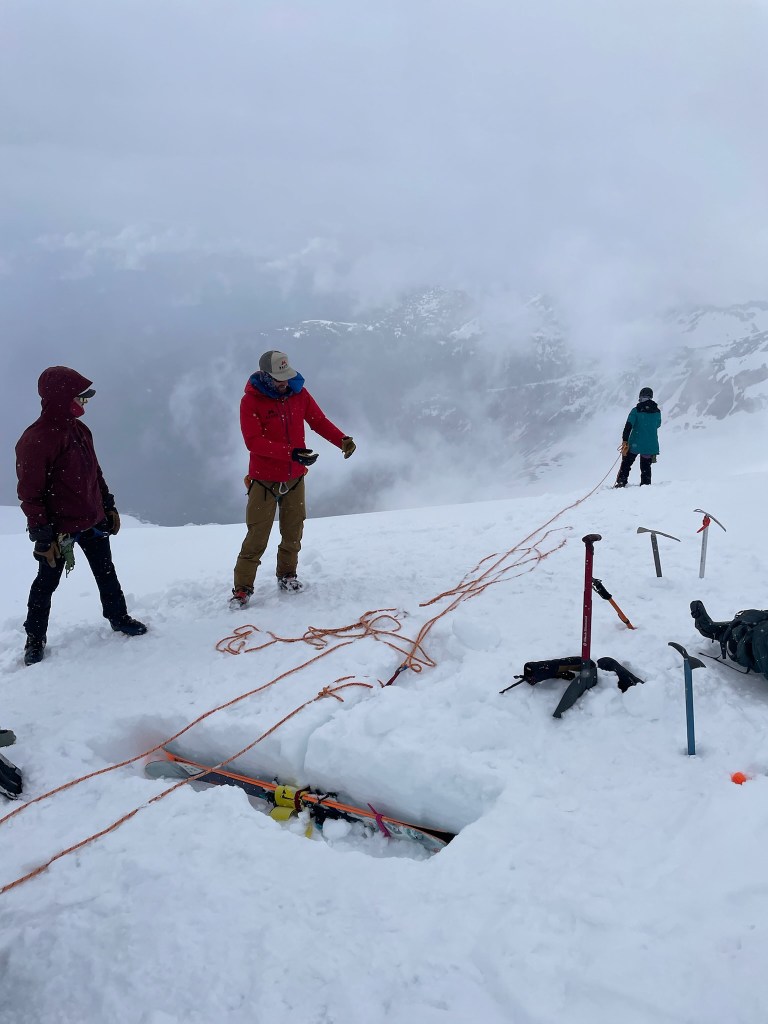
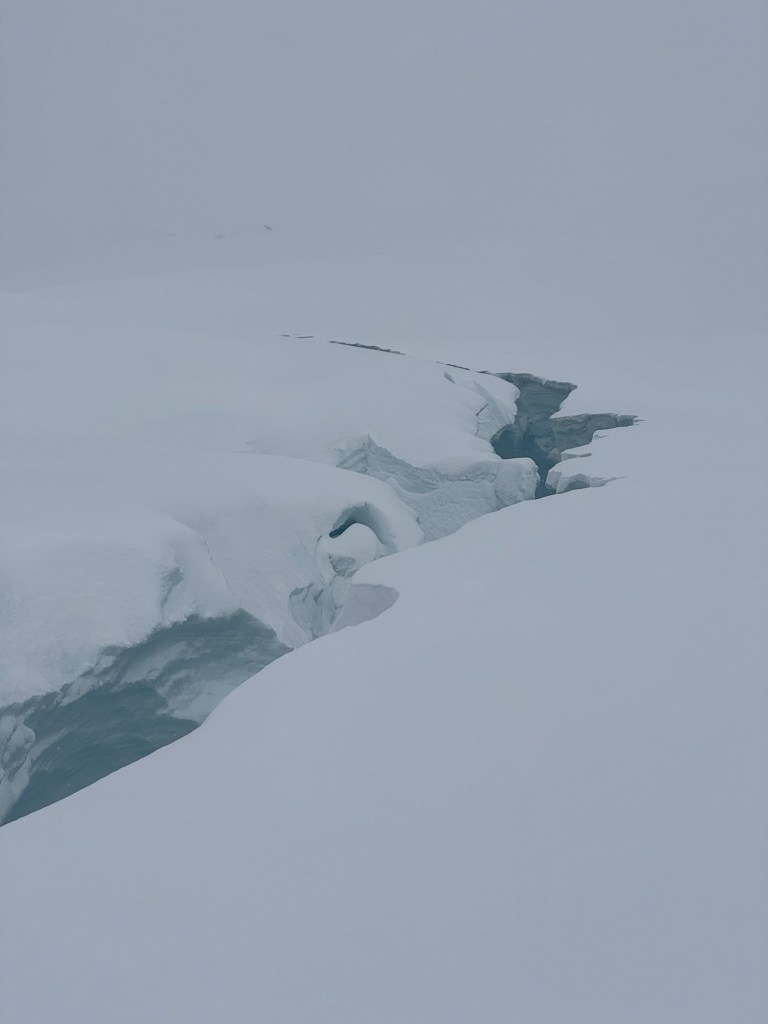
    Thankfully we cleared this section without much of an issue. The group was a bit tired and the weather was still not perfect, but the six of us made it to the col and took a much needed rest. Unfortunately this was still not our day. The summit ridge was a hardpack of variable conditions, mainly ice. Climbing us this section would require the group to be ‘short roped’ and we’d likely have to downclimb the headwall instead of skiing. Combined with the fact that this additional 1500 ft or so of elevation would put us well into the evening, we reluctantly made the call to head back down. Regardless of this decision, this meant we could ski down and spend some time learning our intended crevasse rescue for the day. We skied back down until we reached the edge of an obvious and massive crevasse to begin. Normally when traversing this type of terrain, all members of the group are tied together with a single rope. In the case that one person falls into a crevasse, the others quickly arrest the fall with an ice axe and then preform a fairly involved rescue – the goal for the day. John gave a great intro and we all demonstrated our knot skills before starting off (I delivered candy bars at this point as promised). Next we practiced building an anchor out of a pair of skis buried in the snow. This deadman anchor was the same style of support as our tent stakes from before and served as a central secure point to haul someone out of a crevasse safely. Next up came some complex rope management which allows one of us to safely check on the victim, prepare a safe edge of the crevasse wall for rope to pass through, and finally set up a rigging system of pulleys that create enough leverage to pull someone vertically up and out of the crevasse. I’ll spare the details, but it was much more complicated than I had imagined. Preforming a practice rescue in a relatively safe situation is one thing, but doing this without a guide and in consequential terrain with lives at stake still seems incredibly daunting to me. For any future days out on a glacier I’d have to put in much more practice.

    Tanner pre-crevasse jump
    John explaining the rescue rigging system
    The crevasse we practiced with

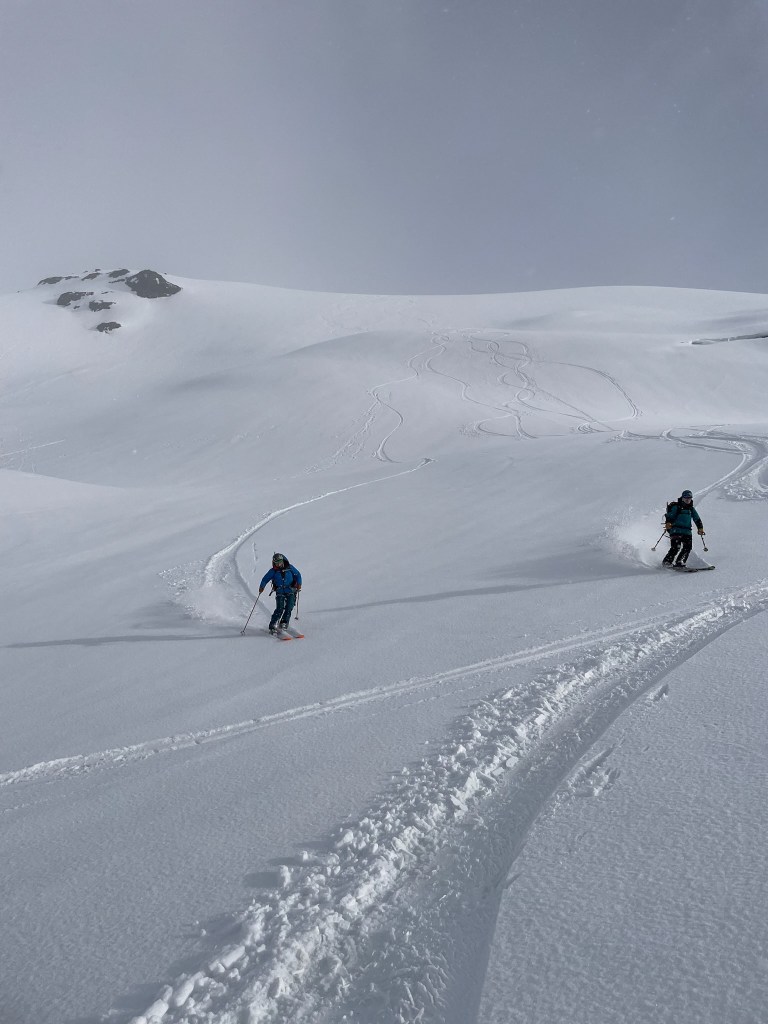
    On this day we had the luxury of doing a mock rescue, where one volunteer would step off and into the crevasse. Tanner was the guinea pig, while myself and Trevor stood ready to catch him with our axes. John gave the signal and he awkwardly sunk into the abyss while Trevor and I leapt to the ground and dug in. Catching a fall was not as bad as I expected, but the aftermath seemed impossibly difficult. The rest of the group in theory would have to construct a new deadman anchor with skis, then hook up the rope before I could get out from my position clenching the ice axe. Rigging this up and hauling Tanner out was still pretty fun, but I still could not imagine how difficult a real experience would be. At this point it was getting late in the day and we started making our way back down the glacier. Weather was surprising clearing just a little bit and this made for a pretty surreal descent. It was snowing periodically throughout the day and allowed for big arching turns down good snow. In the foreground was a spectacular view of the alpine environment and skiing down felt like we were on a different planet. Anywhere you looked were vast stretches of white with a cloud layer below. As we made it towards camp, the last thousand feet or so was prime powder and we all got a spectacular party lap right to our tents. This was the best consolation prize we could have gotten and immediately we all were thinking of a second lap. It was a little past 7 at that point, so we quickly put our skins back on and headed up the ridge once more. This was probably my favorite part of the whole trip as we got glorious views of the Thunder Glacier to our right and Mt. Baker’s summit to our left. Clouds peaked in and out until we eventually snagged some momentarily crystal clear views of the area. As we basked in the view, we quickly transitioned one last time and got ready for a second powder lap. It was about 8pm in the middle of May and here we were skiing some pristine snow with great friends right back to camp. Even though we didn’t summit, this was such a great gift for an otherwise uncertain weekend.

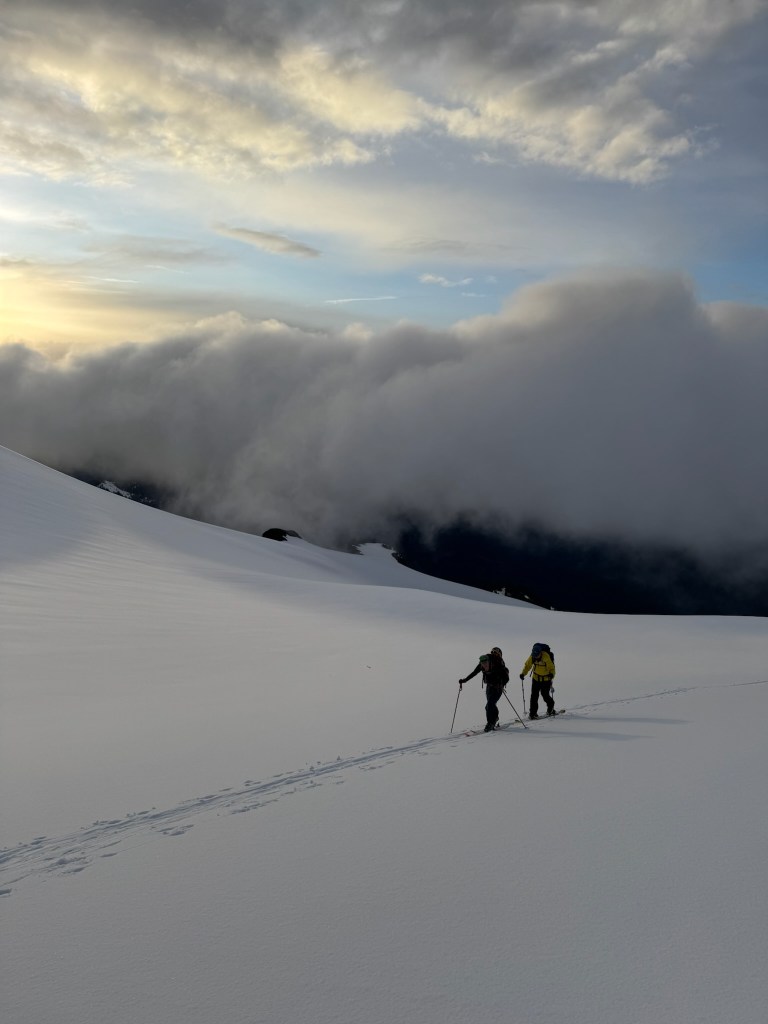
    Meredith and Sof skinning up above the clouds
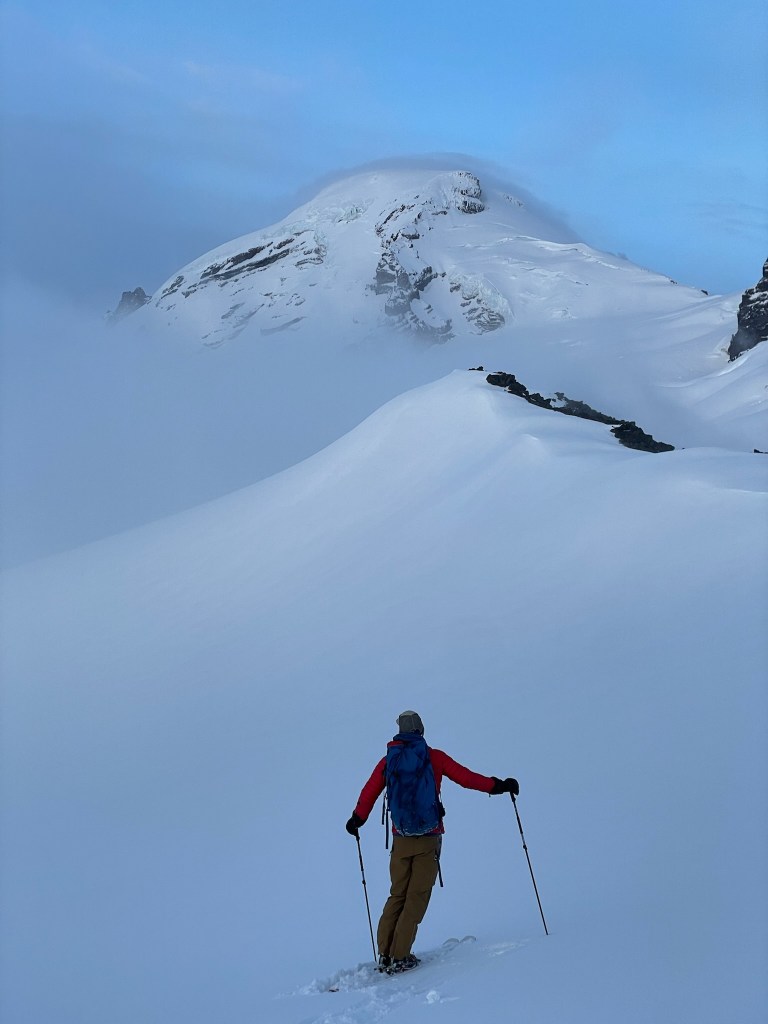
    A glorious view of Mt. Baker with John in the foreground
    Powder, at 8pm, in mid May

    That night we chatted about the highs and lows of the day while munching on our dinner at the kitchen. We didn’t think the summit was a great option for the next day either, so instead we opted for another round of rescue practice and an afternoon exit to the trailhead. The next day we did exactly that and this time Meredith opted to experience the leap into the crevasse. It was pretty rare to get to practice on a real glacier in this fashion, so we all appreciated the second chance to hone in our skills. This time we made quick work of the rescue as we only had until about 2pm to make it back to camp. This time we also got some good turns in on the way down before starting to pack up for the day. We filled in the big kitchen holes and then awkwardly packed our loads into backpacks for the way down. Surprisingly this turned out to be one of the sketchier experiences of the weekend. Skiing down with a 50+ pound bag made for unsteady and difficult turns down the gully. I was extra careful not to hurt my knees, but knew the others in my group who were less experienced would have a tough time. Thankfully we made it down without any issues (later Sof did wind up tweaking a knee) and started back down the trail. My shoes at this point were still pretty soaked, but it was only a few miles all downhill. Before we knew it, we were all back at the trailhead in one piece. Mt. Baker stool tall above the clouds at this point and we could finally see it peaking above the trees. After distributing our gear back to John, we then made our way to a local brewery in Bellingham for some earned drinks and food. We shared stories with Ryan and Sof’s partner, who were waiting there for us to return. All of us were stoked from the experience and glad to be back to civilization. Trevor, Tanner, and myself would fly out the next morning so afterwards we headed back to their house for an early sleep.

    Last turns in front of camp before heading out
    Our group at the highpoint of the weekend, the Colfax-Baker Col

    The whole experience learning about glaciers, snow camping, and rescue on Baker was all I could have asked for. We got more than we bargained from the skiing even if the summit would have to wait for another year. We also all clicked as a group and made some great memories for years to come. Sometime in the future we could take these efforts to bigger mountains and expand the envelope for adventures on skis. For this year, I was mostly done with volcano skiing. Except for the fact that about a month later I had the opportunity for a blitz trek to Lassen peak near the Bay Area. Long story short: my friend Hao and I drove out on a Friday night, slept at the trailhead, and did a lap and a half on California’s southernmost volcano all before 1 pm the next day. It was a great adventure to cap off the ski season and tick another volcano off before the next year.

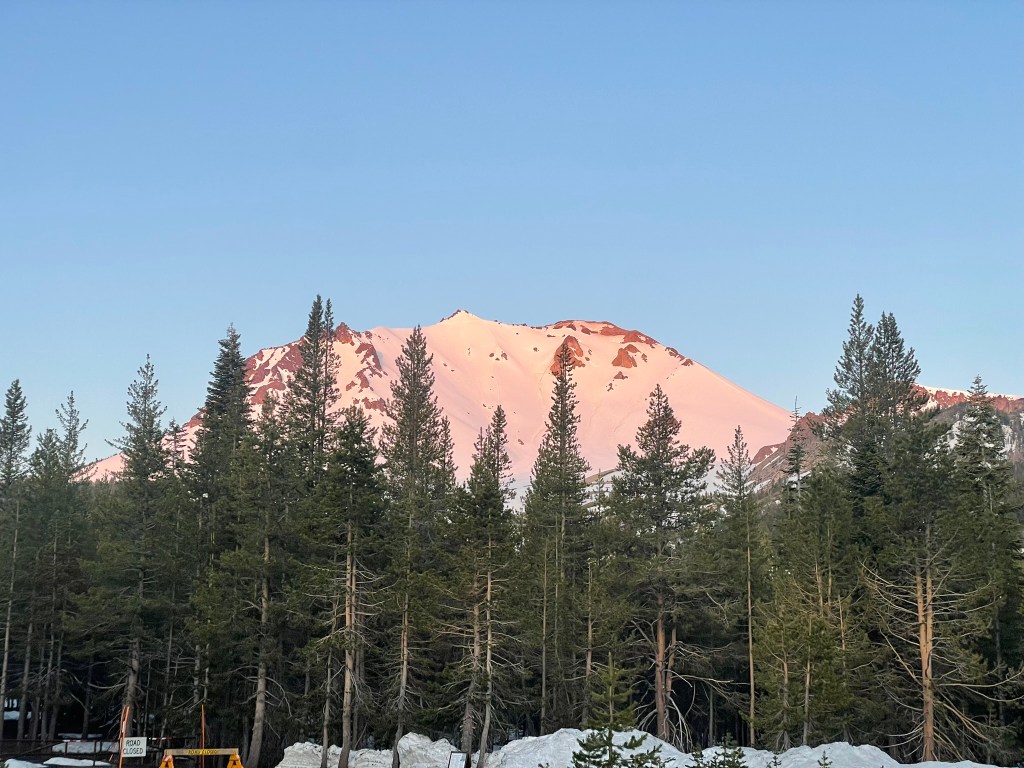
    Lassen peak basking in alpenglow
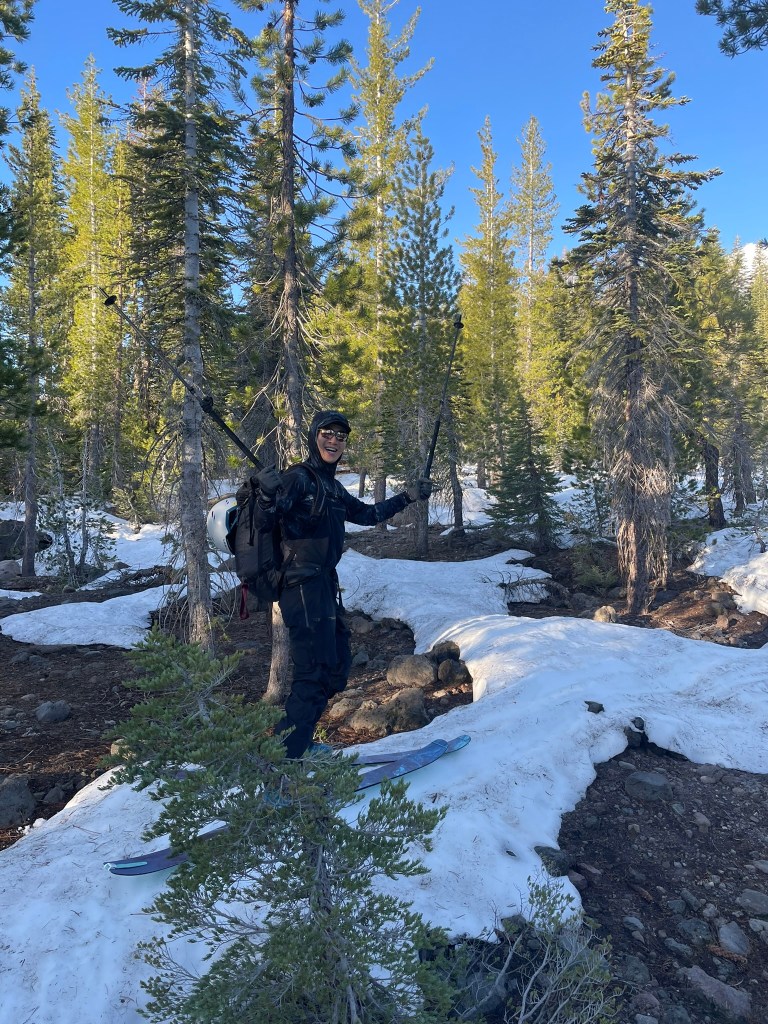
    Hao mid bushwhack
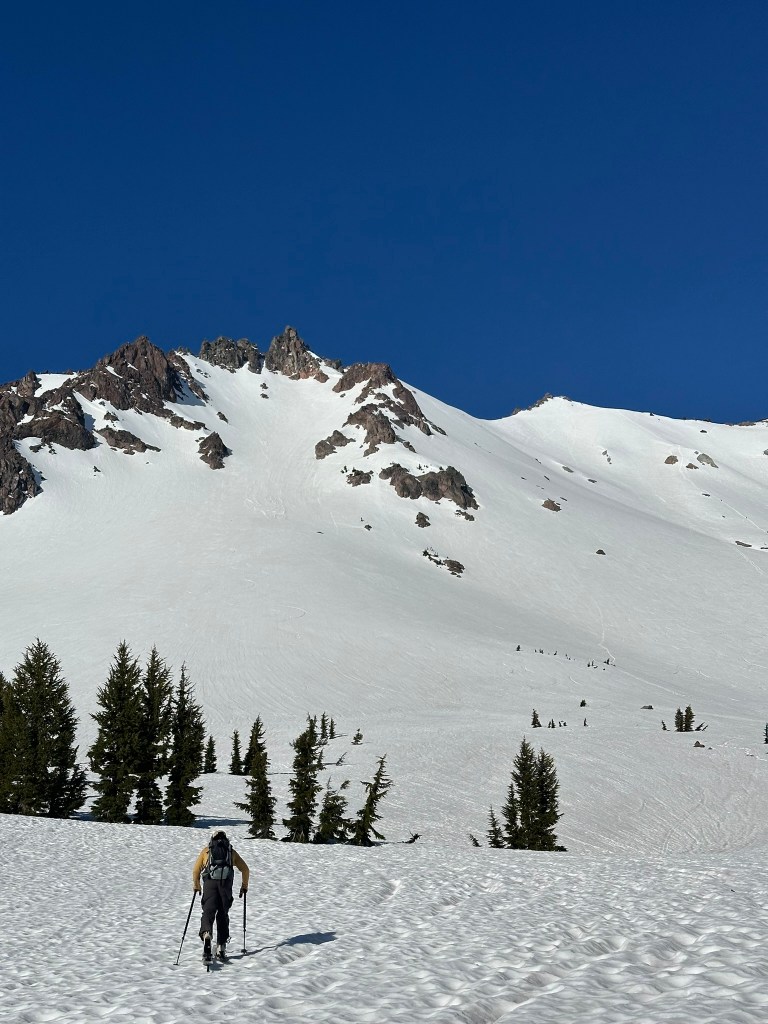
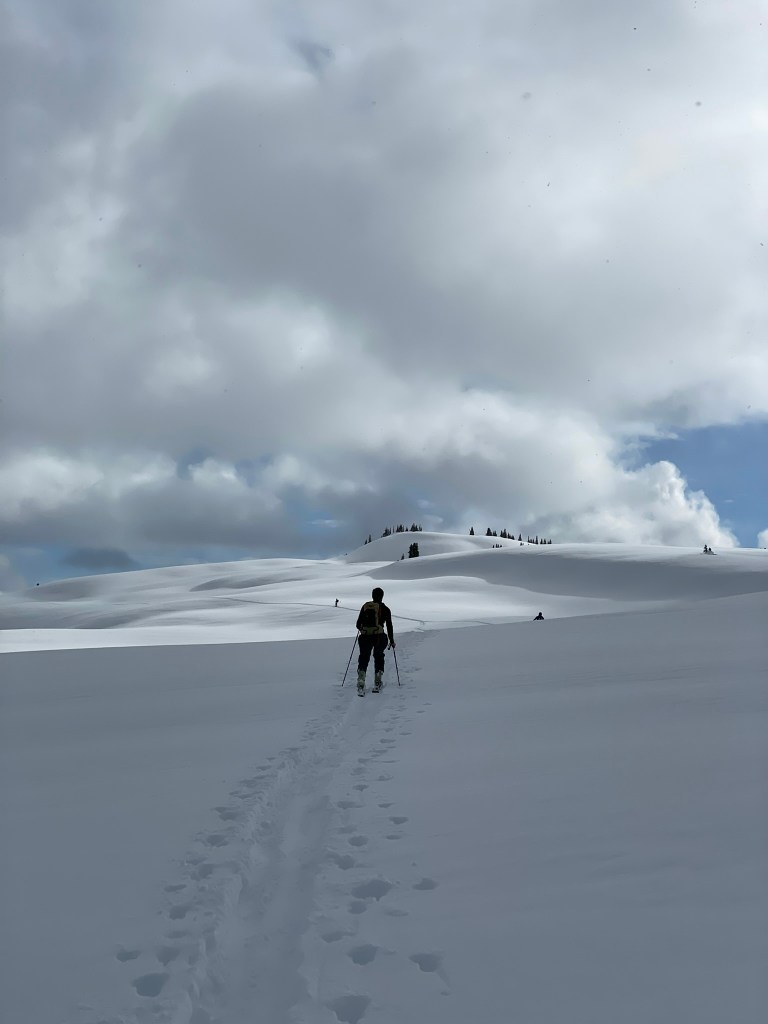
    Skinning towards Lassen
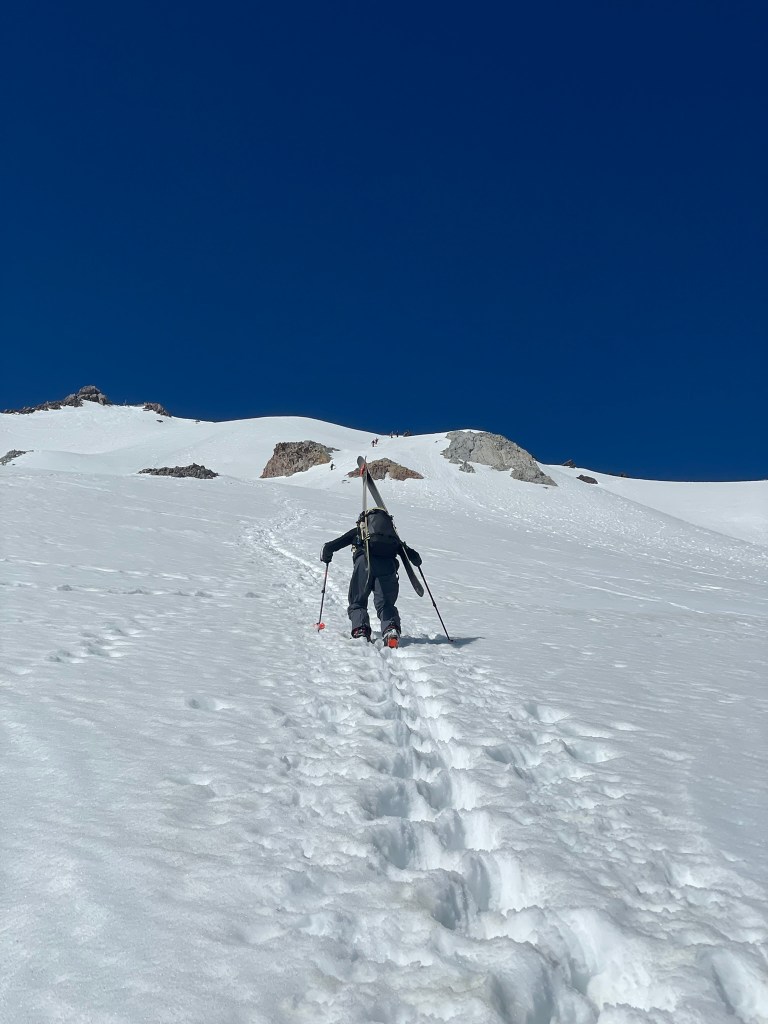
    Endless bootpack up Lassen
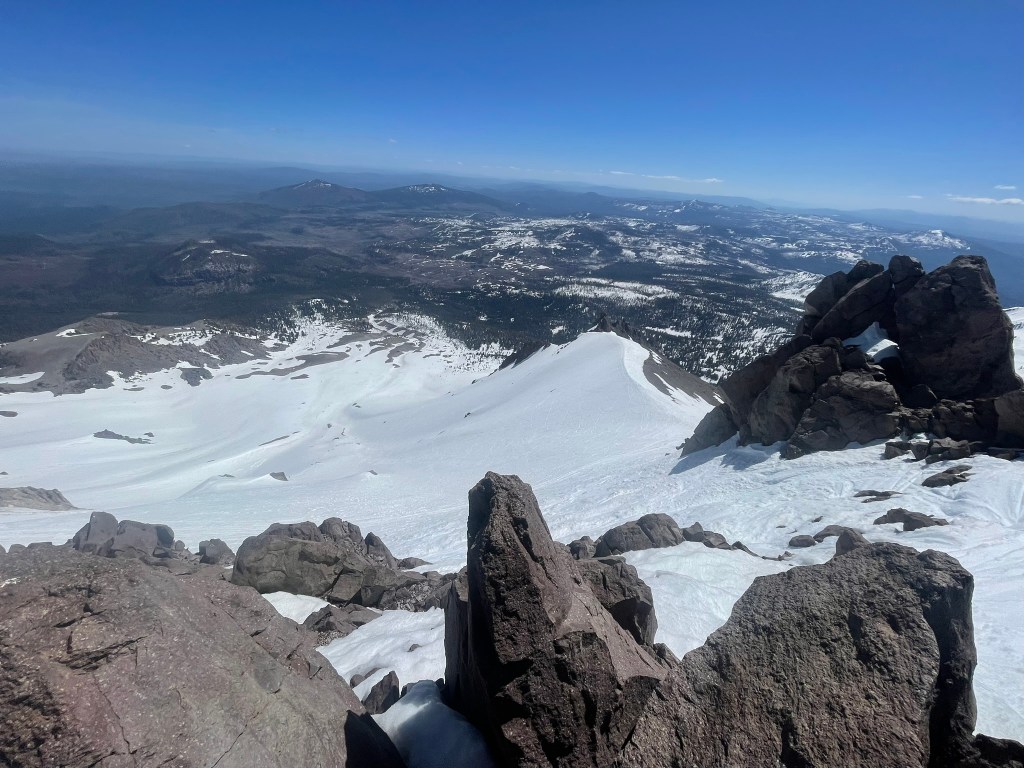
    3000 ft of corn skiing from the peak of Lassen
  • ’25 Spring Touring

    ’25 Spring Touring

    Spring is one of my favorite times of the year to ski – the weather is nicer, the days are longer, and the avalanche danger generally reduces. It’s the perfect time of the year to explore new terrain and plan bigger days out in the mountains. This particular season I was also on track to beat my overall record for total number of days skiing and was quickly approaching 50 total days. This was only possible because I had made a much bigger effort to prioritize days in the mountains than ever before. I moved to San Francisco, got a job with unlimited PTO, and joined a ski lease in Lake Tahoe with a dozen other friends from the bay. There we skied nearly every weekend in the season, and frequently made trips out to visit friends out of state when the opportunity rose. I had also just gotten back from a two week trip to Canada to ski in the Canadian Rockies and to go on my first backcountry hut trip to the Purcell Mountain Lodge. Now it was time to get out for the spring and finish out the season strong. I had bookmarked a bunch of weekends in a row for big days in new terrain and the first one on our list was my first tour in the Eastern Sierra.

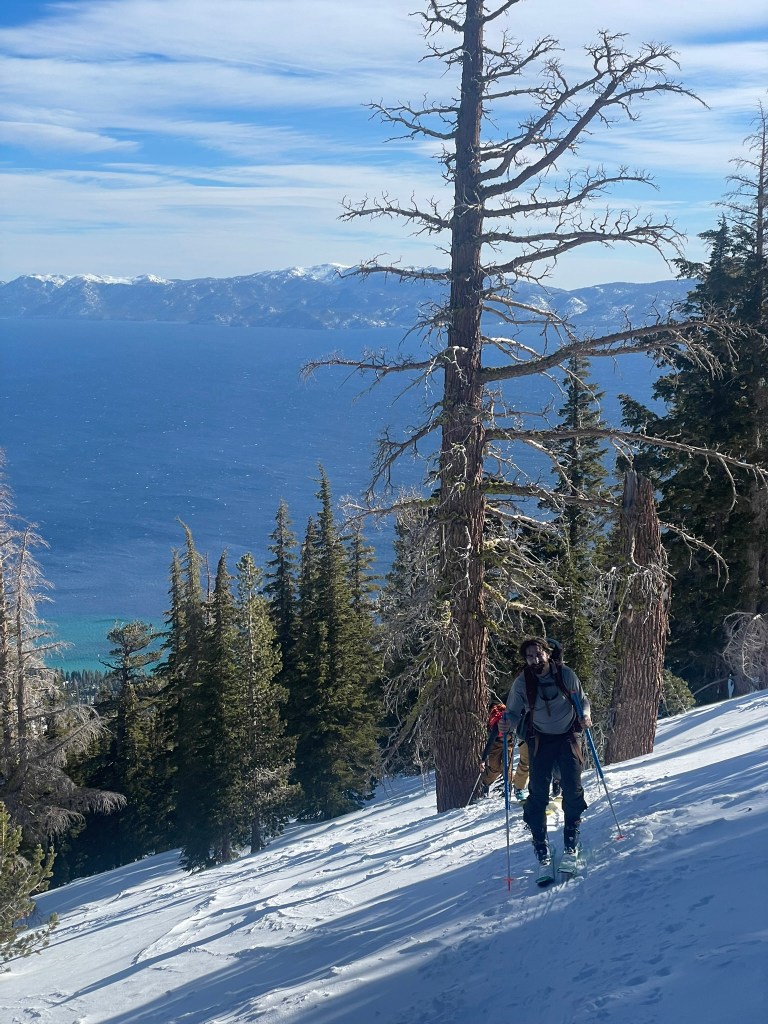
    Winter season tour at Rubikon peak with a glorious view of Lake Tahoe in the background

    Quite a bit south of Lake Tahoe lies the ‘East Side’ range, it marks the crest of the Sierra and generally lies between Bridgeport and Lone Pine. In this region are the vast majority of 14ers in California and some of my favorite destinations to camp and explore. We decided to scope out the Twin Lakes area in Bridgeport for this weekend and had a group of four all from our Canadian hut trip a few weeks prior. There were a few objectives in mind, but the night before we were still deciding whether to commit to the couloir left of the “Incredible Hulk” or to ski in the Horse creek drainage two valley’s over. Both started from the same trailhead, but we were afraid the drainage to the Incredible Hulk would be muddy and unappealing in the warm Spring conditions. After a long drive, we made it to the trailhead and camped on the road in true dirtbag fashion. In the morning, we packed our bags & ate a quick breakfast before making heading on our way at ~6 am. We wound up choosing to head towards Horse Creek and made our way with hiking boots and skis on our backs across ~1500 ft of elevation and switchbacks. Eventually we made it to the snowline and transitioned to skins. In the distance we could see both Matterhorn and Horse Creek Peak, which were both sharp granite peaks that rose high above the snowline below. Many other parties were touring that day, but nearly all were headed to the “Ski Dreams” couloir next to Matterhorn. It looked spectacular, but Horse Creek was equally cool, had less people, and was new terrain for all of us.

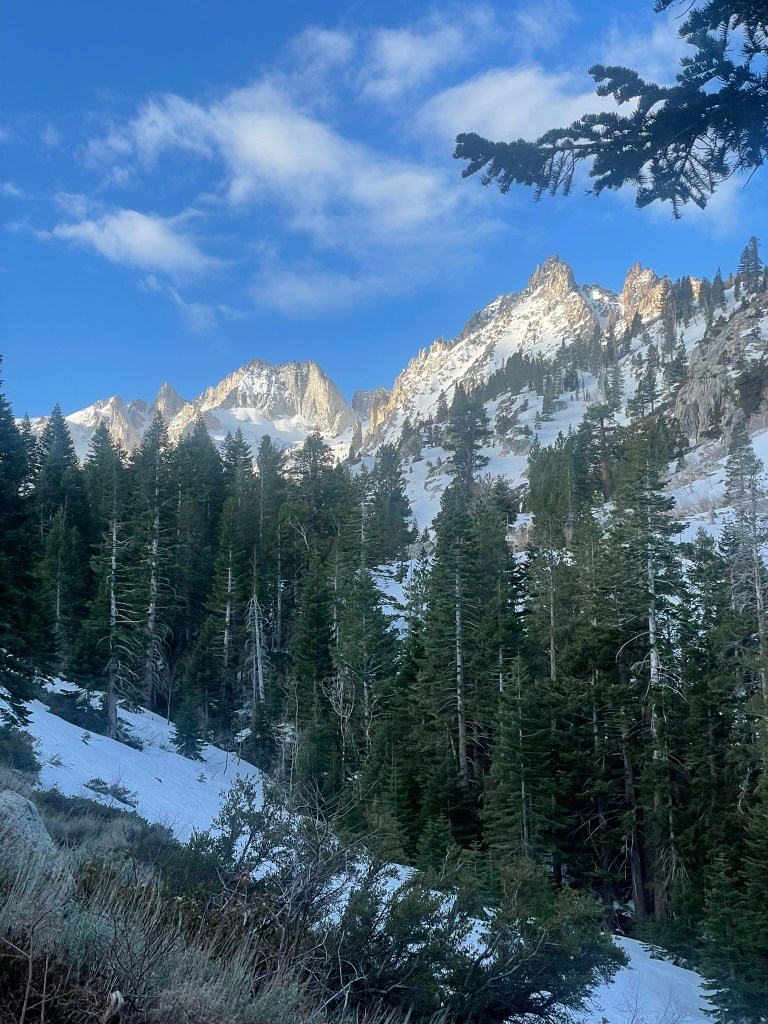
    View from the trailhead at Twin Lakes
    View of Matterhorn peak (sharp peak on the leftmost side) when approaching Horse Creek

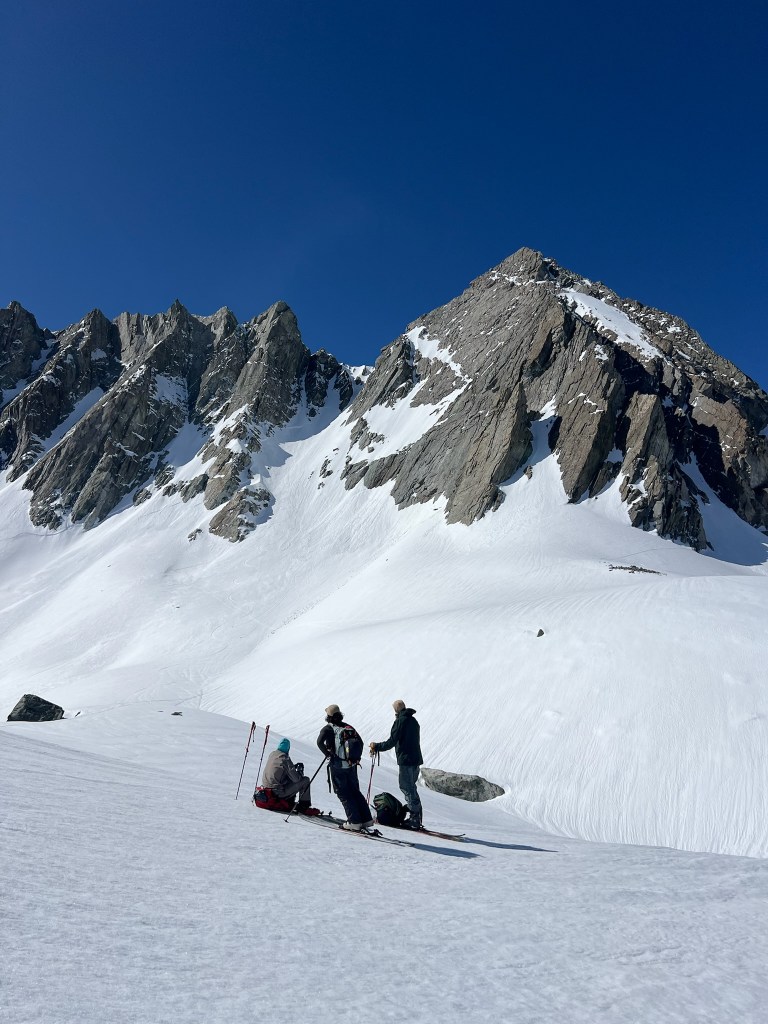
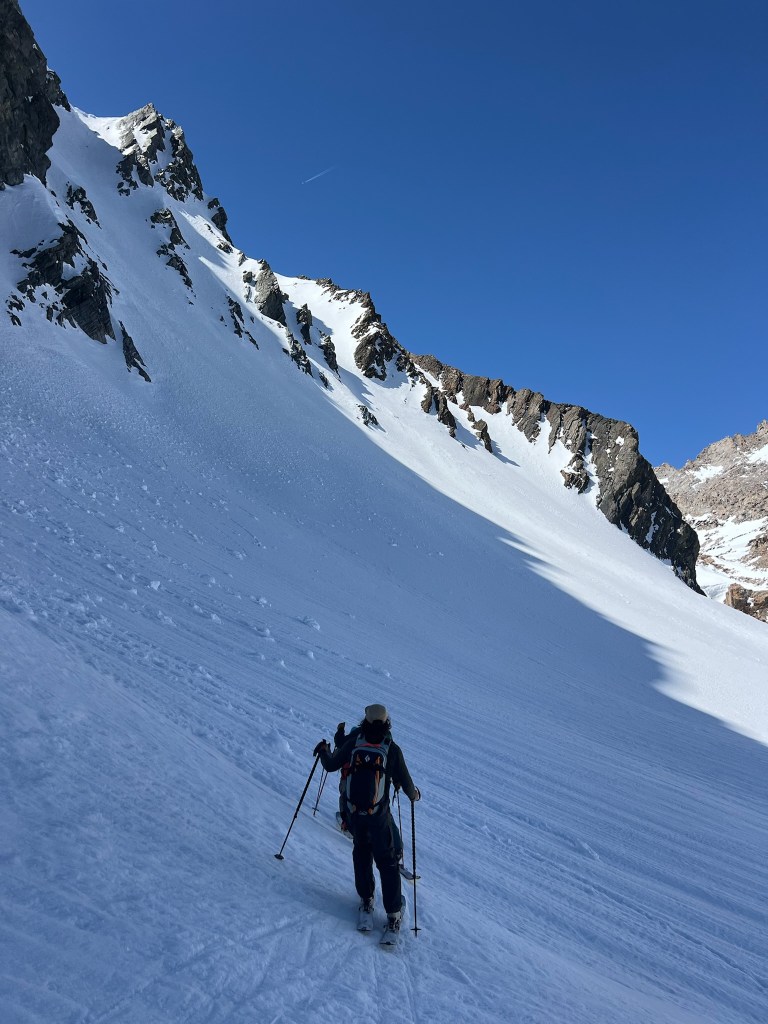
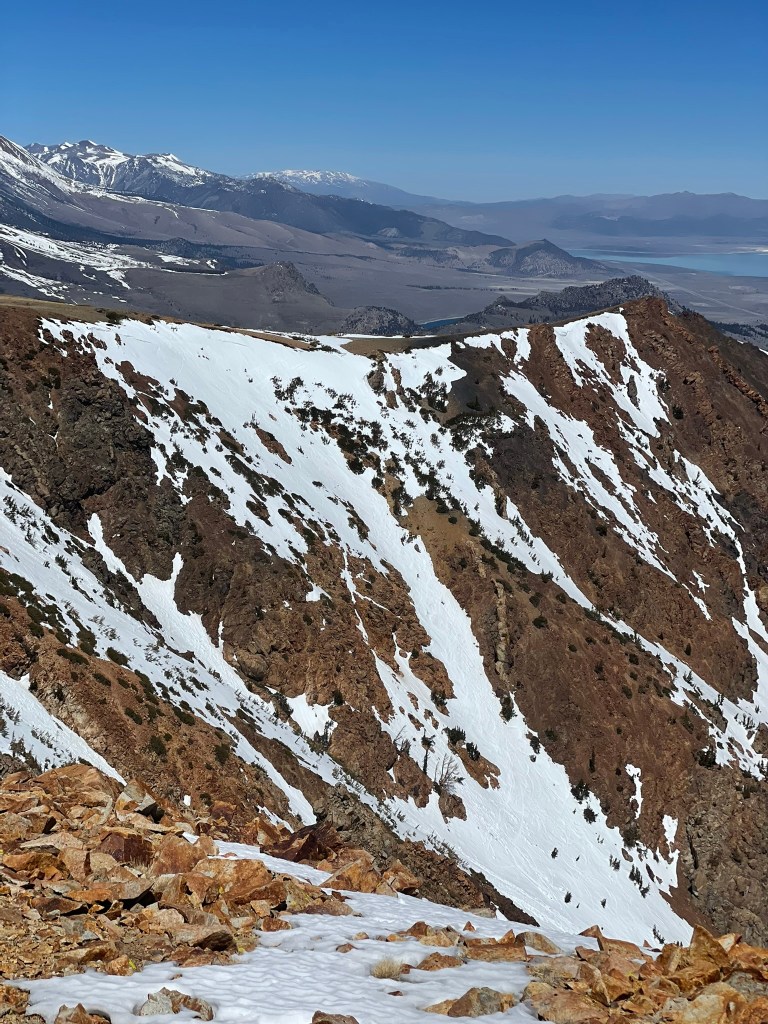
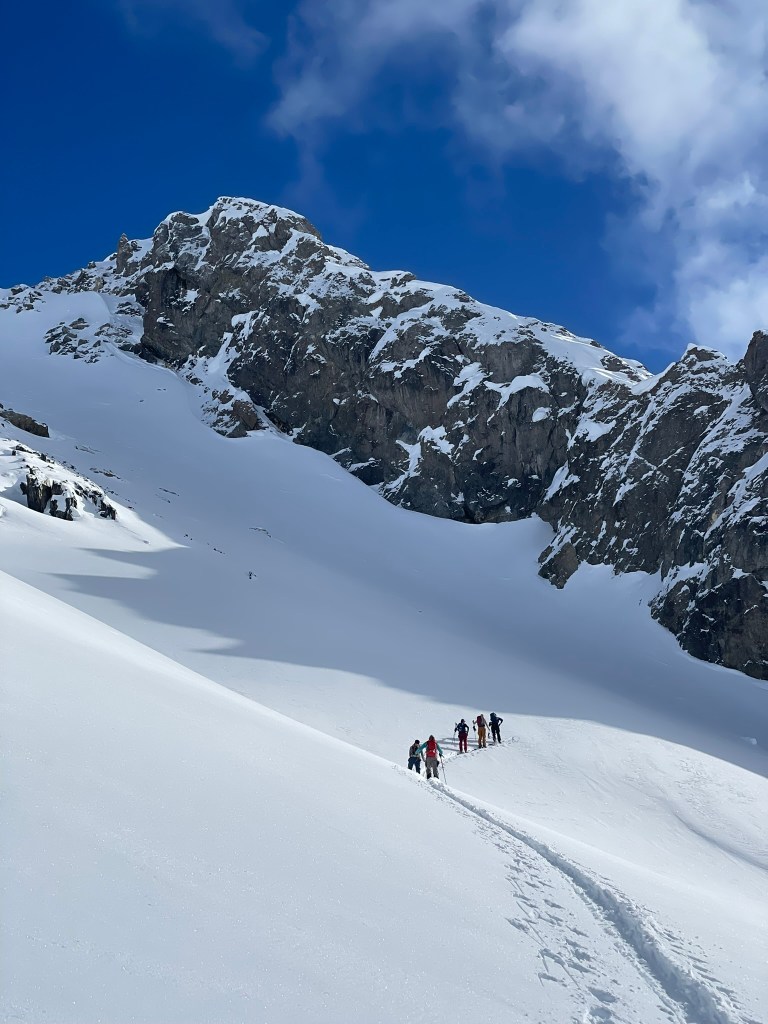
    Before we got there, we were met with two steep headwalls and a long valley before we made it to the basin of Horse Creek. We ate a quick lunch when we arrived and discussed what objective to prioritize. Two couloirs sandwiched the peak in front of us, which both looked pretty spicy. On our left was the NE couloir, which reminded me of the Big Couloir at Big Sky, MT. It definitely required two ice axes and the headwall was narrow and rocky. the NW couloir on the opposite side was definitely the more mellow of the two, so we headed that way and I secretly put the NE side on my tick list for the future. As we skinned around to the NW side, it was clear this objective was super cool. There were three chutes in total and we began to boot up a medium difficulty line. I set the bootpack and had two axes, but probably could have gotten away with just poles. We made it to the top after having climbed ~4500 ft for the day and felt great. The snow was a bit variable, but still soft enough to make good turns as long as we avoided the icer shaded sections. Regardless we had a blast skiing down and debated whether or not to make a second lap. At the time I decided to just go down, but we definitely should have gone for a second lap. The way down was still a ton of fun as the headwalls we climbed up were great for big arching turns in soft corn. Soon we were back on dirt, but spotted a sneaky patch of snow that led us nearly back to the lake trail. Overall it was a big day both in terms of milage and vert, but couldn’t have been a better start to the spring touring season. The setting was amazing, the couloir was challenging but well within our ability, and our group got along great.

    View of the NE couloir in Horse Creek Peak
    Touring towards the NW couloir at Horse Creek Peak, we opted for chute centered in this photo

    One week of work passed before I was making another 6-7 hour drive from the bay area to the Eastern Sierra. This time I was staying with two friends from LA in a Mammoth Airbnb and hoping to get some laps in for their first tour of the season. That first night we all chatted through some ideas for what to do, but ultimately decided on heading to June Lake for some sidecountry within a zone called “The Negatives”. In the past I heard June Lake is a beautiful resort and it was on the Ikon pass, so this was the perfect location for an introduction tour. We began the day aiming to get on the first chair a little before the peak chair opened, which was great for sleeping in more than usual on a day like this. Three chairs later, we made it to the top of the resort and looked north to our objective for the day. Carson & the Negatives peaks both looked amazing and had a ton of different options for the descent. We figured we could decide between them once we made some more progress towards the Negatives summit. The skin track was relatively straightforward and we were following a ton of others on the way up, but our group was a little less experienced than usual. Really this just slowed up the pace a bit and I was able to soak in the views on the way up. The tour was only ~2000 ft, so before I knew it we had reached the summit and were joined by 2-3 other parties. All the lines coming off the ridgeline looked awesome. There were clearly a lot of other skiers in the area and conditions were still prime corn, so we opted for a central line on the North face.

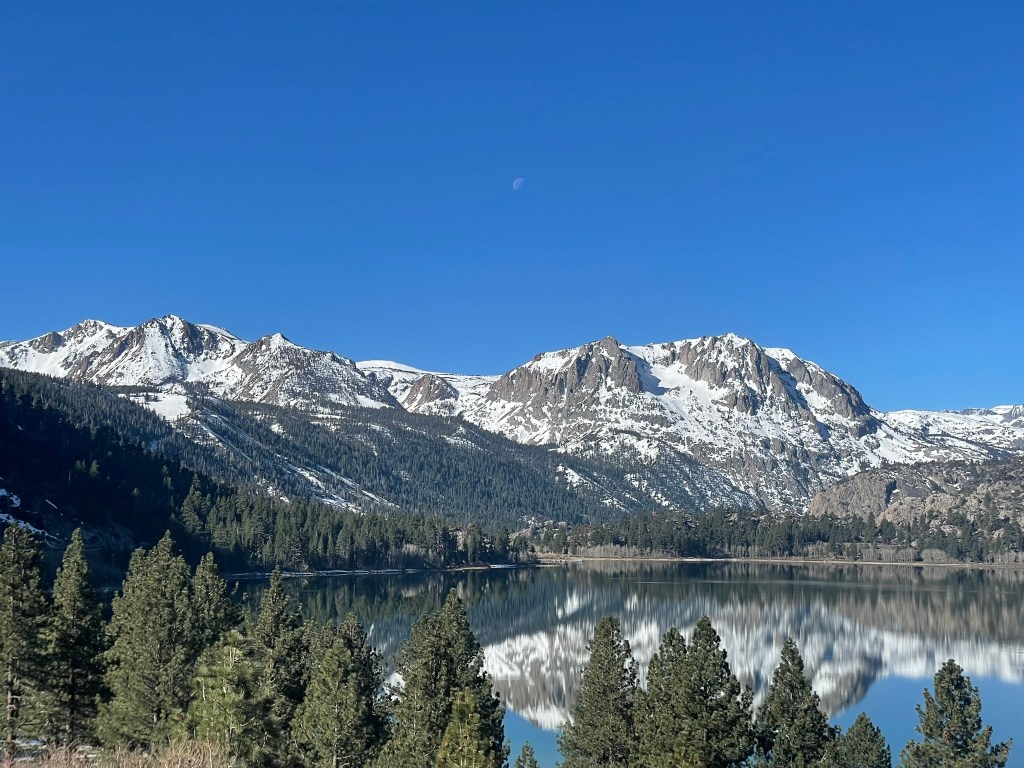
    June Lake with a view of Carson peak on the right and the Negatives on the left

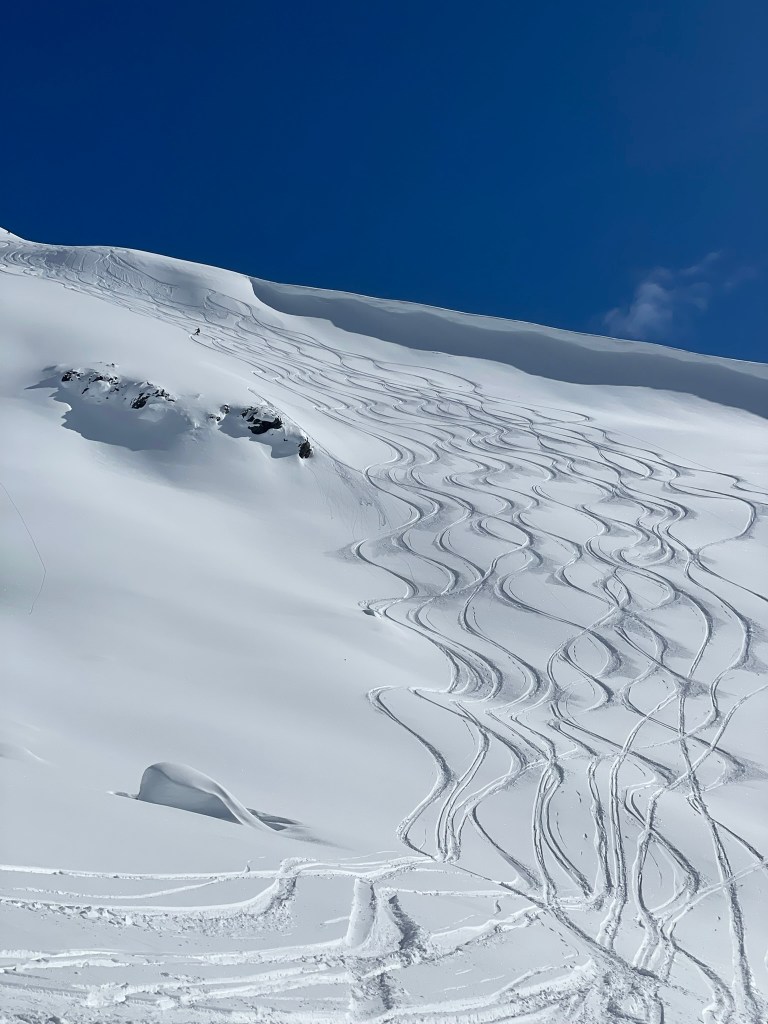
    We traversed to the start of the line and saw a glorious slope below us. There were plenty of tracks below, but the snow was soft and not bumped up at all, making for some great and playful turns on the way down. We descended in two pitches and rested briefly at the base of the slope. Again there was another 2nd lap debate, and we made the same mistake again. Opting for a single lap was the right idea, but next time I’m definitely shooting for more. Soon after we made it onto an open meadow and pointed back towards the resort. We made a hilariously bad path back by making a bunch of unnecessary course corrections along the way, but eventually made it back to the resort and skied some groomers to end the day. The line we skied was super visible at this point and it was definitely on my mind to come back to this zone for the future. However, the next day we just skied some fun inbounds laps at Mammoth resort and headed back early for the long drive home. The following week I’d be back for even more spring touring, but this time I’d be even further from home.

    Our line (N3?) within the Negatives with the desert valley in the background

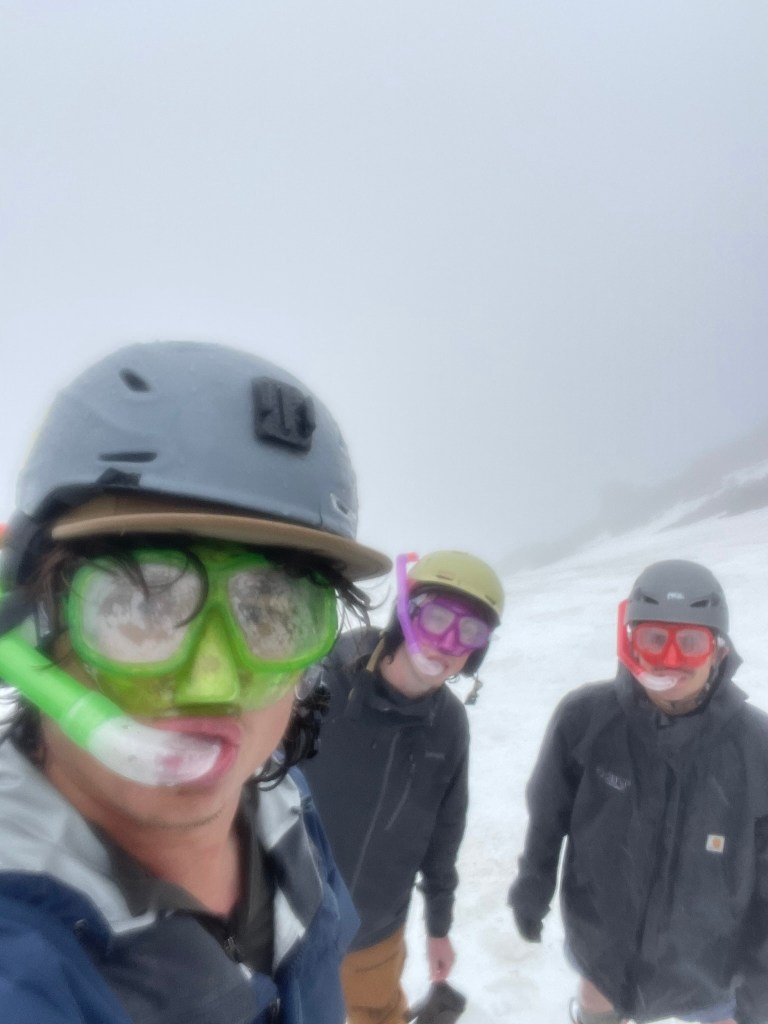
    This was the second year of my friend Devin and I’s journey to the East Coast to try and ski Mt. Washington’s Tuckerman’s Ravine. We both went to school in Boston, so there was a well timed reunion in the spring and a good excuse to make an adventure out of the trip. We had originally planned on staying at a friend’s cabin in Franconia with a big crew, but many bailed and we wound up skiing with a trio and still snagging the cabin. So after a long redeye flight across the country, I woke up in Boston and began the drive over to Tucks with Devin & Stink. It went relatively quick, but when we arrived we somewhat hilariously learned of a bachelorette party nearby and had to make a brief appearance. Somewhat unsurprisingly, we also learned that the next day would be pretty bad conditions for skiing: warm weather and rain. The third of our group, Stink, had come from Colorado and was puzzled as to why we still wanted to ski. But Devin and I were hardened from an East Coast upbringing and were unphased. We even bought some dollar store snorkeling gear to help us breath in the rain and give us some good energy for the following day.

    Devin looking pensive at the base of Tuckerman’s Ravine

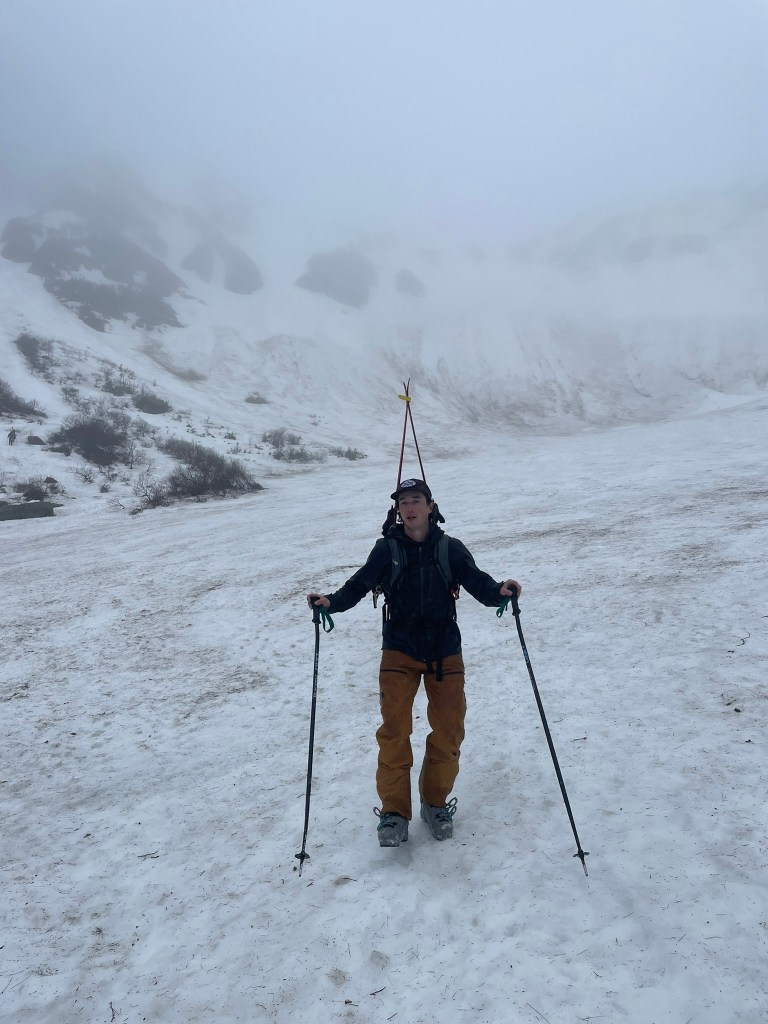
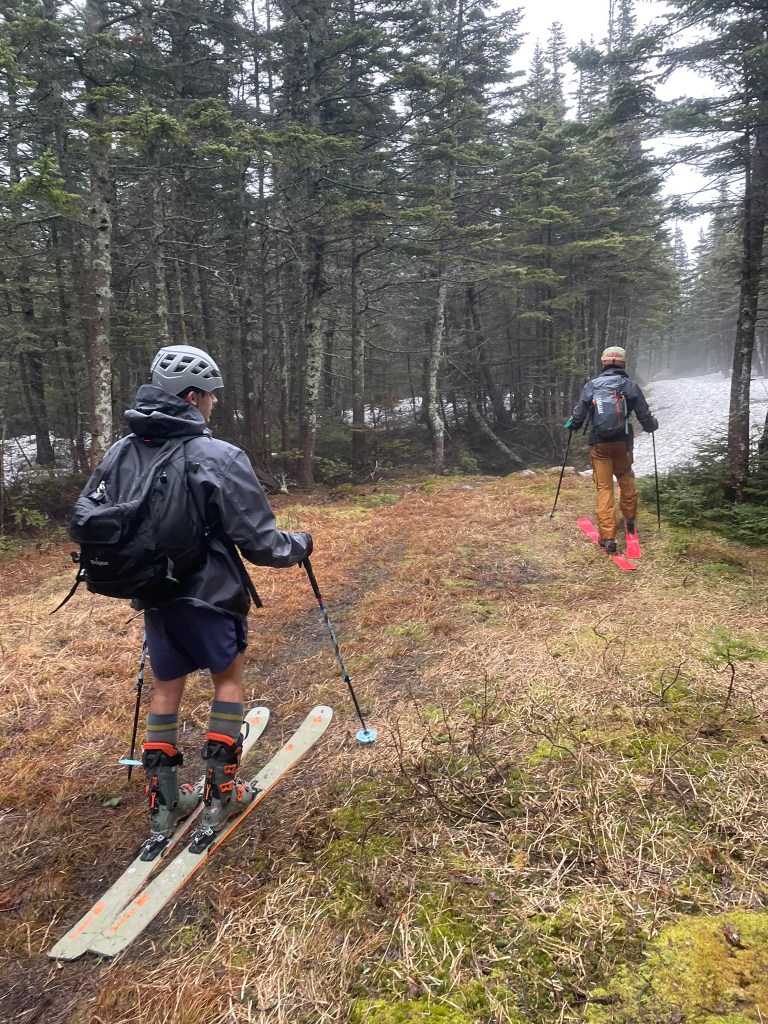
    We woke up the next morning to more rain and headed to the Pinkham’s Notch trailhead. Once again we would be hiking with skis on our back for pretty much the whole trail. This was also our Colorado friend Stink’s 2nd time touring, so he rented gear, wore an airport style boot bag as a backpack, forgot his crampons, and for some reason did not bring pants. We figured he’d figure it out and made our way up the Tuckerman’s Ravine trail and up to the base of the slope. The year prior we had hiked straight up the ‘chute’ on the main headwall, but this year we opted for an easier climb up the Left Gully in order to avoid needing crampons. It was still a bit spicy with ice patches here or there, but overall we made it to the top pretty quick. We even traversed over to take a look at the chute, but decided the conditions were variable enough to not take the risk of falling (a fall here would not be good). Instead we headed back to the Left Gully and started our way down. Unfortunately Stink’s ski almost immediately pre-released and he slid a hundred feet or so down the gully. He did manage to self arrest and was totally fine outside being a little more spooked for the day. Devin and I figured we’d just hike back up for lap 2 (did it right this time) and meet Stink where he was. This time we traversed even further in order to ski a new line called “Hillman’s Highway”. This was a mellow, but long gulley that ran outside the main ravine. We threw on our snorkeling gear to navigate the rain and made our way down the wet & mogully slope below. Skiing this was my favorite part of the day so far and we were spit out much further down than the Left gully would. Greeting us was the Sherburne trail meant for a ski descent, but given its lower elevation it was in pretty dire shape. The three of us navigated river crossings, lots of rock & dirt, and several sections where we hiked down grassy slopes to save some hiking on the way down.

    Hike up Left Gully
    Snorkels to help us see in the rain at the top of Hillman’s Highway

    Soon enough we were back down to the trailhead and done with another big weekend of ski adventuring (~4500 ft of gain). We took a pit stop at White Mountain Ski Co. to drop off some skis and wound up trading a coffee for a trip report (see https://whitemountainski.co/blogs/white-mountain-backcountry-conditions/wet-day-at-tucks-4-26-25). After some good chats with their crew, we made it back to Boston to celebrate our reunion and finally end the trip. Skiing Tuckerman’s ravine was also my 50th day of skiing this season. Although I still had more in the tank (ultimately ended the ’24-25 ski season with 54 days), I was incredibly proud of my effort to ski more this season and develop a strong group of friends to go on more adventures with in the future. Next season I’ll aim for even more days touring and hopefully opt for the 2nd lap every time.

    Typical East Coast pow day at the Sherburne trail, Stink’s boot bag and lack of pants prominent

  • Purcell Mountain Lodge

    Purcell Mountain Lodge

    Around the start of winter in 2023 going into 2024, my friend Meredith asked if I was interested in a hut trip in Canada for the following season. Without knowing much of the details, I immediately said yes and was stoked to learn more about what this might involve. To my surprise, Meredith and a few others had booked an entire hut with 16 total people out in the remote Purcell mountain range backcountry. This was a luxurious cabin that was fully staffed with guides, a chef, and an accompanying airport that would fly us out there in a series of helicopter rides. We’d stay there for about a week and ski tour the incredible Purcell mountain neighboring glacier national park. I didn’t even know this sort of trip was possible and was absolutely blown away by the thought. Now the hard part was waiting a full year to travel out to Canada and met our crew. Before then, my goal was to level up my ski touring skill set and hone in my set of gear to survive long days in the cold Canadian backcountry.

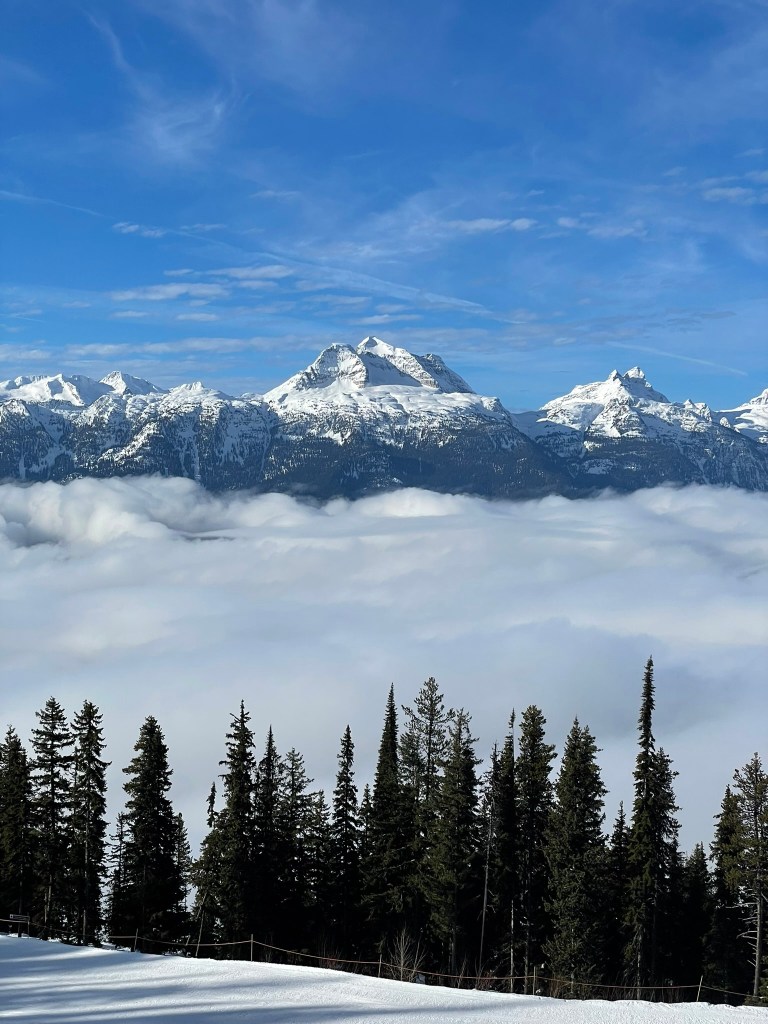
    Bigbie mountain as seen from Revelstoke

    Skipping ahead to the start of the winter in 2024 going into 2025, my life changed quite a bit. I was now living in SF from LA, I had a ski lease with some friends in Lake Tahoe, and I was in much better shape than the previous year. The hut trip began in March and I had a ton of time to dial in my setup and get more comfortable on the skin track. That season our go to tour was Rubicon peak, where we could make quick laps and ski amazing gladed terrain with relatively low avy risk. I even got a new pair of touring boots, which were a bit lighter and way less painful than my last uncomfortable pair of Lange’s. I had also changed jobs and had quite a bit more flexibility taking off time than previously. This worked out perfectly as I could join another group of friends on a trip to Revelstoke for the week prior to our hut trip in the Purcell’s. So all that was left was to enjoy the remainder of the winter season and get ready for two weeks skiing in Canada

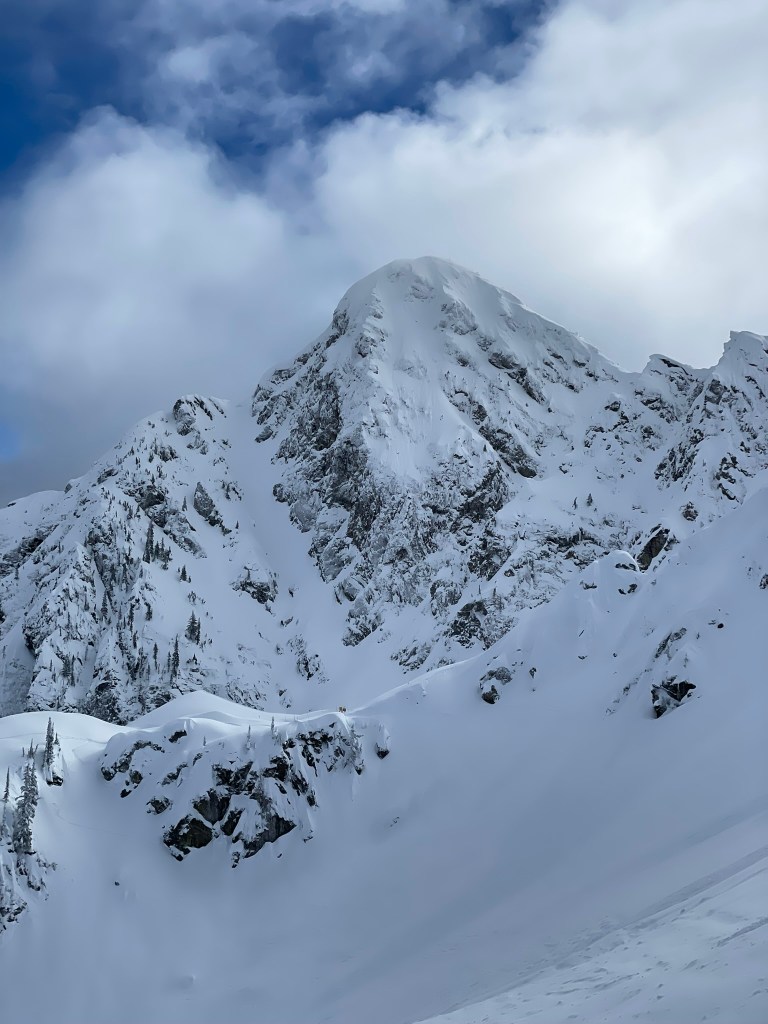
    Mt. McKenzie looming over the North Bowl at Revelstoke

    As the end of February arrived I had already skied about ~30 days that season, ran about 10-15 miles a week, and got in ~8 days of touring. I could not be more excited to test out my skills in bigger terrain and meet a new crew of capable skiers. Although I had known about a third of our group from college, the rest were friends of friends who happened to be good fits for this trip. Before I could meet them, I met my own crew at our Airbnb in Revelstoke, BC. There we were granted with about a foot of snow in the first storm of the week, covering up the melting spring snow below it. The first day skiing was probably our best, as we got some amazing fresh tracks and open powder bowls skiing on the North side of Revelstoke’s summit. Only about the top 1500 feet or so maintained good snow quality as temps below this line quickly warmed and changed the landscape into spring conditions. Despite this, we still had a great time reaping the good conditions for the first half of the week. My friends from the hut trip began to arrive the following Saturday and met us for a day of skiing at the resort. Unfortunately for them, there was no more snowfall and temps began to rise again. This made for a fun groomer day and we still had a great time enjoying the bluebird conditions as we toured the mountain once again. Sunday was our last day inbounds and we got a few runs in before I said goodbye to my friend group at Revelstoke to head back to Golden, BC. On our way there we drove through Roger’s Pass, which was part of the trans-Canadian highway through Glacier National Park and a famously great place for ski touring. Our destination was a big Airbnb for all those on the hut trip, which was located in a small logging town deep within the Canadian rocky mountains. Kicking Horse, another ski resort known for its imposing terrain, was also nearby and we managed to get two days passed discounted for the weekend after our hut trip. Regardless, I was mainly excited to meet our crew and do some final packing before we headed to the airport the next morning.

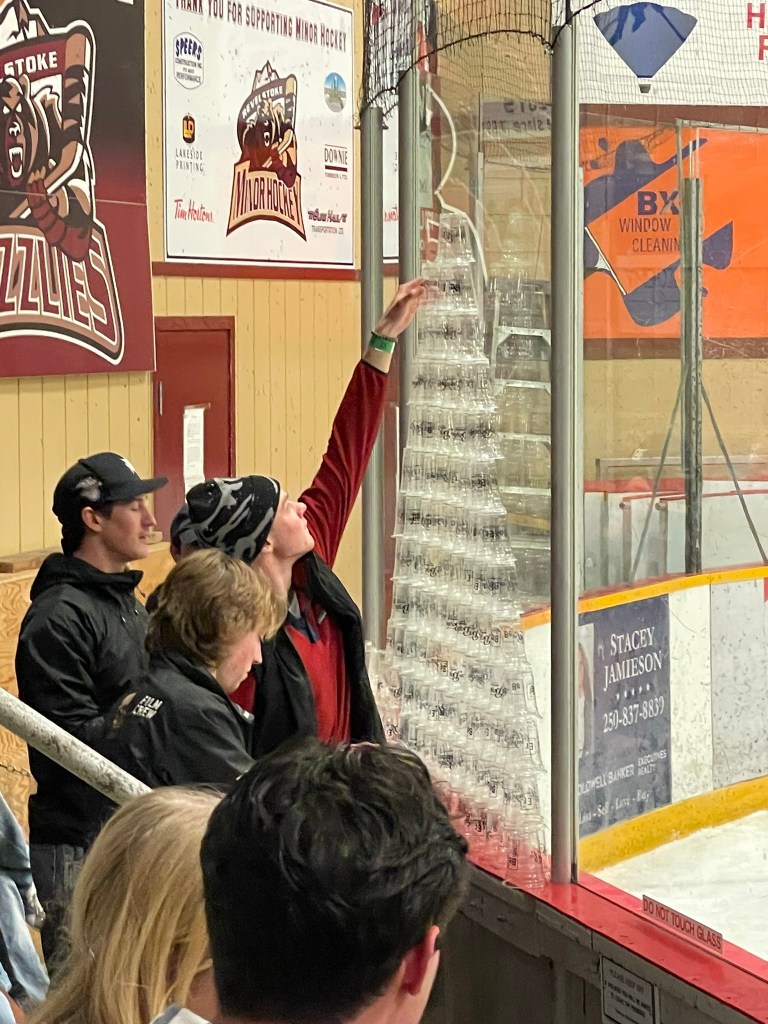
    Stacking cups at the local Revelstoke Grizzle’s game in town

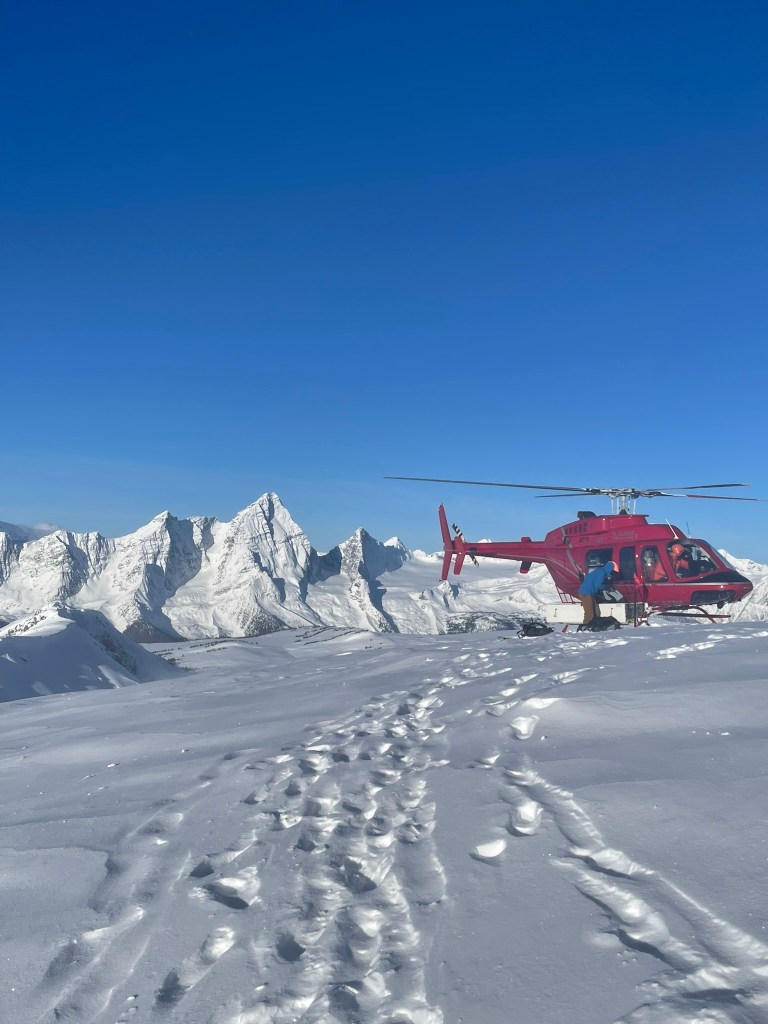
    I woke up at 6 am and could not have been more excited to start our day. The airport was close by and we were greeted with two helicopters, our guides for the day, and an unfortunate set of low altitude clouds looming in the sky. We filled out some paperwork, packed our bags away, and then waited for a few hours until we could finally get a helicopter in the air. Finally flying out was a great relief and such a cool experience in itself. I flew in the larger of the two aircraft, an extended Bell Huey with an 11 passenger capacity and the biggest blades I had seen on a helicopter before. We all sat face to face and could see the mountains pass by eerily close below us as we made our way into the range. The flight lasted probably 20 mins or so and then we landed just 50 feet or so from the lodge sitting in the middle of a peaceful alpine meadow covered in endless blankets of snow. The lodge itself was immaculate and massive for its location deep within the mountains. There were two main buildings along with a sauna, one was the main lodge while the other hosted an accompanying family within a smaller chalet. The main lodge had three levels: one basement for the crew and storage, one main common space & kitchen, and a top floor containing many rooms & showers for our group of 16. I was blown away by how nice it all looked and how many staff members there were to take care of us. Before this I had never been on a trip this luxurious and mainly had gone on ski trips in true dirtbag fashion. This was a rare treat and I was loving every second.

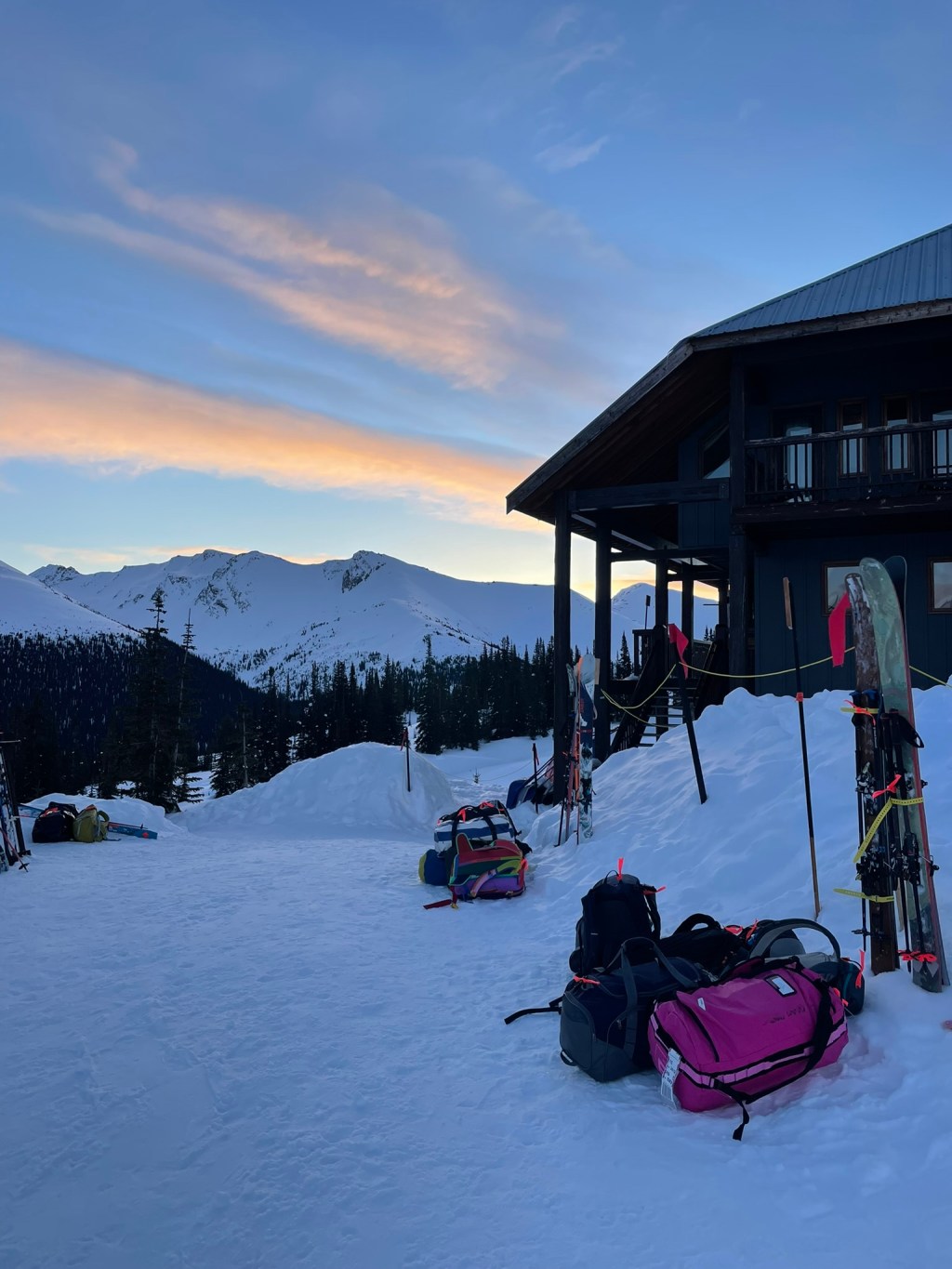
    The Purcell Mountain Lodge’s Chalet with a view of Porcupine Mountain in the background

    That afternoon we quickly got ready for a introduction tour where we would practice some avalanche rescue skills and see some of the landscape in front of us for the first time. Our group was very large and generally had two guides with us at all times. For now we all traveled in one big pack, heading out to the top of the ridge nearby and skiing some of the trees to the valley below. Our lodge was a bit unusual in that it sat on a meadow across from the majority of accessible terrain and separated by a ~1000 ft climb up the valley. This made skiing in the morning very quick, but always required one more skin up at the end of the day. Regardless, it was still a great time that day and we got our first chance at skiing some fun and mellow trees into the drainage below. When we got back, we were greeted with an apres meal from the chef and got our first shower in before dinner. The food at this point was already spectacular and served as a stark contrast to our hard work on the skin track. Our meal that night was bone in chicken thighs with some incredible curry and vegetables on the side. Drinks were a la cart, but were a great addition to the trip too. Slowly I met more of our group that day and knew that we were all super capable and excited for the days ahead.

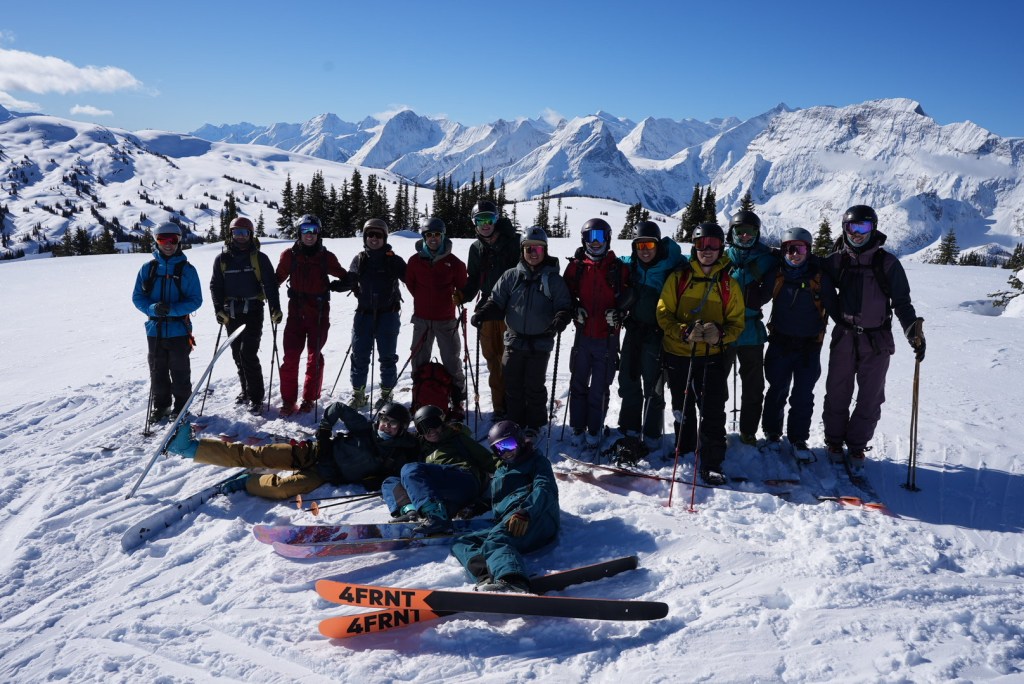
    Our group of 16 standing in front of the crazy views to the west

    The next morning we awoke to prepared coffee and another amazing breakfast meal. Our guides had a whiteboard at the far side of our dining table with a plan laid out for the day and told us of a special surprise. Today was our best weather window and we had the opportunity for a ‘heli bump’. All 16 of us decided to go and take one more helicopter ride to the nearby Ptarmigan peak. This saved us about 3000 ft of elevation gain and placed us right above some glorious north facing alpine bowls to start the day. Adding to this, there was also a child ski influencer (?) who took one of the helicopter rides from the airport to see the nearby Copperstain mountain’s south face – it was a weird but interesting note from the morning. After taking in our first real ‘heli ski’ experience, we made our way down some incredible gullies and into a drainage below Copperstain. Soon we split into three groups and headed back up towards the NE side, which is almost impossible to access without a bump early in the day. Once we made it to the cornice lip of the summit ridge, we saw an untouched and wide open north face with the best powder I’ve skied that whole year. While the group behind us chose to lap this face a few times, my group made our way down and then continued to the valley floor below. That was until suddenly my ski pre-released and quickly vanished before my eyes as it flew over the ridge below us.

    Post heli bump views of Mt. Sir Donald on the top of Ptarmigan

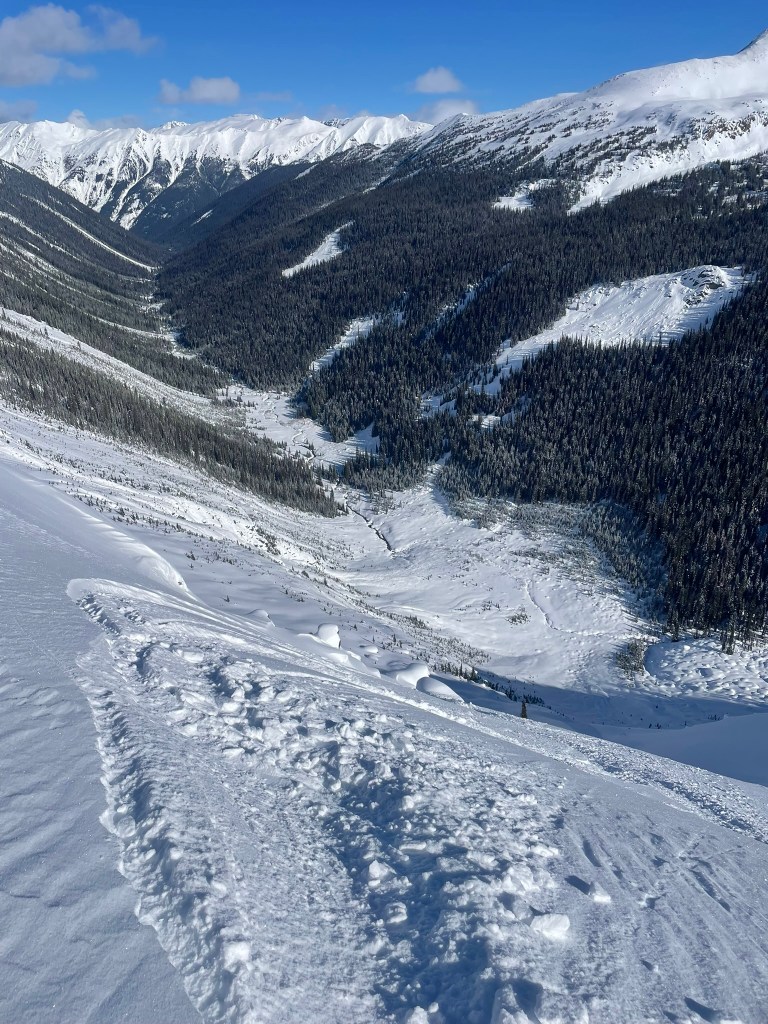
    I had no idea how that could have happened so quickly and immediately changed my mood from stoked to anxious. Our guide was not very happy either and let me down the gully below us with one ski. This turned out to be quite hard work as it as deep snow and steep terrain. I definitely did not have a good look for my new friends accompanying me, but everyone stayed positive as we made it down to the valley below. Our guide had assumed the ski just flew down the entire face, but when we got there it was no where to be found. I tried to not think of the consequences until it was sure that the ski was lost, but it was hard to take it all in at once. Then we suddenly had a great idea to contact the group above us for help. Out of shear luck, one of them had brought a drone and he was able to fly it overhead. Another guide took the controls and thankfully was able to spot our tracks which led right to the lost ski. Ironically enough, if we had just looked over the ridge we would have found the ski not 50 ft from where it released. Regardless, the group behind us had one guide to spare and he thankfully retrieved the ski and made his way down to us in the valley. I was back to feeling okay, but our whole group knew that we had just narrowly avoided a horrible outcome for the trip (likely another helicopter ride).

    View down the steep gulley where my ski fell

    Making it back from the valley floor also turned out to be difficult. There was about 2500 feet of climbing and part of it was through some steep powder and sketchy terrain. I was feeling exhausted from my one ski descent of this face and struggled up the rest of the slope. But that did not stop me and the group from having a good time. We did another lap on ‘Moonraker’, the NE powder slope on the backside of Copperstain and then headed back up to Ptarmigan for our last alpine lap of the day. Skiing these faces was absolutely spectacular and made me appreciate how finding these remote locations could result in some crazy untouched terrain. Granted this case was a bit special, we were paying for a shortcut to experience this, but it still served as a reminder for the future. Finding these moments in the remote backcountry was absolutely worthwhile. When we made it back to the valley, we had just skied nearly 5000 ft of incredible terrain and were ready for one last push up ‘Hydro Hill’. This was the climb back to the cabin and went relatively quick this time. I was still feeling quite exhausted as this was probably the biggest day of the trip and the biggest tour I had ever done to date. Luckily our chef Josef was there to greet us with another spectacular apres snack: pizza and beers. Shortly after we were back stretching and showering on the top floor and getting ready for the main courses. Taking a look outside and back onto the mountains we had just skied had me in a loss for words. I was incredibly grateful to be on a trip with friends skiing, let alone in a place as beautiful as this and having some pretty insane luck with getting my ski back earlier in the day. The next morning was about to be another big day, so after dinner it wasn’t long before we were all back in bed and excited to start it all over again.

    Looking ahead at the steep powder gully towards Copperstain after finding my ski

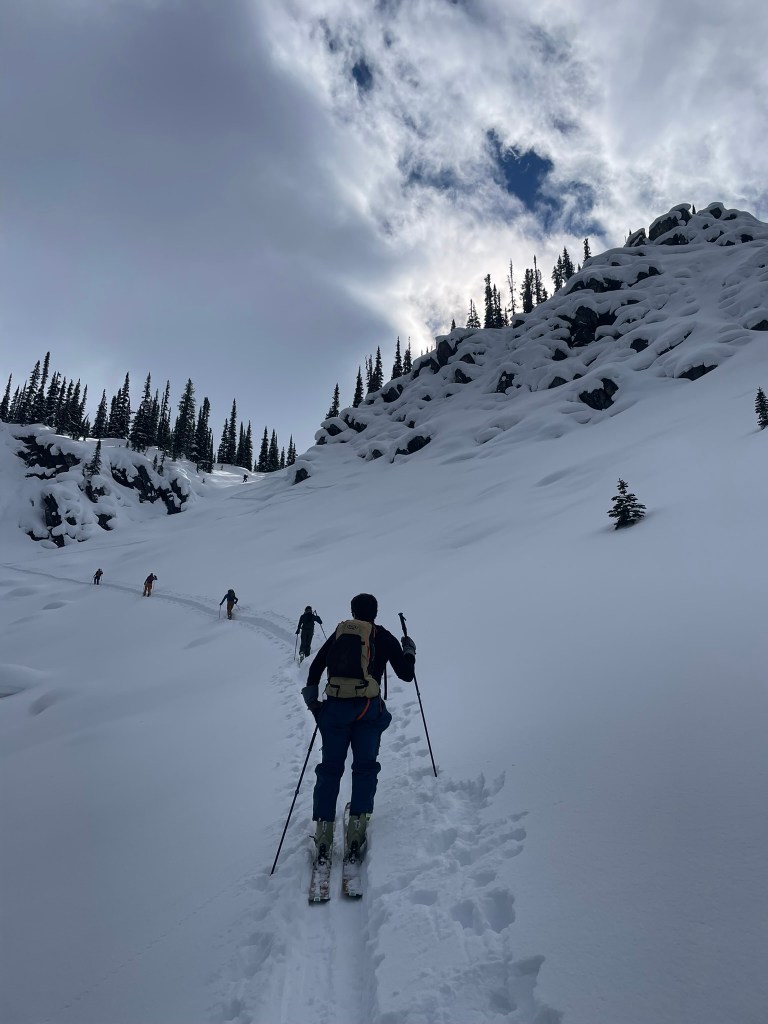
    The next morning we again woke up to coffee, an amazing breakfast, and our guides ready with a whiteboard describing our plan for the day. And that plan was to take a look skin north and over to a wide open face of glades called ‘The Burn’. I chose to join the fast group again and we headed out promptly at 9 am to chase some fun powder laps. The view on the way over was fantastic and we were gifted with relatively low elevation gain on the way there. Instead we would once again head down into the valley once we arrived and begin the first climb of the day. The first lap was awesome and filled with playful wooded terrain and lots of snow. I paired up with a friend and we chased each other through pillows & between burnt trees down to the drainage below. Our group was antsy to get back up for round 2 and we set the pace strong. Each lap was just below 1000 ft of gain and we generally paced each between 45-60 mins. Soon after we were joined by the other groups, who would pass us on the uphills and downhills as we zig-zag-ed through the terrain. In total we made four laps that day and totaled about 4500 ft of gain, still a crazy big day for me normally. In addition, we also had about 3 miles of traversing to make it back to the cabin – which went by faster as I got to know more of our group. That night we debated over what would be the next objective as we soaked in the sauna and sipped on some a la cart brews. We all wanted to get back to the alpine, but also were eying a set of big kickers that our chef had constructed at the top of the glades near our hut. Our guides were hesitant to commit that night, so we kept faith and enjoyed another night of great meals, some stretching, and hanging out in the common space.

    Endless rolling hills on our way back from The Burn

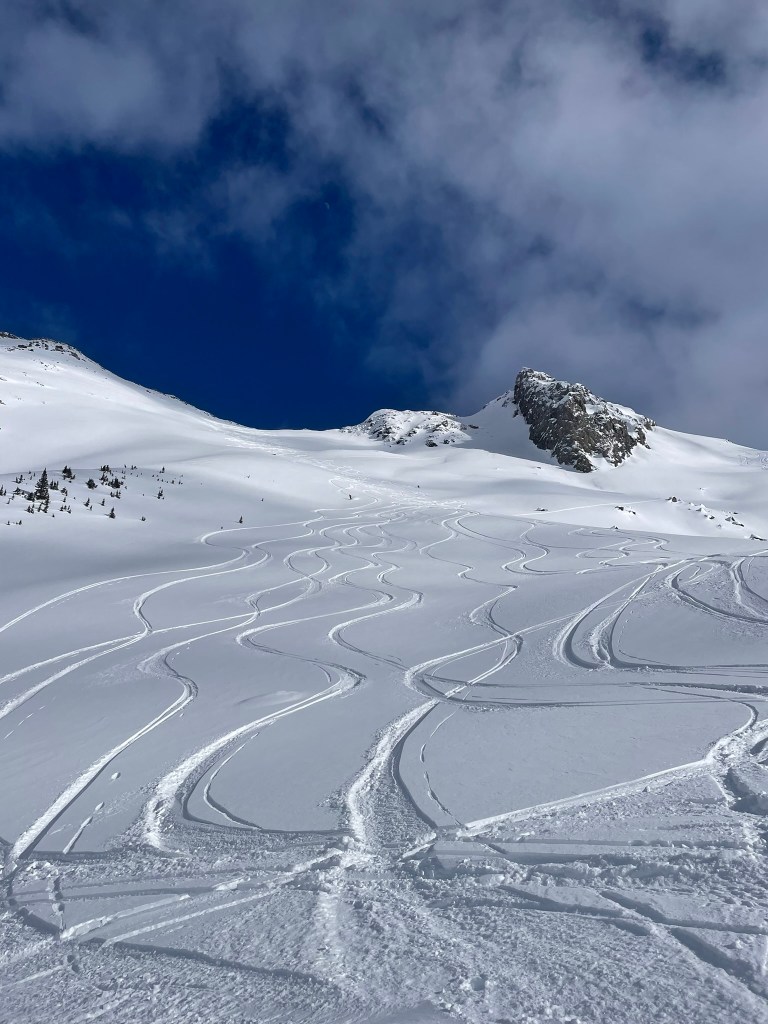
    Another morning just as nice as the last and we were gifted with an amazing plan for the day: we would venture out to Porcupine mountain, the last of the three in the valley we had yet to ski. On porcupine there were two gigantic bowls that are rarely skied at the lodge due to their steep aspects and generally large approaches. Since we were skiing in early March and didn’t have a ton of recent snowfall, the snowpack was generally stable enough for us to attempt these glorious objectives. And so our whole group mobilized into one for our last day and made our way out across the valley once more. We first skied the trees (‘Kneegrinder Glades’) and then our guide set a skintrack up to the treeline of Purcupine. The views from this point on the rest of the valley were incredible. Endless alpine terrain loomed below us and there was no civilization in sight. To our west was the incredibly prominent Mt. Sir Donald, which stood about 2000 ft taller than the peaks on our end of the valley and housed massive glaciers on all sides. To our south was the tenured helicopter skiing terrain, which had all the powder faces and pillow lines I would imagine it to be. Soon after we began to climb the ridge proper and into our first line of the day: ‘Double Espresso’. This was a massive north facing alpine bowl completely untouched for our group of now 19 (3 guides accompanied us). We all took turns cruising down and making big arching turns. At the bottom we were all stoked as usual and took videos of each other coming down back to back. At this point we were all feeling great as the whole group had no issues coming up or down. The guides felt good too and led us back up an adjacent face and into our 2nd lap of the day. this time we were on ‘Long Overdue’, a face that none of the guides had skied all year due to its remoteness and exposure to avalanches. I think for most of us this was the highlight of the trip: 19 of us made it up two incredible alpine bowls in one of the most inspiring settings I’ve been in before. This second lap matched the first, as it was long enough to really savor the moment and have a ton of fun on the way down. I was feeling over the moon and excited to ski back down to the valley floor. There we had some bonus wiggles and bounces off boulder pillows as we slowly approached the treeline. Instead of climbing directly up Hydro Hill, a group of us diverted slightly to make it back to Yosef’s big kickers at the top of the ridge. There we all took turns hitting the smaller of the jumps and had a ton of fun leaping into a powdery runout below. It was a bittersweet moment because after the last jump, we hiked up the ridge one last time and skied back down to the lodge. The next day we would fly out in the morning and end one of the best ski vacations of my life.

    Double Espresso
    Skin track up to the top of Long Overdue
    Long Overdue ❤

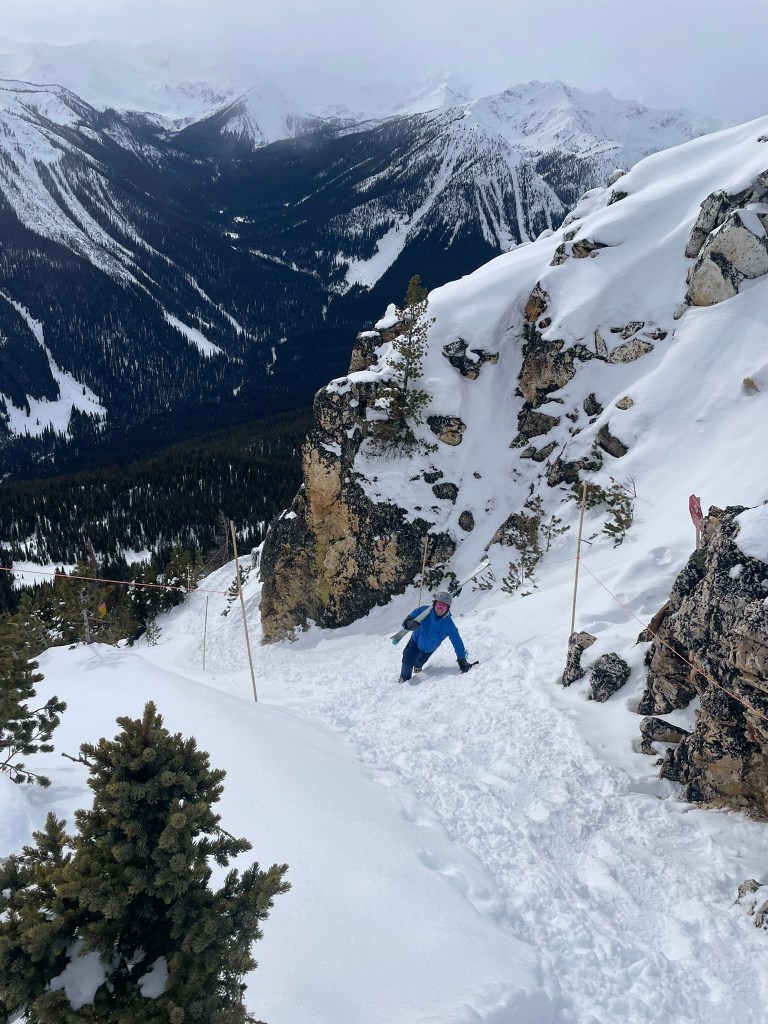
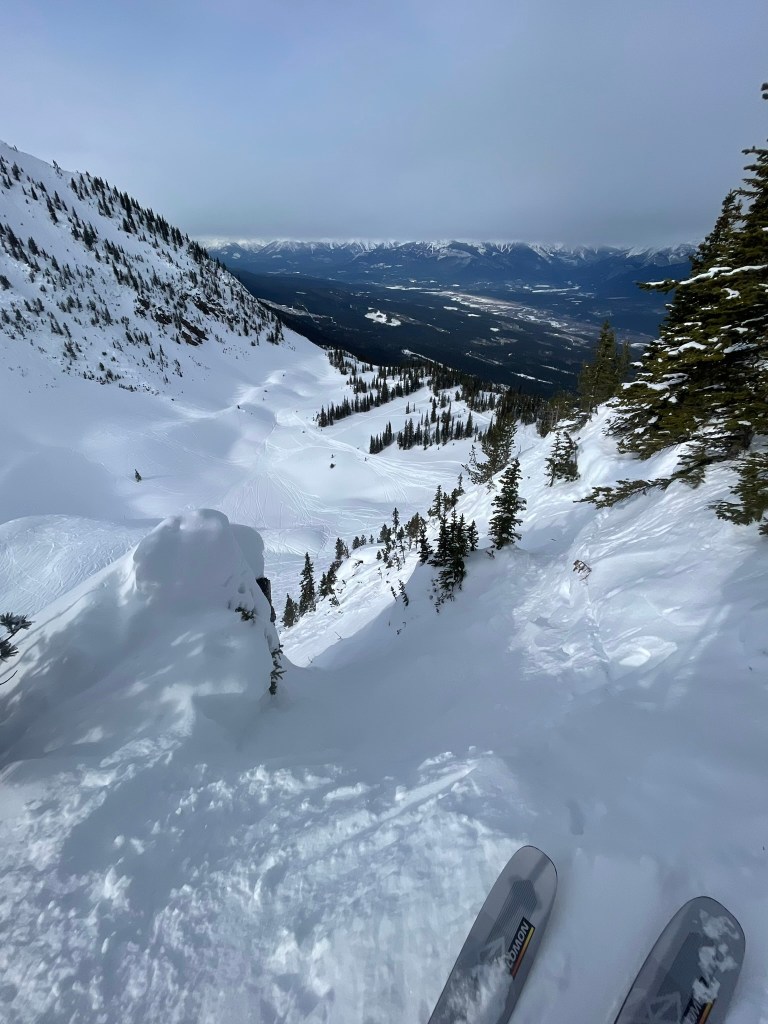
    Our group was feeling great after the last day of touring and reminisced over the week with a round of ‘Roses & Thorns’ for dinner. It was another great meal and we were able to get everyone in the hut (including guides & our Chalet family) to participate by stating their least & most favorite moments from the trip. For me it was the fact that I met such a cool group of people and accomplished my goal of ‘hanging’ with the fast crew the whole time. After dinner we hung out as usual and savored the hut’s amenities for one last night. In the morning, we scrambled to clean out our rooms, pack bags, and shuffle back into the helicopters for our journey back to Golden. Some of us were leaving that next day while myself and a smaller group would stay to ski some more in bounds days at Kicking Horse. At this point I had already skied 10 days, but was equally excited to take lifts again and see some new terrain. Kicking horse turned out to be a crazy and intimidating mountain. Its known for steep ridges lined with countless chutes on either side. It only had three lifts in the entire resort, which meant there was a ton of hiking involved for those adventurous enough to explore the biggest lines. Our group made a hike out to ‘Terminator 2’ peak that first day and experienced the most sketch portion of the trip: an exposed hike up and crazy steep ski down. This was my favorite type of skiing and I was having a blast exploring this new terrain. In our view was also the south face of ‘Terminator 1’ which had hosted the Freeride World Tour earlier in the year (in bounds!).

    Terminator 2 hike
    Skiing Terminator 2

    The last day we also skied Kicking Horse and had a fantastic crew. We spent the majority of the day lapping chutes as fast as we could, pushing each other to ski in good style. We paused in a yurt for some lunch and beers before making our final lap of the day skiing some very technical and imposing terrain. I even blew out one of my shift bindings after sending off a cliff in the woods, but had no gear or physical injuries thankfully. After this I drove with a friend back to Calgary and grabbed a final meal with our crew. The next morning we would fly back to California and end our two week stint in some of the coolest areas I had ever been. This trip served as an experience of a lifetime, one that I will always remember. And the best part of the whole thing was that I met ~10 new people that all shared this experience and would help me progress in touring for the season to come. I’m incredibly grateful to be in a position where this is possible and to have had such a memorable experience along the way <3.

    Smiling on the ridgeline before Double Espresso
    The view of Mt. Sir Donald from the Purcell Mountain Lodge at sunset
    The kicker at the end of the last day touring, looking closely you can see tracks from both Double Espresso and Long Overdue in the background